Key facts
- NASA Science published the Astronomy Picture of the Day page titled “The Moon Watchers” on November 27, 2026.
- Some people know the November full moon as the Beaver Moon.
- The full moon of November sat close to perigee on November 24, 2026, which is the nearest point in the Moon's elliptical path around Earth.
- The full moon in November appeared among the largest and brightest because it was near perigee, a phase commonly called a supermoon.
The full Moon rose opposite the setting Sun on November 24, 2026, appearing large and bright above fields, fences, backyards, and stone walls for anyone on Earth to watch.
NASA Science posted the Astronomy Picture of the Day page “The Moon Watchers” on November 27, 2026. The November full moon is known to some as the Beaver Moon. The full moon sat near perigee, the nearest point in the Moon’s elliptical path around Earth, making it appear among the largest and brightest full moons, a phase commonly called a supermoon.
The November full moon started a series of four straight perigee full moons, with three more perigee full moons following in the months ahead. The next chance to watch a supermoon rise comes when the Cold Moon rises on December 23, 2026. NASA Science also previewed that the next Astronomy Picture of the Day after November 27, 2026 would be themed “remember where you parked.”
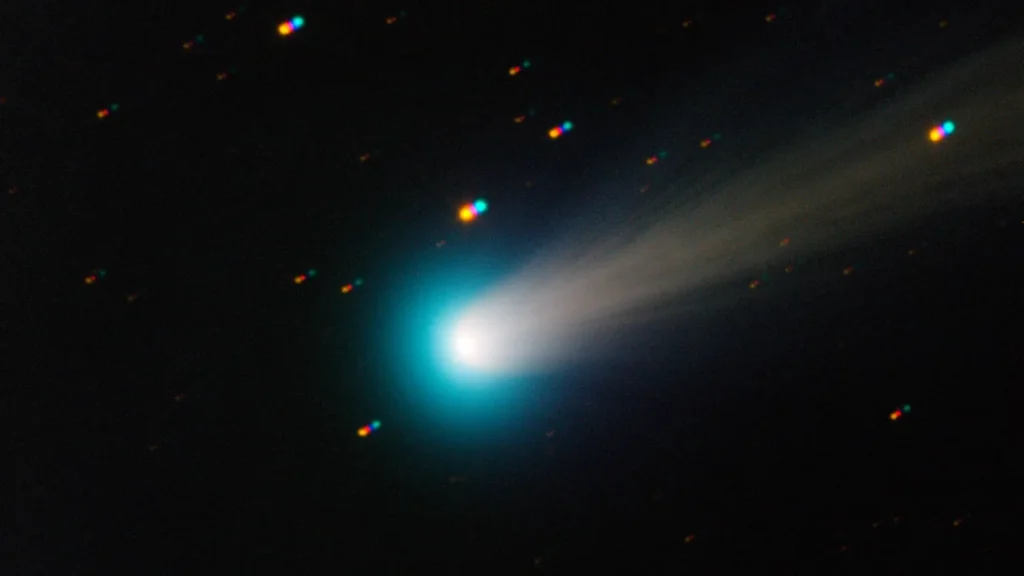
Comet 161P/Hartley-IRAS reached perihelion on November 26, 2026, the closest solar approach in its 21½-year orbit, and the Moon-free viewing window reopened that night. Astronomy Magazine said the comet stayed around 10th to 11th magnitude, with no appreciable tail but a noticeable green glow around the nucleus in recent astrophotos. Around 7 P.M. local time on November 26, the comet sat 30° high in the western sky after sunset from 40° N 90° W, well above the turbulent air near the ground.
On November 26, the comet rested in western Sagitta, roughly 6.3° north-northeast of 3rd-magnitude Zeta (ζ) Aquilae. A 4-inch telescope can show the comet, while larger apertures reveal more detail near the nucleus, including a sharpened southern flank as it moves into the solar headwind. Looking 2.1° northeast of the comet finds the Coathanger asterism in Vulpecula, a one-degree-long pattern whose hook sits on the lower side of the hanger shape.
Astronomy Magazine gave sunrise at 6:59 A.M., sunset at 4:36 P.M., moonrise at 7:53 P.M., and moonset at 10:26 A.M. local time on November 26 from 40° N 90° W, with the Moon waning gibbous at 82% illumination at 10 P.M. Astronomy magazine’s senior editor Alison Klesman, who earned a Ph.D. in astronomy and has studied subjects ranging from minor planets to supermassive black holes, wrote the Sky This Week column. The magazine supplies local rising and setting times for the Sun and Moon from 40° N 90° W, and lists the Moon’s phase and illumination at 10 P.M. local time from that spot.
Venus appeared near Spica, a bright star in the southeastern predawn sky, during the week of November 27, 2026. In-The-Sky recorded Venus at maximum brightness for its current morning apparition at 1:37 P.M. EST (1837 GMT) on November 27, 2026. Viewers in the United States could see Venus rising into the southeastern sky before sunrise in the coming week, while Mercury stayed close to the horizon beneath it.
On the morning of November 27, Spica stood under five degrees from Venus, about the width of three middle fingers at arm’s length. Spica is made of two stars orbiting each other every four days, separated by roughly 11 million miles (under 18 million kilometers), so they cannot be separated visually even with any amateur equipment; a 4-inch eyepiece shows the pair as a brilliant blue-white star. Space.com said observers should confirm the sun is completely below the horizon before pointing a telescope at Venus to view a crescent shining across its thick atmosphere.
Venus remains close to the horizon as an inner planet, switches between morning and evening appearances, and its changing moon-like phases and varying distance from Earth make its brightness rise and fall. Over the weeks and months ahead, Venus will display a larger illuminated fraction as it moves away from Earth, even though its telescopic apparent size will slowly shrink.
NASA released “The Europa Concept,” a documentary about Europa Clipper’s journey, on NASA+, the NASA app, and the agency’s website starting Monday, November 23, 2026, with a YouTube release coming soon. NASA describes Europa Clipper as the largest deep-space spacecraft it has ever launched. The craft is two years into a five-year voyage covering 1.8 billion miles (2.9 billion kilometers) to Jupiter to fly by Europa and look for conditions supporting life in its subsurface ocean. NASA said the film follows the team that constructed the craft to withstand Jupiter’s harsh radiation, which may have helped create a potentially habitable setting on Europa.
People have been fascinated by Europa since Galileo Galilei discovered it in 1610. Pioneer 10 collected data in 1973, Pioneer 11 followed the next year, Voyager 1 gave the first detailed view in 1979, and Voyager 2, Galileo, Cassini, and Juno later provided more detailed glimpses. NASA began work on Europa Clipper at its Jet Propulsion Laboratory in Southern California in 2013, beginning an 11-year effort to assemble the spacecraft and nine science instruments ahead of a particular planetary alignment launch window.
The mission dealt with a worldwide pandemic and, ahead of the October 14, 2024 launch, a Category 5 hurricane and tornadoes near Kennedy Space Center in Florida. Caltech in Pasadena oversees the mission, and JPL leads development with Johns Hopkins APL in Laurel, Maryland, for NASA.
APL took part in designing the main spacecraft body alongside JPL, Goddard, Marshall, and Langley; NASA Marshall’s Planetary Missions Program Office oversees program management; and Kennedy’s Launch Services Program managed the launch service.


Join the discussion