Key facts
- An unusually strong and persistent polar vortex drove the 2026 ozone hole's large size by keeping Antarctic stratosphere temperatures favourable for ozone depletion longer than usual.
- Despite its unusually large area, the depth of the 2026 ozone hole stayed close to average, meaning it was less deep than other very large holes in the record, according to Copernicus Sentinel-5P data.
- In September 2026, the Antarctic ozone hole reached a peak of 10.6 million square miles, making it the second largest ever observed for that time of year.
- Launched in October 2017, Sentinel-5P, short for Sentinel-5 Precursor, became the first Copernicus spacecraft focused on atmospheric monitoring.
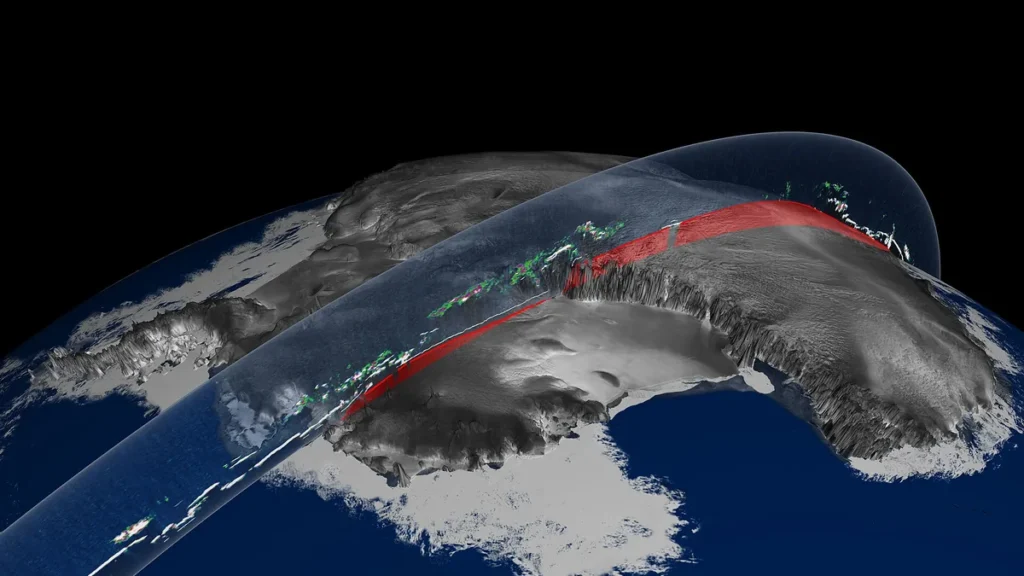
Copernicus Sentinel-5P observed the Antarctic ozone hole at 27.3 million square kilometers by Sept. 20, 2026, as the seasonal depletion neared its typical annual maximum between mid-September and mid-October.
ESA said the area was far larger than Antarctica itself and stood about 6.5 million square kilometers, or 31%, above the 20-year average for that time of year. ESA cited the 2025 Antarctic ozone hole as the fifth smallest since 1992, using the figure to show the sharp reversal between the two seasonal holes.
An unusually strong and persistent polar vortex drove the 2026 hole’s large size by keeping Antarctic stratosphere temperatures favorable for ozone depletion longer than usual. The vortex allowed the hole to expand beyond its usual extent.
Despite its unusually large area, the depth of the 2026 ozone hole stayed close to average, meaning it was less deep than other very large holes in the record, according to Copernicus Sentinel-5P data. ESA said scientists assess both geographical extent and depletion depth, so a wide hole is not necessarily a deep one.
The ozone hole typically begins forming in August, grows through September, reaches maximum size between mid-September and mid-October, and usually closes by the end of December as stratospheric temperatures rise and the polar vortex weakens. ESA described this annual cycle as background for understanding the timing and persistence of the 2026 hole.
Launched in October 2017, Sentinel-5P, short for Sentinel-5 Precursor, became the first Copernicus spacecraft focused on atmospheric monitoring. The satellite carries Tropomi, an advanced multispectral imaging spectrometer that senses atmospheric gas signatures across the electromagnetic spectrum to map pollutants and stratospheric ozone with greater accuracy and finer spatial resolution than before.
Regular Tropomi observations let scientists track the hole’s size, depth and development while investigating conditions such as stratospheric temperatures and polar vortex strength. ESA said Sentinel-5P plays a vital role in tracking ozone recovery year to year and over coming decades following the global phase-out under the Montreal Protocol.
Assimilating satellite data into atmospheric models reveals concentrations of ozone and ozone-depleting substances, which helps evaluate international ozone-protection efforts. ESA said future missions including Sentinel-5 on MetOp Second Generation A-type satellites and the upcoming Altius mission will continue long-term atmospheric measurements.
Future Copernicus Sentinel-5 instruments on MetOp Second Generation A-type satellites are set to deliver long-term worldwide atmospheric-composition data, while the forthcoming Altius mission will supply detailed vertical profiles of ozone and other gases. ESA said these missions together will help scientists monitor ozone layer evolution and recovery with greater accuracy.
In September 2026, the hole reached a peak of 10.6 million square miles, making it the second largest ever observed for that time of year, according to Smithsonian Magazine, which drew on Copernicus Atmosphere Monitoring Service data. Smithsonian noted the hole began growing earlier than usual in August.
By Sept. 20, 2026, the hole’s size neared the October 2015 peak of 10.8 million square miles. During roughly three months of Southern Hemisphere spring, the hole forms within the stratospheric polar vortex, a ring of fast-spinning westerly winds around Antarctica and the Southern Ocean that traps cold air and creates polar stratospheric clouds.
Chemical reactions on particles in these clouds activate ozone-depleting gases, Smithsonian said, citing a New Zealand-based research team in The Conversation. A stronger and colder polar vortex in 2026 created conditions for the ozone hole to grow to its observed size, according to Hannah Kessenich, a physicist at the University of Otago in New Zealand, speaking to ABC News.
The ozone layer sits in the stratosphere and shields Earth from dangerous ultraviolet radiation that can injure humans, plants and animals; the ozone hole is an area of depleted stratospheric ozone above Antarctica caused mainly by chlorofluorocarbons, or CFCs. The 1987 Montreal Protocol phased out chlorofluorocarbons globally, but the chemicals persist in the atmosphere for decades. Smithsonian presented this history to explain why ozone depletion continues despite the phase-out and why long-term trends matter more than single-year size.
Kessenich told ABC News that assessing recovery from ozone-depleting chemicals means examining the hole’s depth instead of its size. She said the 2026 hole is not as deep as in previous years and that year-to-year variability is expected. Susan Solomon, an atmospheric chemist at MIT, said in an email to Live Science that longer-term metrics indicate the ozone hole is recovering slowly as expected.
According to Kessenich and colleagues in The Conversation, an expanded ozone hole pushes the Southern Annular Mode positive, altering winds and precipitation, including increased rainfall on Australia’s southeast coast. Smithsonian included this weather impact as one of the effects of an expanded ozone hole across the Southern Hemisphere.
The 2026 ozone hole is expected to shrink again by late January 2027. Smithsonian offered this as the expected seasonal end to the hole after its September 2026 peak.
Climate change has increased wildfire frequency, and particles in wildfire smoke can spark atmospheric chemical reactions that break down ozone, according to a study published in Nature in 2023. Smithsonian included this under a note about wildfires damaging the ozone layer.
Scientists have not yet determined how climate change influences polar vortex strength or why larger ozone holes last longer than before; shifts in global atmospheric dynamics may produce longer-lived holes, potentially requiring adjusted ozone recovery timelines. Smithsonian said it is too soon to tell what drives recent dynamical variability and that more research is needed, according to Kessenich speaking to Live Science.


Join the discussion