
Key facts
- Rohit Dokara, formerly at the Max Planck Institute for Radio Astronomy, led the team behind the serendipitous discovery. The find brings the number of similar known cases to just a handful.
- A pulsar is a rapidly rotating, highly magnetized neutron star that sends out powerful radiation beams from its poles; a regular flash appears on Earth whenever a beam points this way.
- Pulsars form when massive-star cores collapse in supernova explosions that also blast out supernova remnants; each remnant forms a rapidly expanding shell that dissipates in around 100,000 years.
- For reasons not fully understood, a pulsar often receives a powerful kick in the explosion that propels it from the cloud's center, and it can trail a comet-like tail through surrounding gas.
Astronomers have spotted a rare pulsar already beyond its supernova remnant in the Milky Way. Phys.org reported the discovery.
The discovery was serendipitous. Rohit Dokara, formerly at the Max Planck Institute for Radio Astronomy, led the team behind the find. The astronomers were trying to explain why the Milky Way has far fewer observed supernova remnants than models predict when the association turned up. The find brings the number of similar known cases to just a handful, and the article frames the detection as accidental.
Dokara’s team investigated the remnant shortfall by combining observations from several large-scale radio surveys gathered by telescopes around the world over the past two decades and at many frequencies. These surveys record radio waves from electrons spiraling through magnetic fields in a remnant’s expanding shell and can reveal pulsars and their tails. Combined with pulsar timing, the measurements yielded a pulsar’s age from its spin-down rate and its angular separation from the shell’s center in radio images. Spin-down is found by precisely timing the pulses, while separation is read from the radio images.
Accounting for free electrons slowing lower-frequency radio waves more, the team measured arrival delays between frequencies to estimate the pulsar’s and remnant’s distance from Earth. Lower-frequency waves are delayed more by the thinly spread free electrons between stars. The delay between frequencies reveals how much free electron material lies between Earth and the source. From this measurement the team fixed the distance to both the pulsar and its remnant.
From these factors the team estimated the pulsar’s velocity and the remnant’s size and evolutionary state, placing it on the path from the initial supernova to a dissipated cloud. The team estimated the pulsar’s transverse velocity, one of the largest values for Milky Way pulsars. Dokara said, “We estimated its transverse velocity to be over 1,400 kilometers per second (870 miles per second),” and called such extreme-kick objects unique windows on the galaxy’s fastest compact bodies.
A pulsar is a rapidly rotating, highly magnetized neutron star that sends out powerful radiation beams from its poles; a regular flash appears on Earth whenever a beam points this way. The beams are only visible when one pole’s radiation sweeps across Earth, like a lighthouse beam. Pulsars form when massive-star cores collapse in supernova explosions that also blast out supernova remnants. Each remnant forms a rapidly expanding shell that dissipates in around 100,000 years, fading into interstellar gas.
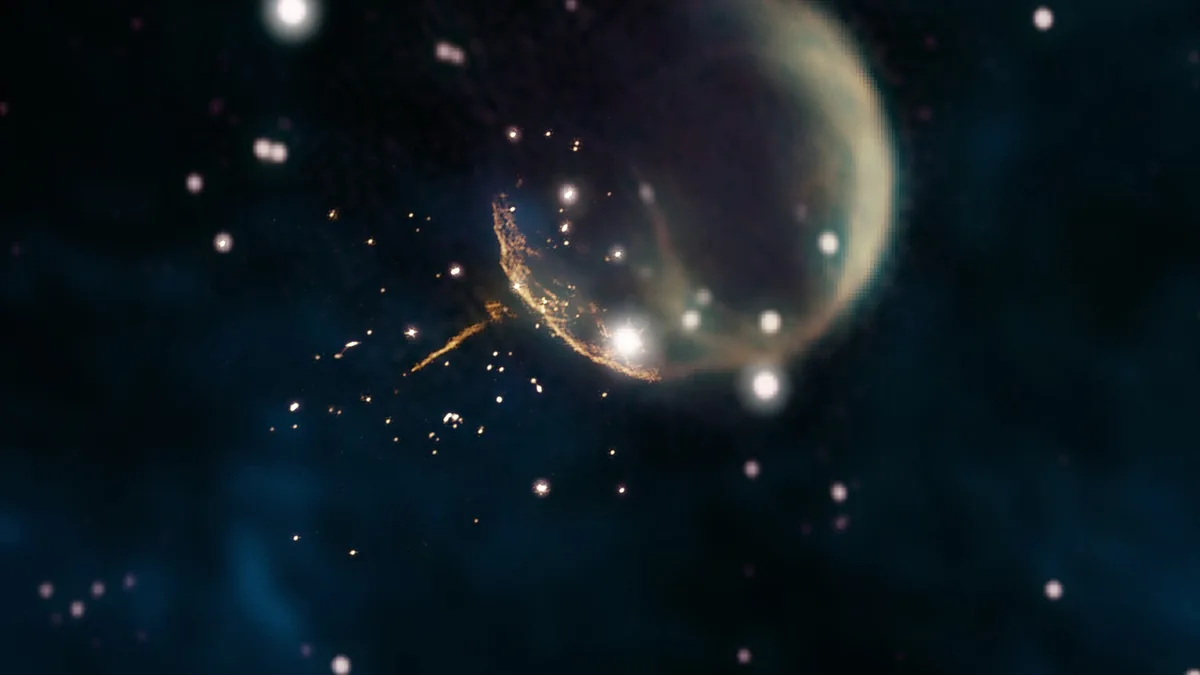
For reasons not fully understood, a pulsar often receives a powerful kick in the explosion that propels it from the cloud’s center, and it can sweep gas into a comet-like tail behind it. Dokara says that, as far as he knows, four cases exist of a pulsar formed after a core-collapse supernova moving faster than the diffuse ejecta that becomes a shell, giving views of the galaxy’s fastest compact objects.
Astronomers estimate roughly 2,000 supernova remnants should exist in the Milky Way, but only around 400 have been discovered so far. The gap between predicted and observed remnants motivates the survey work. While combing the data, Dokara found a new supernova remnant shell with a known pulsar well outside it, the pulsar’s tail pointing clearly to the shell’s center. The association had previously gone unnoticed in the data.
The shell and tail were first seen in MeerKAT images. MeerKAT is a latest-generation radio telescope, and the team hopes similar finds will recur in future large surveys. Pulsar J1909+0749 is the runaway, and supernova remnant G42.1-0.2 is its shell.
The results were accepted for publication in Astronomy & Astrophysics and are available on the arXiv preprint server. R. Dokara et al. authored Pulsar J1909+0749 and supernova remnant G42.1-0.2 in Astronomy & Astrophysics in 2026. The work appeared in Astronomy & Astrophysics in 2026. Dokara says each such survey has enormous science potential and this work shows how standard methods can combine survey data to find rare associations.



Join the discussion