
Key facts
- The two new sites added in the 2021 campaign were the 12-meter telescope at Kitt Peak Observatory in Arizona and the Northern Extended Millimeter Array (NOEMA) interferometer in the French Alps.
- Müller explained that the physical baseline between two antennas determines the spatial scale that baseline can resolve, comparable to how moving Very Large Array antennas on railway tracks changes the field of view.
- An independent team led by Samuel Lai, a researcher with Australia's Commonwealth Scientific and Industrial Research Organisation (CSIRO), validated the first image of M87*, thereby supporting general relativity.
The Event Horizon Telescope Collaboration imaged the innermost jet of the blazar 3C 279, located about 538 million light-years from Earth, during a 2021 observing campaign. The collaboration reported the jet’s dynamics and geometry at sub-parsec scales in a paper published in the journal Astronomy & Astrophysics. Universe Today reported the results on Nov. 25, 2026. The 2021 campaign was the largest EHT array configuration published to date.
3C 279 is a blazar, a bright galaxy with a supermassive black hole at its center that is classed as an active galactic nucleus. The blazar launches a relativistic jet of ionized matter directed straight toward Earth. That alignment makes the object especially useful for observation. Because of its brightness, 3C 279 is considered a prime target for very-long-baseline interferometry and is frequently used for calibration.
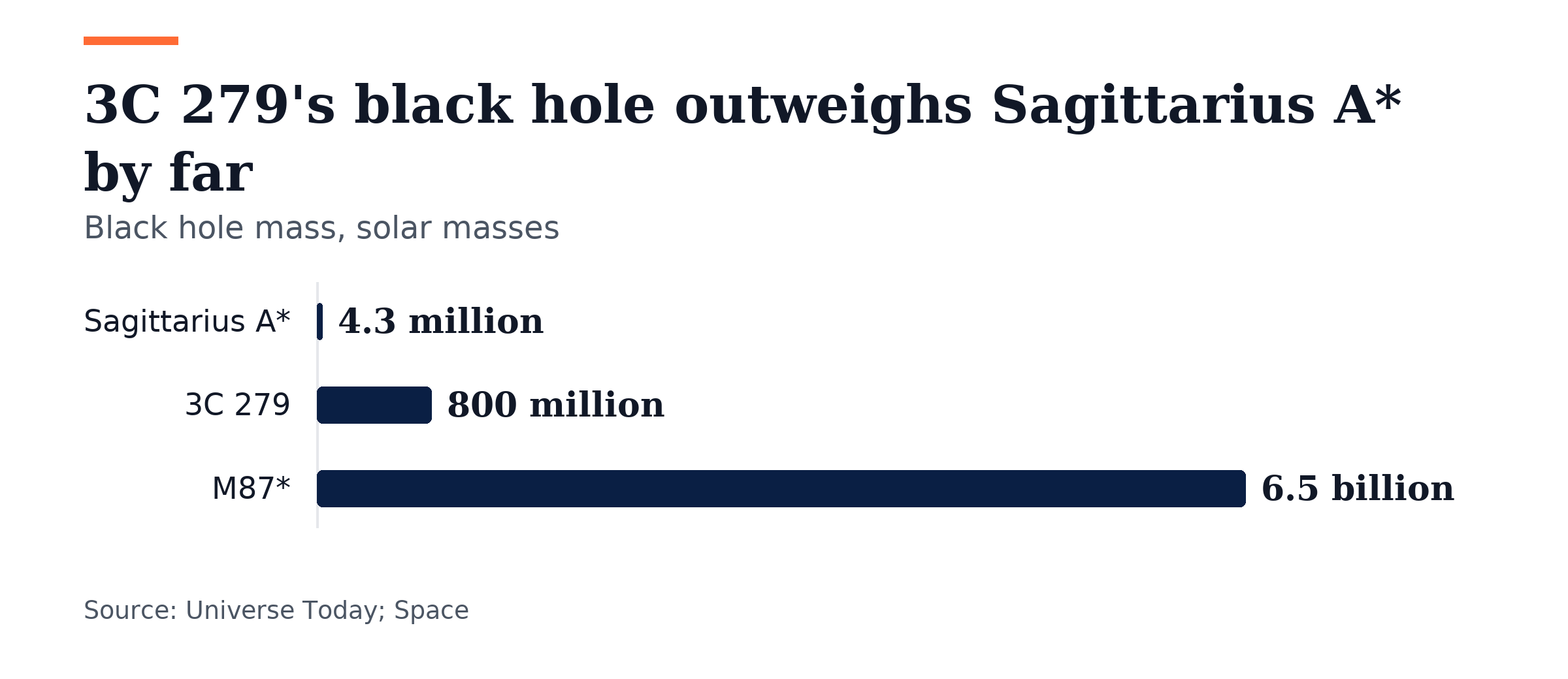
The jet of 3C 279 is powered by a supermassive black hole with an estimated mass of about 800 million solar masses. For comparison, Sagittarius A* is about 4.3 million solar masses. The mass estimate appears alongside the object’s distance of about 538 million light-years and the Sagittarius A* comparison. The distance figure is given alongside the note that the object’s brightness makes it a very-long-baseline interferometry calibration target.
The campaign added two new sites. The two new sites were the 12-meter telescope at Kitt Peak Observatory in Arizona and the Northern Extended Millimeter Array interferometer in the French Alps. Kitt Peak and NOEMA provided crucial intermediate baselines that significantly improved coverage at intermediate scales. That improvement enabled constraints on specific angular scales essential for probing compact and extended jet structures.
The source links these constraints directly to the ability to study both compact and extended structures in the 3C 279 jet. Hendrik Müller, a staff scientist in the Data Management and Software group at the National Radio Astronomy Observatory and a former researcher with the Max-Planck-Institut für Radioastronomie, was lead author of the Astronomy & Astrophysics paper. Müller said the EHT continuously grows by adding more telescopes every year, including the Greenland Telescope in 2018. He explained that telescope locations cannot be changed, so new sites add information unavailable in previous years.
Müller said the closeness of Kitt Peak and NOEMA to other array sites made them especially important, since fixed telescope positions cannot be moved and new sites add information unavailable in prior years. He cited NOEMA’s proximity to Pico Veleta near Granada, Spain, as an example.
“The physical baseline between two antennas in the array determines the spatial scale that this baseline can resolve,” Müller said. He compared moving antennas closer together to zooming into an image with higher resolution but a smaller sky view, similar to moving Very Large Array antennas on railway tracks to change the field of view.
To process EHT data volumes, the team relied on Comrade, DoG-HiT, kine, and Difmap imaging software. This strategy was similar to the one used to reconstruct the 2019 M87 black hole image. Müller explained that the team used different software packages making different assumptions about the image to build confidence by checking for consistency across methods.
The results suggest the 3C 279 jet curves so that one section of it points closer to Earth. This bending is presented as an explanation for brighter emission and slower apparent motion seen farther along the inner jet. Müller explained that plasma traveling close to the speed of light concentrates its radiation in the direction of travel. When that direction lines up more closely with Earth, emission appears brighter.
Müller said features moving more nearly straight toward Earth can appear to move more slowly across the sky, like a car coming almost head-on that shifts little in the field of view. This apparent-motion effect is part of the explanation for why the jet bend makes brighter emission and slower lateral motion compatible with constant plasma speed. Farther along the inner jet, the EHT images show brighter emission and slower apparent motion.
The image’s brightest spot can lie downstream from the black hole where the jet aims most directly at Earth. This follows from the direction change making the jet point toward Earth and increasing observed brightness while reducing apparent sideways motion. EHT images show the direction of the inner jet changes over time. This provides clues about what is driving the jet.
The team saw features moving more slowly along a brighter stretch farther out in the jet. These slowly moving features on the bright stretch are cited as evidence that the bending toward Earth could explain both brightness and slow lateral motion. The changing direction over time is linked to those slowly moving features on the bright stretch and to where the jet accelerates.
Müller said features near the apparent base of the jet already move across the sky at speeds like those far downstream. He said that if those features travel with the plasma, the jet likely gains much of its speed over a short distance near its base. This observation is offered as a clue about where the jet gains speed, suggesting acceleration happens over a short distance near the base.
The mechanisms driving 3C 279’s central jet remain a mystery, and future observations could reveal behaviors not yet seen. Astronomers have decades of observations of how the 3C 279 jet behaves on larger scales but only a few images of its behavior at the sub-parsec level. This contrast explains why the EHT’s sub-parsec imaging of 3C 279 is valuable despite the long history of larger-scale studies.
The EHT provides deep surveys and high resolution, showing details of the innermost jet that were not available before. The source presents this as the reason the collaboration is extremely useful for studying 3C 279’s innermost jet. Müller said only a few quasars have received this level of detail, making 3C 279 one of the best chances to learn how a black hole launches its jet and accelerates it to nearly light speed. He called the current manuscript just the beginning of that journey of understanding jet launching and acceleration.
Müller said the team has EHT observations from several years and observations at other frequencies scheduled around the same time that are currently being analyzed. He explained that observing at different frequencies reveals different parts of the jet, and closely timed observations help separate frequency effects from real jet changes. Müller said the team expects a series of results from these data over the next few years.
The EHT is a very-long-baseline interferometry array of radio observatories that functions as an Earth-sized telescope. Its first black hole image of M87* was released in 2019 and its first image of Sagittarius A* in 2022. The EHT Collaboration gave the first image of a black hole: the supermassive black hole at the heart of the M87 galaxy, designated M87*.
M87 is located 55 million light-years away, and M87* has a mass around 6.5 billion times that of the sun. These figures appear in the source’s description of the 2019 EHT image of M87* and its significance as an immense scientific achievement. Between 2024 and 2026, the EHT array produced detailed images of the relativistic jet emanating from 3C 84 and M87*. This follows the source’s summary of the 2019 M87* image and the 2022 Sagittarius A* image, placing the 3C 279 observations in a broader EHT jet-imaging program.
An independent team led by Samuel Lai, a researcher with Australia’s Commonwealth Scientific and Industrial Research Organisation, validated the first image of M87*. Lai’s team developed advanced machine-learning and artificial intelligence techniques, including GenDIReCT, to capture information about the black hole’s structure and filter out interference from the EHT viewing M87* through Earth’s atmosphere. The validation was published Nov. 11, 2026. It supported confidence in the EHT results and supported general relativity.
“When we applied it to the original EHT dataset, we found a black hole almost identical in size and shape as the historic EHT image,” Lai said. He said the model had no prior idea what a black hole looked like. Lai called the result the first truly independent validation of the EHT image and an important step in the scientific process, settling questions about atmospheric effects and image-processing influence on the M87* picture.
Laurent Loinard, Director of the EHT Collaboration, said GenDIReCT recovers M87*’s ring structure across several years, matching the EHT Collaboration’s published results. Einstein published his theory of general relativity in 1915. General relativity predicted that superheated glowing plasma would form a ring around the event horizon, with the black hole’s shadow cast on it.


Join the discussion