Key facts
- The required solar array covers about the same area as an American football field.
- To prevent electronics from overheating, the craft would require roughly 2,500 square meters of radiator panels.
- At roughly $3,360 per kilogram, dedicated Falcon 9 launches put the launch leg alone at three to thirteen times the full combined launch-and-build price for one data center.
- Lawrence Berkeley National Laboratory research projects that U.S. data centers might use 580 terawatt-hours of electricity across five years, adding roughly 17-46 gigawatts above current levels.
Universe Today reported Nov. 25, 2026 that Dr. Slava Turyshev, a researcher at NASA’s Jet Propulsion Laboratory, wrote an arXiv preprint called Orbital Data Centers: Spacecraft Constraints and Economic Viability. It argues that back-of-the-envelope calculations are too optimistic about the feasibility of orbital AI data centers and that technology for profiting from AI in space remains far off.
Turyshev’s paper describes why orbital data centers seem appealing: they would draw on essentially unlimited free solar power, sit beyond individual NIMBY protesters — those who oppose projects in their own neighborhoods — and need no water cooling systems. The article says ground-based data centers are running into bottlenecks such as newly elected hostile politicians and hard caps on how much more power the electrical grid can supply. The paper frames the problem as three main physics hurdles that culminate in one giant economic hurdle, with scale deciding everything.
Even so, organizations are proceeding with orbital computing plans before the real economics catch up with them, the article says. The FCC gave SpaceX permission to put one million Starmind data centers in orbit by 2040 on Nov. 25, 2026, the day it was published, citing the approval as evidence that organizations are proceeding with orbital data-center plans even though the paper sets out constraints. Google booked a Blue Origin flight to test its Project Suncatcher computing constellation in November 2026, another example of organizations moving ahead before real economics catch up.
Turyshev’s baseline case is a 1-megawatt orbital processing facility, roughly matching a small commercial server room in processing power. A dawn-dusk orbit cuts time in Earth’s shadow, yet the facility still calls for solar panels covering 5,640 square meters. The panel area would span roughly an American football field in size, which the article calls the first size-and-weight obstacle for orbital data centers.
Radiator panels covering roughly 2,500 square meters would be needed to stop the electronics from overheating. Power generation and cooling equipment together bring the 1 MW craft to 30 metric tons before structural trusses, control thrusters, and radiation shielding are added. Including those elements, the full 1-megawatt system likely lands between 34 and 59 metric tons.
Current rocket fairings, the nose cone that surrounds a payload during launch, cannot hold a 1-megawatt facility, so Turyshev shifts to a 100 kW design for practicality. His estimate is roughly 5 metric tons for one such spacecraft instead of assuming it is exactly 10% of a 1-megawatt system. To meet demand, between 170,000 and 461,000 100-kW stations would have to be deployed over five years.
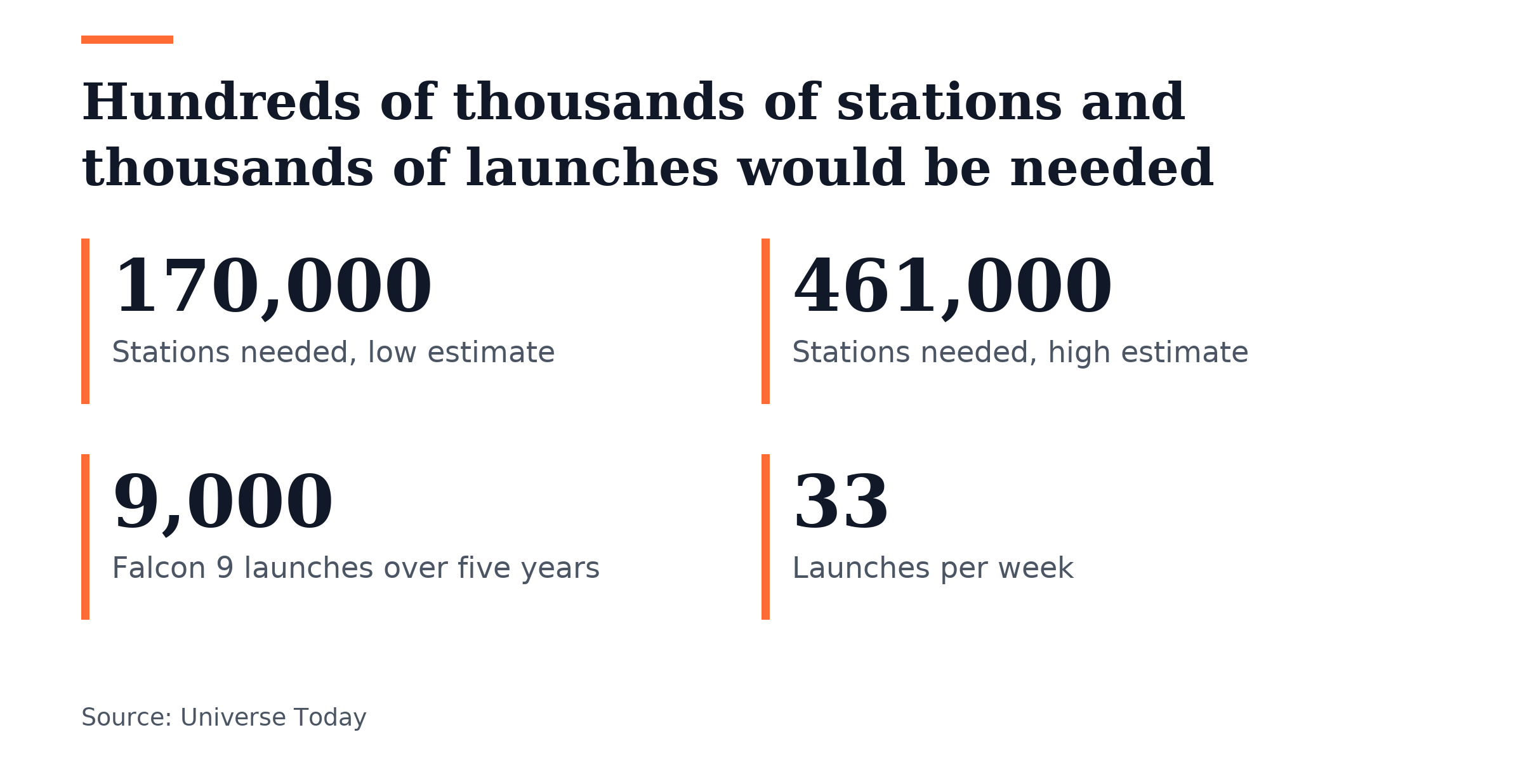
That means almost 9,000 Falcon 9 launches, or roughly 33 per week, since each Falcon 9 carries at most four stations. The article calls this the launch-capacity bottleneck, ahead of any consideration of communications, radiation, or economics.
On the ground, high-end AI data centers cost $10,000 to $40,000 for each kilowatt of computing capacity. Matching that pricing at 40 kilograms per kilowatt requires an orbital satellite whose combined launch and manufacturing costs reach $250 to $1,000 per kilogram. Dedicated Falcon 9 launches cost roughly $3,360 per kilogram, making the launch leg alone three to thirteen times the full cost of building and launching one data center. U.S. data centers might consume 580 terawatt-hours of electricity over five years, adding roughly 17-46 gigawatts beyond current levels, according to Lawrence Berkeley National Laboratory research.
The paper says realistic optical downlink speeds from orbit run about 13 to 26 gigabits per second rather than the 200-gigabit-per-second headline number. Those links need a clear line of sight to a station on the ground and cannot operate through cloud cover.
Cosmic rays trigger single-bit flips in memory, forcing processors to run error-checking algorithms and reducing usable computer time. Across a five-year mission, radiation damage together with micrometeoroid strikes degrades both electronics and solar panels. That steady wear raises the cost of each calculation completed, feeding the economic hurdle.
Turyshev points to useful niches: orbiting spacecraft that process raw imagery or sensor data from Earth observation and beam refined insights down, plus communications-based edge computing riding on constellations such as Starlink. The article concludes that it might be a while before these efforts recognize the hard physical limits they face, once real economics catch up with them.




Join the discussion