Key facts
- NASA deliberately crashed its DART spacecraft into the asteroid Dimorphos in 2022 as a test of planetary defences to see whether a space rock could be knocked off course.
- Dimorphos is Didymos's 500-foot-wide moonlet.
- Patrick Michel said DART flattened a whole side of Dimorphos into a large crater while the rest of the space rock stayed much the same.
- Patrick Michel said the impact crater left the boulder fields covering the rest of Dimorphos unchanged.
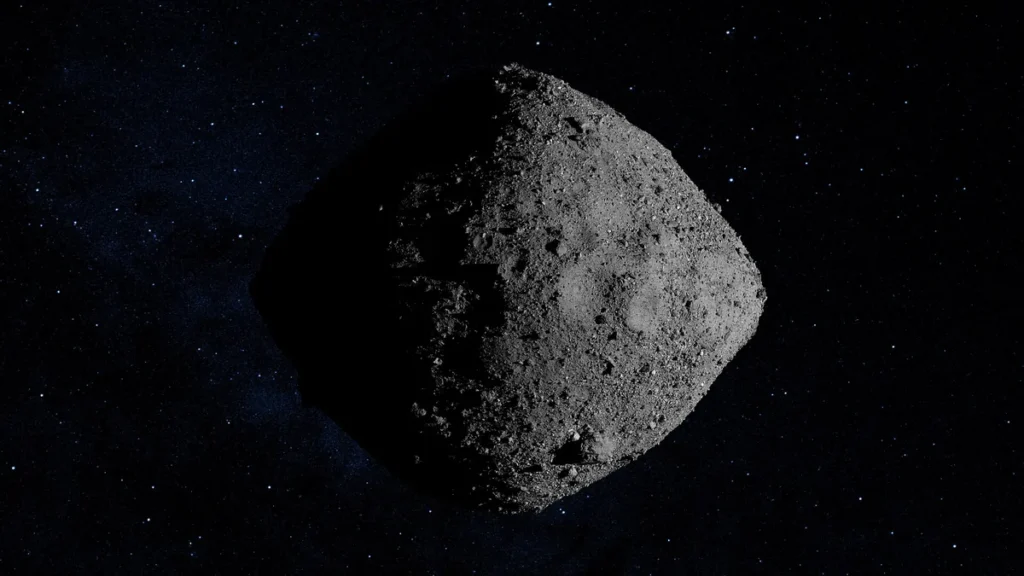
NASA deliberately crashed its DART spacecraft into Dimorphos, Didymos’s 500-foot-wide moonlet, in 2022 to test whether a space rock could be knocked off course.
The impact created a stadium-sized crater that extends across Dimorphos’s entire width, Patrick Michel, France’s National Centre for Scientific Research Director of Research and Hera’s principal investigator, said. The crash flattened one side of the asteroid into a large crater while the rest of the space rock remained much the same. The boulder fields covering the rest of Dimorphos stayed unchanged.
Scientists had debated whether Dimorphos gained a crater, altered its shape, or stayed unchanged after the crash. Patrick Michel said the outcome was all three at once. “Much to our surprise the answer turns out to be all three at once!”
Its first observations came from about 25 to 30 kilometers away from the asteroids. The car-sized probe used a monochrome Asteroid Framing Camera, a 25-color multi-spectral Hyperscout H, and a JAXA-developed Thermal Infrared Imager for measuring surface temperature.
Ian Carnelli, Hera mission manager, said DART demonstrated that an asteroid’s orbit can be changed. “NASA’s DART mission demonstrated that we can change an asteroid’s orbit,” Carnelli said. He added that Hera is revealing what happened to the asteroid itself and described the combined missions as a decisive step toward establishing asteroid deflection as a dependable means of safeguarding the planet.
In March 2026, after the 2022 controlled crash, NASA revealed that its Double Asteroid Redirection Test had successfully altered the orbit of Dimorphos and Didymos around the Sun.
In December 2026, ESA plans to move Hera closer to Dimorphos and Didymos to capture higher-resolution images of the impact site, with the spacecraft going to barely eight miles away from the asteroids. In January 2027, Hera will deploy a pair of shoebox-sized CubeSats to collect more data and move nearer to the binary system.
A Luxembourg-led research team built the Juventas CubeSat, which will use radar to examine the asteroid’s interior and later touch down on the asteroid. An Italian-led team will use the Milani CubeSat to prospect asteroid dust and other surrounding materials.
Researchers will use combined measurements from the closer phase to gauge how efficient the impact was and to strengthen future deflection plans. Hera mission scientist Michael Kueppers said the asteroids are ringed by hundreds of orbiting boulders measuring only a few meters across, and the boulders surround both asteroids in the binary system.
NASA released video of the 2022 impact moment, and fresh images show how much damage the asteroid sustained. The first Hera images were unveiled at the Berlin Natural History Museum’s dinosaur hall, where Ian Carnelli connected the mission to preventing an impact like the one 66 million years ago that changed life on Earth. Carnelli said an impact 66 million years ago reshaped the path life took on Earth, and that humanity is now testing ways to stop a similar event from recurring. The team chose the dinosaur hall deliberately for the unveiling of Hera’s first images.
Dimorphos posed no threat to Earth. Space agencies including NASA are studying orbit changes for asteroids as one method of defending Earth against potentially dangerous future impacts from asteroids.




Join the discussion