Key facts
- Scientists do not know how the terrain formed, and similar arrangements have not been observed anywhere else on Mars, according to Paul Geissler, the late planetary scientist of the US Geological Survey.
- Daedalia Planum sits in the highlands of the volcanic Tharsis region near the Martian equator at an altitude of 5,455 meters (17,900 feet).
- On Earth, sorted patterned ground creates orderly stripes, circles, and polygons in cold environments when repeated freezing and thawing cycles separate larger rocks from finer soil.
- It is possible that freeze-thaw cycles affect the Daedalia Planum highlands, though this cannot be assumed.
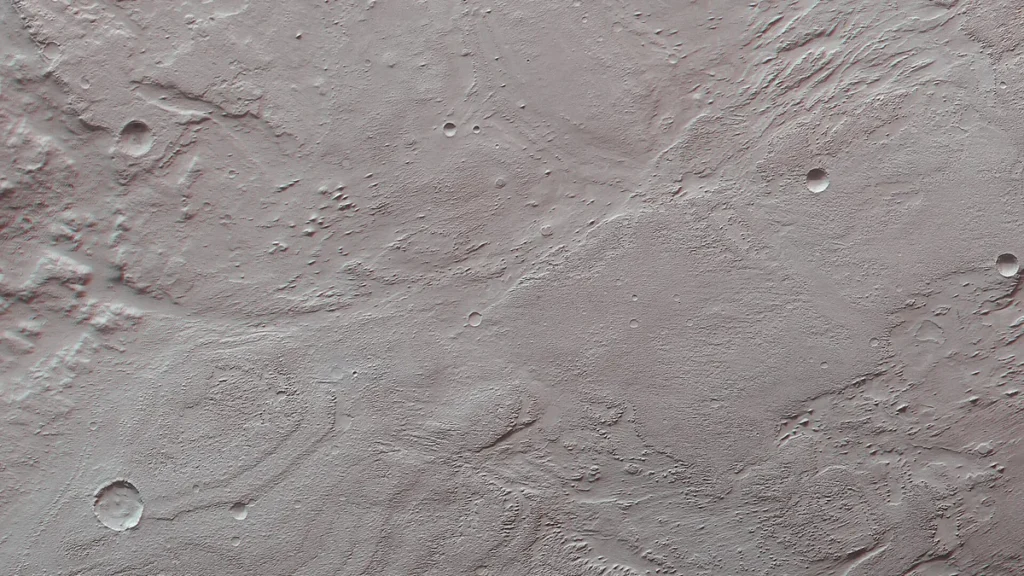
HiRISE (High Resolution Imaging Science Experiment) imagery from NASA’s Mars Reconnaissance Orbiter, obtained in August 2024, revealed bright boulders arranged in long curving rows across Daedalia Planum in the Tharsis highlands near the Martian equator, according to ScienceAlert.
The rows cross a swath of ground roughly 5 by 15 kilometers and look like a fingerprint, with gaps of 5 to 10 meters, or 16 to 33 ft, between them. Paul Geissler described the regular spacing of the rows.
Daedalia Planum sits in the highlands of the volcanic Tharsis region near the Martian equator at an altitude of 5,455 meters, or 17,900 feet. Orbital images obtained in 2002 had suggested Daedalia Planum was relatively bland and topographically featureless.
The August 2024 HiRISE imagery overturned that earlier impression. Paul Geissler, the late planetary scientist of the US Geological Survey, wrote about the formation in October 2024. He described bright boulders in long curving rows that resemble a fingerprint and said the arrangement has not been observed anywhere else on Mars.
Scientists do not know how the terrain formed, according to Geissler. On Earth, sorted patterned ground creates orderly stripes, circles, and polygons in cold environments when repeated freezing and thawing cycles separate larger rocks from finer soil. The phenomenon offers a natural explanation for stone arrangements without invoking mistaken identities.
It is possible that similar freeze-thaw cycles affect the Daedalia Planum highlands, though this cannot be assumed. Seismic shaking on Mars is presented as another possibility alongside freeze-thaw cycles for the boulder rows in Daedalia Planum.
Seismic shaking could sort boulders through the Brazil nut effect, in which larger rocks rise and smaller ones sink when the ground shakes beneath them. Questions remain about whether seismic shaking can produce such orderly rows and whether Tharsis has enough seismic activity to explain them.
Geissler gave the rows a precise measurement. “Bright boulders are arranged into long curving rows separated by 5 to 10 meters,” he wrote in October 2024.


Join the discussion