Key facts
- ESA's Euclid space telescope has spotted the farthest and therefore earliest quasar ever seen, called J1504+6252, which came into being 630 million years after the big bang.
- The discovery breaks a record Euclid set in July 2026; the new quasar is 40 million years older than the previous record holder, only four months after the earlier record was set.
- J1504+6252 has a redshift of z = 8.13, the highest redshift on record, so it is the first quasar ever found with a redshift above eight.
- The quasar is devouring material at a comparatively slow pace, below the Eddington limit, implying it reached its size through unusually fast growth spurts early in life rather than steady slow growth.
ESA’s Euclid space telescope has spotted the farthest and earliest quasar ever seen, called J1504+6252, which formed 630 million years after the big bang, researchers announced Nov. 24, 2026.
The discovery breaks a record Euclid set in July 2026. J1504+6252 is 40 million years older than the previous record holder, and the earlier record was set only four months before. The new object has a redshift of z = 8.13, the highest on record, making it the first quasar ever found with a redshift above eight. Redshift measures how much light has been stretched by cosmic expansion, and a greater redshift indicates an older source.
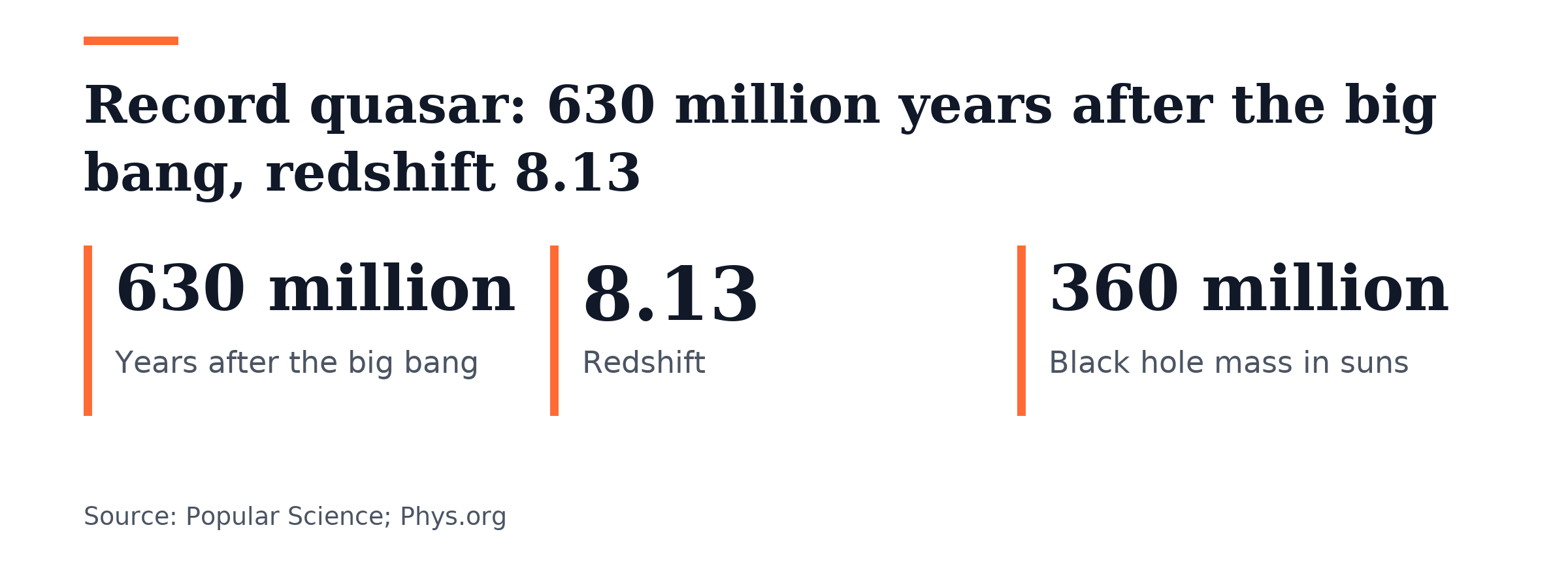
Follow-up observations show the quasar hosts a supermassive black hole about 360 million times the mass of the sun. A black hole that large so early in cosmic history confounds astronomers and challenges existing models of black hole formation.
The quasar is devouring material at a comparatively slow pace, below the Eddington limit, implying it reached its size through fast growth spurts early in life rather than steady slow growth. The result matches a direct-collapse scenario, where a huge gas cloud collapses under its own gravity to make a black hole, though direct-collapse conditions were likely rare then.
Julien Wolf, a postdoctoral researcher at the Max Planck Institute for Astronomy in Heidelberg who is now at the European Southern Observatory in Garching bei München, led the discovery team. Wolf and his colleagues calculated the conditions under which proposed black hole formation scenarios could produce a black hole as massive as the one powering the quasar. Wolf said, “The closer to the Big Bang we find them, the faster their black holes must have grown.”
Astronomers gave the quasar the nickname Dún Aonghasa to honor its age and location, referring to a prehistoric clifftop fort in Ireland that overlooks the Atlantic Ocean. The nickname reflects the object’s position at the edge of the visible cosmos, paralleling the ancient fort’s coastal setting.
J1504+6252 appears in the telescope’s image as it looked about 13.1 billion years ago, when the universe was just 5 percent of its present age. Quasars are extremely bright galactic nuclei containing supermassive black holes that are feeding; as gas spirals inward and heats up, it outshines an entire galaxy. This process, accretion, makes quasars the brightest persistent sources in the universe.
These quasars belong to the epoch of reionization, when increasingly energetic radiation heated and ionized gas after the cold, dark “dark ages,” helping establish conditions that shaped the universe observed today. ESA Euclid Project Scientist Valeria Pettorino calls ancient quasars time machines that enable exploration of the early universe and how the first generation of galaxies came to be.
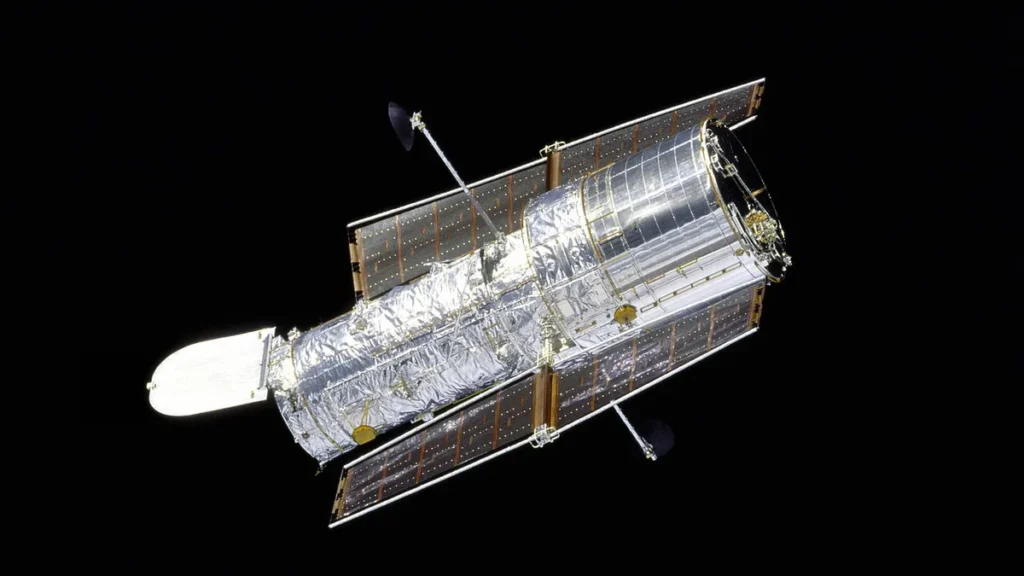
ESA launched Euclid in 2023 to examine dark matter and dark energy, which are estimated to account for about 95 percent of the universe, though astronomers still know very little about them. In barely 1.5 years of operations, Euclid has flagged 31 quasars, including 12 beyond a redshift of 7, placing them within the universe’s first 770 million years. The earlier release’s 31 quasars all came from Euclid Wide Survey data, and the survey will eventually cover more than one-third of the sky.
The survey’s combination of large sky area and the ability to capture faint infrared radiation lets Euclid identify less bright quasars that earlier searches struggled to find. Euclid’s success comes from combining enormous sky coverage with detailed images and faint infrared detection, supported by thousands of Euclid Consortium scientists and engineers processing enormous datasets.
Euclid found the previous record holders in July 2026: EUCL J172902.75+641018.1 at redshift 7.77 and EUCL J125308.55+705432.3 at redshift 7.69. Both appeared in the universe’s first 670 million years and are just over 13 billion light-years away from Earth.
EUCL J125308.55+705432.3, the second-oldest quasar in that release, occupies a galaxy rich in gas and dust where star formation is intense. That setting could clarify how early massive galaxies formed beside giant black holes at their cores. Daming Yang said, “These early quasars date back to the Universe’s infancy,”
The object was first identified in the Euclid Wide Survey and confirmed as a quasar by follow-up observations with the W. M. Keck Observatory, the Hubble Space Telescope, the Large Binocular Telescope, and the James Webb Space Telescope. Keck and Hubble provided the first hints, while the Large Binocular Telescope and ultimately the James Webb Space Telescope revealed the redshift of z = 8.13.
The findings were published in Astronomy & Astrophysics as “Euclid: Discovery of Dún Aonghasa, a quasar at z = 8.13 hosting a 360-million-solar-mass black hole” by J. Wolf, S. Belladitta, et al. The peer-reviewed paper appeared in the journal on the day of the announcement.
Astronomers anticipate that Euclid will discover several additional quasars past redshift 8 over the coming years. This expectation follows from Euclid’s wide survey capability and its record of flagging numerous distant quasars in a short time.

Join the discussion