
Key facts
- Antariksh Venture Capital Fund (AVCF) led the Series B round with a $6.4 million investment.
- SatSure creates AI and foundational models that extract insights from imagery, providing the company with capabilities across the full value chain.
- The collected data covers monsoon patterns, farm landscapes and urban expansion, among other topics, and could support work in fields such as infrastructure and finance.
- The regulator's grant backs SatSure's role in India's partnership programme for a commercial satellite constellation.
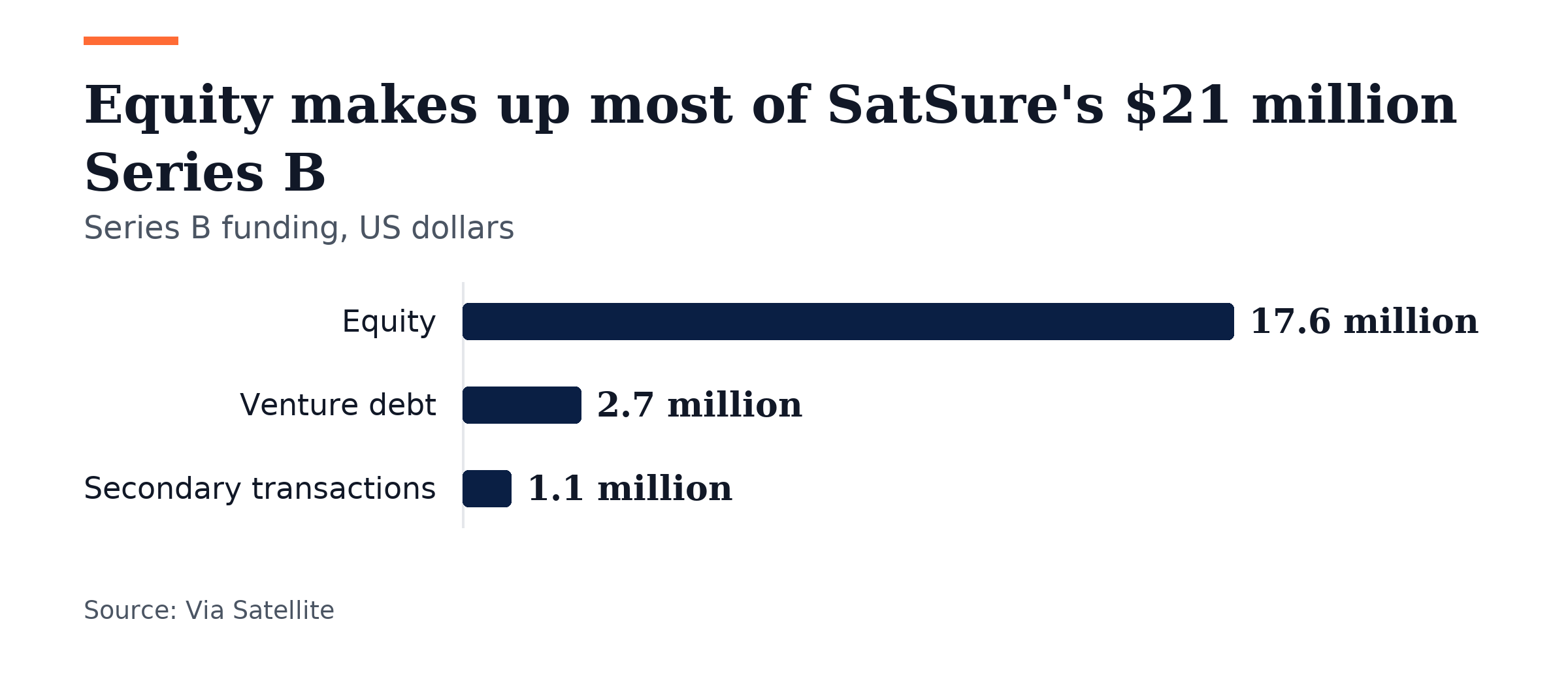
Bengaluru-based Earth observation startup SatSure raised a $21 million Series B round on Nov. 20, 2026, through a combination of equity, debt and secondary transactions with investment from India’s sovereign space-technology fund.
SatSure disclosed the split of the instruments when it announced the financing. A Series B is a later-stage venture funding round. Equity is an ownership stake in the company. The round includes $17.6 million in equity, $2.7 million in venture debt, which is debt financing for venture-backed companies, and $1.1 million in secondary transactions, which are sales of existing shares rather than new stock issued by the company.
Antariksh Venture Capital Fund led the round with a $6.4 million investment. The fund is anchored by IN-SPACe, India’s national space regulator, and run by SIDBI Venture Capital Limited.
The Bengaluru company plans to use the Series B capital to advance its optical payloads ahead of a 2027 orbital flight and to support its work on India’s national Earth observation constellation, where it is a partner. Optical payloads are instruments that capture imagery from orbit. Earth observation means gathering information about the planet using satellites. SatSure owns KaleidEO, which builds optical satellite payloads.
KaleidEO demonstrated its optical, multispectral payload in aerial tests, and SatSure has not yet launched a satellite. Multispectral payloads capture imagery in multiple wavelengths of light. The company also creates AI and foundational models that extract insights from imagery, providing capabilities across the full value chain. India’s national Earth observation constellation is a network of satellites for planetary data.
Prateep Basu, SatSure’s chief executive and co-founder, said intelligence is reliable only when a company owns the full chain from orbit payloads to AI and foundation models. He said the round lets SatSure build that stack further from India for the world. Prateep Basu made the remarks in connection with SatSure’s Nov. 20, 2026 Series B announcement about building its full stack from India for the world.
On June 11, 2026, SatSure Analytics secured a 246 million rupees ($2.57 million) grant from India’s space regulator to develop AI models for Earth observation. The grant conversion used an exchange rate of $1 to 95.7400 Indian rupees.

India’s space sector has long been led by ISRO. The grant formed part of a broader Indian effort to build sovereign AI capabilities and cut reliance on foreign technology for satellite data. India has opened its state-run, ISRO-led space sector to private firms and created a 10-billion-rupee fund for scaling space startups. The grant backs SatSure’s role in India’s partnership programme for a commercial satellite constellation.
SatSure said the grant will support development of large Earth observation models using satellite and drone data tailored to India to improve accuracy over global models where global models struggle with local conditions. Drone data is imagery and sensor information collected by uncrewed aerial vehicles. Foundation models are AI systems trained on broad data that can be adapted to many tasks. Large Earth observation models are AI systems trained to interpret satellite imagery at scale.
The collected data covers monsoon patterns, farm landscapes and urban expansion, among other topics, and could support work in fields such as infrastructure and finance. Rashmit Singh Sukhmani, SatSure’s co-founder and chief technology officer, said the sector is shifting from project-specific analytics to reusable intelligence infrastructure. Rashmit Singh Sukhmani made the comments on June 11, 2026, alongside the grant announcement for large Earth observation models.
Reusable intelligence infrastructure refers to analytics systems built to serve many projects rather than one-off tasks. He said the models could support decision-making systems reflecting India’s geography and climate dynamics, its agricultural diversity, and its infrastructure requirements.

Join the discussion