Key facts
- A doctoral researcher at the University of Sydney has found evidence that the Milky Way is unusual compared with nearby galaxies in where new stars are born.
- A vast rotating stellar structure near the center of the galaxy drives powerful shock fronts through clouds of gas, compressing the gas and producing conditions in which new stars are born.
- The lead author is Dr. Hillary Davis, who recently completed her doctorate at the University of Sydney. She is affiliated with the School of Physics and the Sydney Institute for Astronomy.
- In most similar galaxies, star formation commonly happens along spiral arms, but in the Milky Way it occurs in a different region where strong shocks usually suppress star formation.
Dr. Hillary Davis, who recently completed her doctorate at the University of Sydney and is affiliated with the School of Physics and the Sydney Institute for Astronomy, has found evidence that the Milky Way forms new stars in an unusual location compared with nearby galaxies, according to Phys.org reporting on Nov. 20, 2026.
She said star formation occurs along the shock front of the Milky Way’s bar, which is uncommon for most bars in nearby galaxies. In most similar galaxies, star formation commonly happens along spiral arms, but in the Milky Way it occurs in a different region where strong shocks usually suppress star formation. She said the findings improve understanding of central Milky Way structures and of gas motion relative to them. The research appeared in Nature Astronomy in 2026.
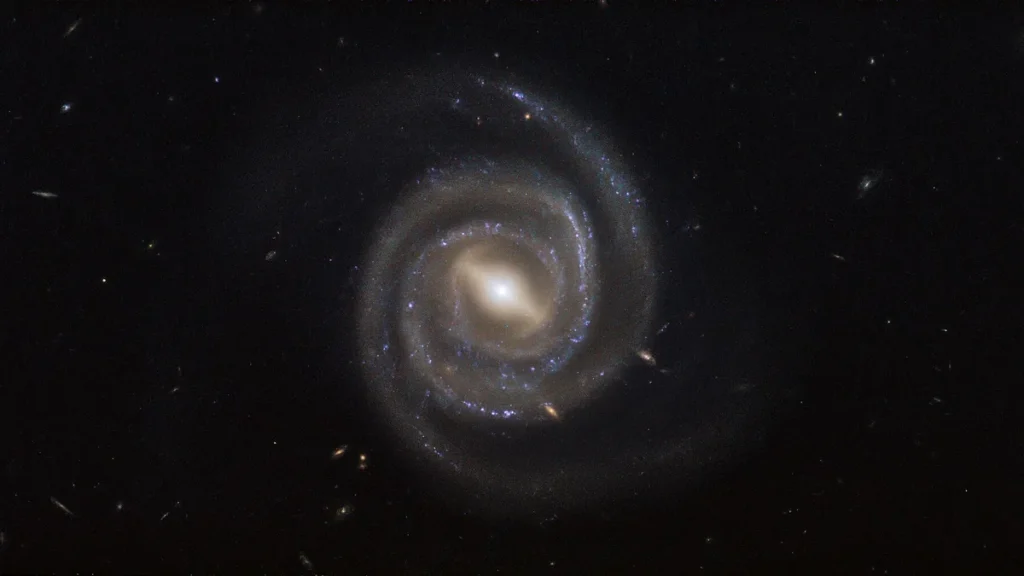
The Milky Way is a barred spiral with an elongated concentration of stars at its center called the galactic bar. The bar spins and applies gravitational forces to nearby gas.
Its rotation creates powerful shock fronts in which gas compresses, as air compresses in a shock wave. A rotating stellar structure near the center drives these shock fronts through gas clouds, compressing the gas and producing conditions in which new stars form.
In nearby barred galaxies that astronomers can observe directly, shock fronts commonly suppress star formation even when gas is present. The research suggests the Milky Way may be different but not unique, since a few observed galaxies have significant star formation along bar shock fronts. Phys.org reported that the discovery challenges understanding of the Milky Way’s structure.
Davis said the results raise questions about the Milky Way’s spiral structure and bar region, and that this area needs further investigation. The discovery raises questions about whether the Norma spiral arm exists. The arm takes its name from the constellation Norma as seen from Earth.
Masers once linked to the Norma arm line up with the simulated shock front. This indicates that the so-called Norma arm is not wholly a spiral arm but includes a star-forming region at the bar’s leading edge.
Regions where massive stars form host naturally occurring sources of concentrated microwave radiation called masers. They operate like a laser at microwave wavelengths. Phys.org reported that scientists reached this conclusion by comparing simulations of changing galaxies over billions of years with observations of masers.
Davis said comparing new large-scale computerized galaxy simulations evolving over billions of years with a limited set of observations yields a stronger understanding of the Milky Way’s bar and star formation.
The research team estimates the bar reaches roughly 4.3 kiloparsecs, about 14,000 light-years, outward from the galaxy’s center along its major axis. This estimate is consistent with a long bar that rotates slowly. Davis said the results add new limits on the bar’s dimensions, inclination, and spin rate.
The study provides new evidence about the central bar’s dimensions, tilt, and spin, characteristics researchers have debated for many decades. Davis said the galactic bar is hard to observe because of Earth’s location within the galaxy and dust blocking the view.
As a result, the bar’s properties remain widely debated. The observer’s position in the galaxy and dust limit direct observation of the central bar, which is why its properties have long been uncertain. The research appeared under the title The nature of the Norma arm as a bar-driven star-forming shock front, with DOI 10.1038/s41550-026-03010-5.


Join the discussion