Key facts
- Lewis argues that regulators assess risk from individual satellites while overlooking the combined risk of an entire constellation, and he calls for more stringent approaches to regulation.
- Lewis warned that a collision involving an operational satellite is likely even with all current maneuvers.
- NASA scientists, including Donald Kessler, proposed the debris cascade scenario in 1978, in which crowding makes collisions more likely and debris from each collision triggers further collisions.
- Phil Plait warned in a March Scientific American column that increasing satellite counts by thousands could make the danger "apocalyptically worse.".
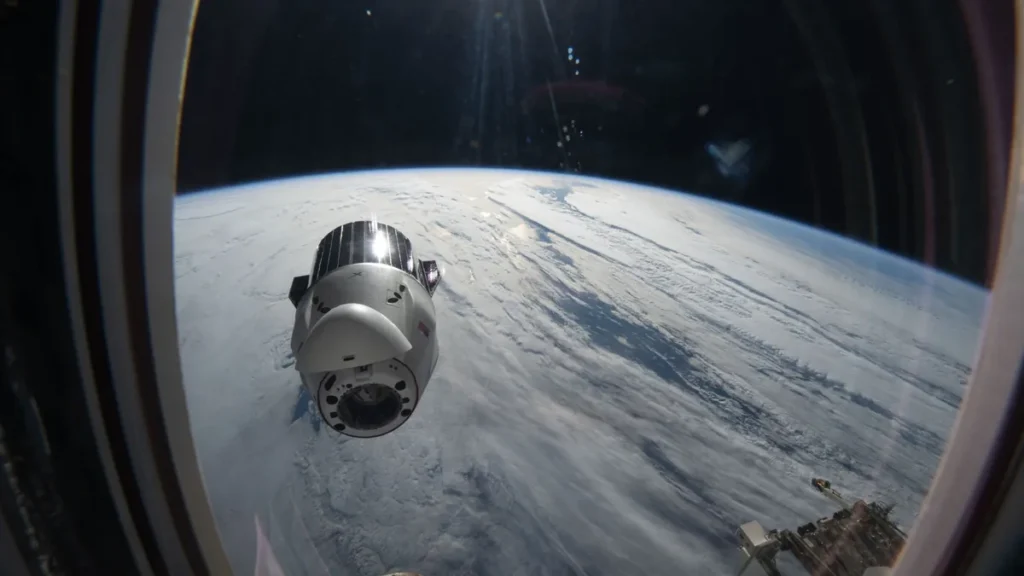
Astronautics professor Hugh G. Lewis, a space sustainability expert, published Critical Sizes of Satellite Constellations on arXiv on July 31, 2026. The paper finds that some planned, partly deployed or fully deployed constellations operate above a critical size, at which point the debris population becomes unstable or runs away. The FCC is reviewing Lewis’s argument that rules designed for single satellites cannot properly assess the risk of an entire constellation, while SpaceX plans to add the largest number of satellites. Lewis has called for more stringent approaches to regulation.
Lewis argues that regulators assess risk from individual satellites while overlooking the combined risk of an entire constellation. The paper does not name any constellations or identify which systems exceed their critical size because critical size is specific to each constellation. The work is a preprint that could not be confirmed as peer reviewed.
Shortly before the arXiv posting, Lewis told Space.com that SpaceX managed orbital traffic well. He subsequently warned that a collision involving an operational satellite is likely even with all current maneuvers.
KeepTrack counts 11,137 Starlink satellites still in orbit, a figure that reflects the current scale of the constellation compared with the proposed expansion to one million satellites. In December 2021, when Starlink was far smaller, Musk said “a couple of thousand satellites is nothing.”
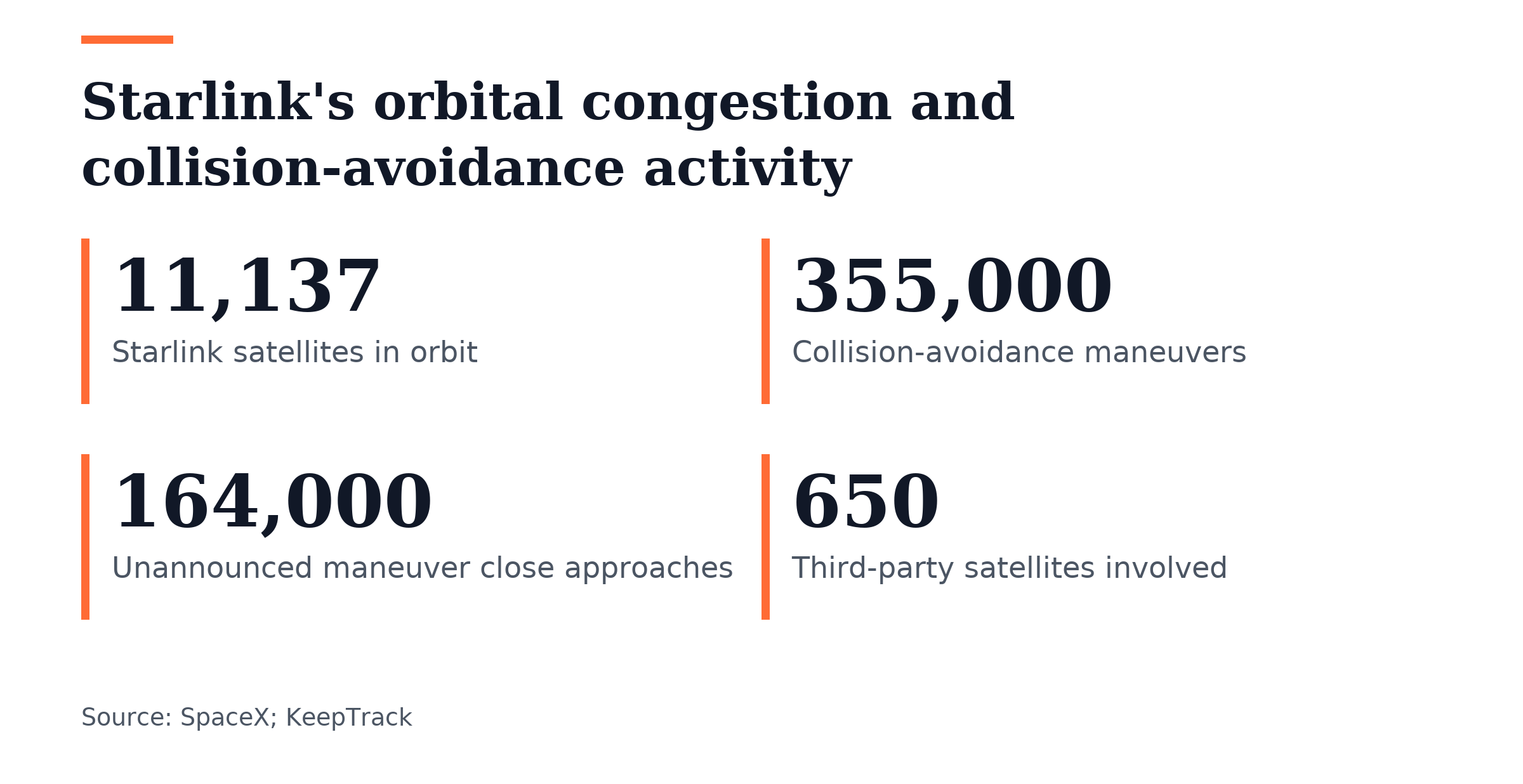
SpaceX reported that Starlink came close to roughly 650 different third-party satellites maneuvering in 2026, and only about half of them shared trajectory information.
SpaceX calls keeping satellite maneuver plans private counterproductive and offers a free data-sharing platform. The position follows SpaceX’s reports of close approaches involving satellites that did not disclose their trajectories. Over a six-month period, Starlink recorded approximately 164,000 close approaches in which the nearest point occurred within four hours of another satellite’s unannounced maneuver.
Starlink satellites made more than 355,000 collision-avoidance maneuvers from June 1, 2025, to May 31, 2026, a figure that reflects the scale of operational avoidance activity reported by Space.com. In August, a close pass put a Starlink satellite within 134 meters of another spacecraft, forcing the satellite to turn its solar arrays edge-on. The incident appears alongside an October 2025 encounter in which another spacecraft briefly put itself on a course within 57 meters of a Starlink satellite. The report is part of a series of close approaches highlighting risks from unshared trajectory information.
NASA scientists, including Donald Kessler, proposed the debris cascade scenario in 1978, in which crowding makes collisions more likely and debris from each collision triggers further collisions. The mechanism could render some orbits unusable for decades, although no cascade has occurred. The European Space Agency describes the February 2009 collision between Kosmos 2251 and Iridium 33 as creating thousands of pieces of debris.
Phil Plait warned in a March Scientific American column that increasing satellite counts by thousands could make the danger “apocalyptically worse.” China has a separate plan for a 200,000-strong satellite fleet, and AST SpaceMobile is building its own constellation. IBTimes reports these as sources of orbital crowding alongside SpaceX’s proposed expansion.

Join the discussion