
Key facts
- A team led by Ben Sutlieff of the University of Edinburgh and Markus Bonse of the European Southern Observatory independently verified Beta Pictoris d using VLT's ERIS instrument and conventional infrared imaging.
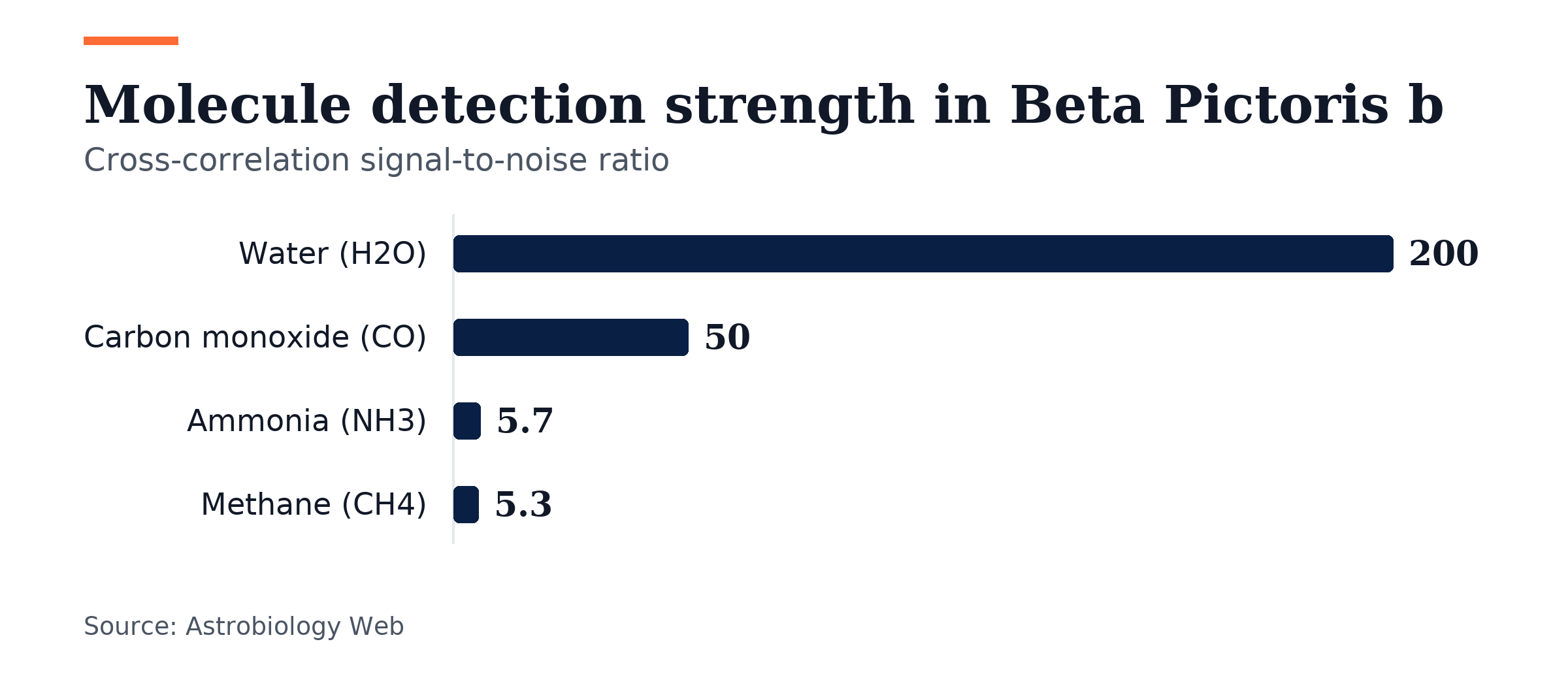
- A high-resolution near-infrared search of β Pictoris b found tentative methane (CH4) and ammonia (NH3) at the velocity expected for the planet, at cross-correlation signal-to-noise ratios of about 5.3 and 5.7.
- Earlier high-resolution spectroscopy of β Pictoris b had detected water and carbon monoxide but not methane or ammonia.
- The analysis recovered water and carbon monoxide at cross-correlation signal-to-noise ratios of roughly 200 and roughly 50.
A team led by Andrea Barone has found tentative methane and ammonia signals in the atmosphere of β Pictoris b, a directly imaged exoplanet orbiting the nearby star β Pictoris. The search used 44 CRIRES+ settings spanning the H, K, L and M bands, cross-correlating extracted spectra with molecular templates. Comparison extractions at an equal projected separation on the star’s opposite side produced no matching peak, arguing that the candidate signals link to the planet’s expected location rather than to that position in general. The candidate signals appeared at the velocity expected for the planet, at cross-correlation signal-to-noise ratios of about 5.3 and 5.7.
Earlier high-resolution spectroscopy of β Pictoris b had detected water and carbon monoxide but not methane or ammonia. The new analysis recovered water and carbon monoxide at cross-correlation signal-to-noise ratios of roughly 200 and roughly 50, offering a much stronger benchmark than the weaker candidate peaks. For molecules whose detection was uncertain, the team weighted each observation by molecular information content and data quality instead of by the measured strength of the candidate molecular signal. Combining many wavelengths increases sensitivity to faint molecular signals, so the team assembled wide spectral coverage across four near-infrared bands to maximize the chance of detecting weak species.
The team classifies the methane and ammonia signals as tentative because their cross-correlation values do not fully account for possible residual systematics. Confirmation would mark the first detections of both species in β Pictoris b’s atmosphere.
“We classify the CH4 and NH3 signals as tentative because their cross-correlation S/N values do not fully account for possible residual systematics.” – Andrea Barone et al. Astronomy & Astrophysics has accepted the paper, led by Barone with co-authors including M. Janson, A. Brandeker, T. Stolker, A. Vigan, K. Hoy and P. Mollière, for publication.
β Pictoris is 19.7 pc away, about 24 Myr old and bright at V=3.85, and its planetary system hosts three directly imaged planets. The system’s relative youth and proximity make it a valuable laboratory, and it is already known to contain multiple directly imaged giant planets. β Pictoris b was directly imaged in 2008, and Beta Pictoris d’s confirmation on July 23, 2026, brought the system to three directly imaged planets, only the second system after HR 8799, 133 light-years away.
A team led by Ben Sutlieff of the University of Edinburgh and Markus Bonse of the European Southern Observatory independently verified the planet using VLT’s ERIS instrument.
Archival SPHERE data and JWST NIRCam observations going back to 2014 also captured the planet, meaning it appeared in images for eleven years without recognition. Beta Pictoris d overlapped in apparent sky position with the much brighter Beta Pictoris b, which helped explain why it went unrecognized. Orbital analysis using eleven years of astrometric positions pinned its semi-major axis at 26.0 astronomical units and confirmed it is co-planar with the debris disk and its two sibling planets.
The debris disk has a sharply defined inner edge at roughly 50 astronomical units, about 4.7 billion miles or 7.5 billion kilometers. Models using only the two known planets could not reproduce that sharp edge, leading theorists to predict a third, outer planet must exist to gravitationally sculpt the disk’s inner boundary. Beta Pictoris d’s orbital position and mass are consistent with that role, but the team needs better measurements of its mass and orbit before deciding how much of the disk’s behavior it can explain.
VLT photometry puts Beta Pictoris d at about 2.4 Jupiter masses. JWST spectroscopy puts it at roughly 2 to 4 Jupiter masses, though stripping the broadband continuum makes that mass estimate less direct. Each estimate still ranks the planet as the smallest of the three known giants; Beta Pictoris b and c each weigh approximately 8 to 10 Jupiter masses.
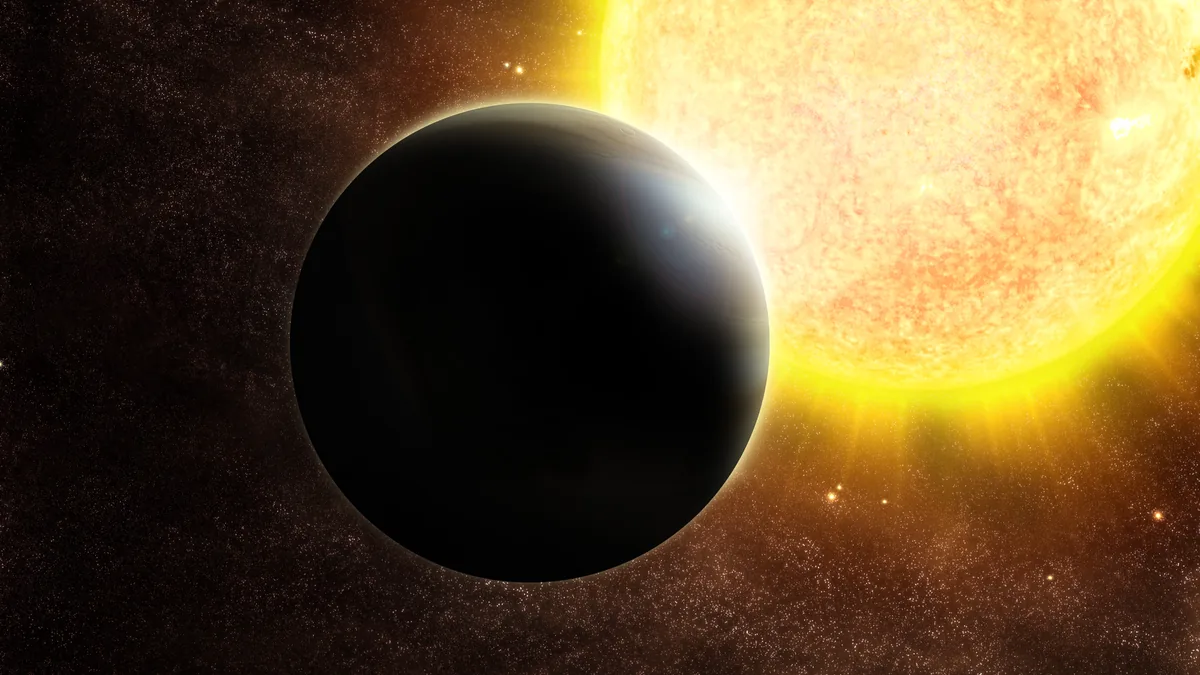
Beta Pictoris d orbits at approximately 26 astronomical units, about 2.4 billion miles or 3.9 billion kilometers, inside the debris disk’s brightest inner region. Researchers estimate its surface temperature at approximately 600 Kelvin, about 330 degrees Celsius or 620 degrees Fahrenheit, making it cool and intrinsically faint. Beta Pictoris d puts out roughly 100 times less light than Beta Pictoris b. Beta Pictoris b was confirmed first in the system in 2008.
Archival JWST NIRCam data later showed Beta Pictoris d’s presence in previous observing epochs, and three instruments – NIRSpec, MIRI and NIRCam – each captured evidence of the planet. Full orbital parameters will require continued observations as astronomers accumulate more astrometric positions.
Researchers estimated the chance that Beta Pictoris d’s signal came from an unrelated background brown dwarf at less than one in 10 million before they considered radial velocity measurements. Researchers reached that estimate after finding repeating carbon monoxide absorption lines while studying Beta Pictoris b, and radial velocity, position and alignment with the debris disk helped conclude the object was bound to Beta Pictoris. Measurements placed Beta Pictoris d within Beta Pictoris’ nearly edge-on disk, with a velocity consistent with an object orbiting the star on the opposite side from Beta Pictoris b.
Spectroscopic detection cancels the planet’s broadband continuum to isolate molecular absorption lines, stripping photometric information needed to measure size, so this detection alone cannot determine Beta Pictoris d’s true radius. Initial modeling favored 900 to 1,200 kelvins but produced unrealistically small radii, so researchers consider 600 to 800 kelvins more likely because that range matches expected radii and detection limits.
Unconfirmed possibilities include Beta Pictoris d’s gravity shaping tilted debris fields, incoming comets, a carbon monoxide clump near the system’s southwest side, or disk asymmetry, though researchers have not confirmed those links.
The Extremely Large Telescope, under construction in Chile’s Atacama Desert with a 39-meter primary mirror, will bring greater light-gathering power and a high-resolution IFU spectrograph to the same spectroscopy-based detection technique. Existing archival datasets from VLT instruments likely already contain signals from undiscovered planets, according to Valentin Christiaens of CEA Paris-Saclay, and the same argument applies to JWST’s archives.
Beta Pictoris is about 63 light-years from Earth and estimated to be roughly 23 million years old, giving astronomers an unusual opportunity to observe how newly formed planets interact with the surrounding debris disk. Beta Pictoris d avoided detection because it is embedded within one of the brightest debris disks ever observed, where dust scatters starlight and creates a diffuse bright background glow similar to fog.
Astronomers proposed that an undiscovered planet like Beta Pictoris d might be shaping the debris disk and producing some of its difficult-to-explain structures. Researchers intend to continue examining Webb’s observations to refine estimates of Beta Pictoris d’s temperature, atmospheric composition, and orbit, providing a more detailed view of one of the best-known planetary systems beyond our own.


Join the discussion