Key facts
- A mathematician at Freie Universität Berlin published a study that merges Newtonian gravity and Einstein's general relativity into a single mathematical model to search for tiny relativistic traces in lunar tides.
- One issue the study addresses is separating possible added signals from measurement mistakes, reference-frame choices, and uncertainty about where the Sun, Moon, and Earth are located.
- The paper is titled Frame Degeneracy and Sine-Quadrature Residuals in Lunar Tidal Modeling and appeared in The Astrophysical Journal in 2026 with DOI 10.3847/1538-4357/aeacd5.
- While Newtonian gravity calculates the Sun's and Moon's pull on tides with high accuracy, general relativity provides a more complete picture that includes gravitational waves.
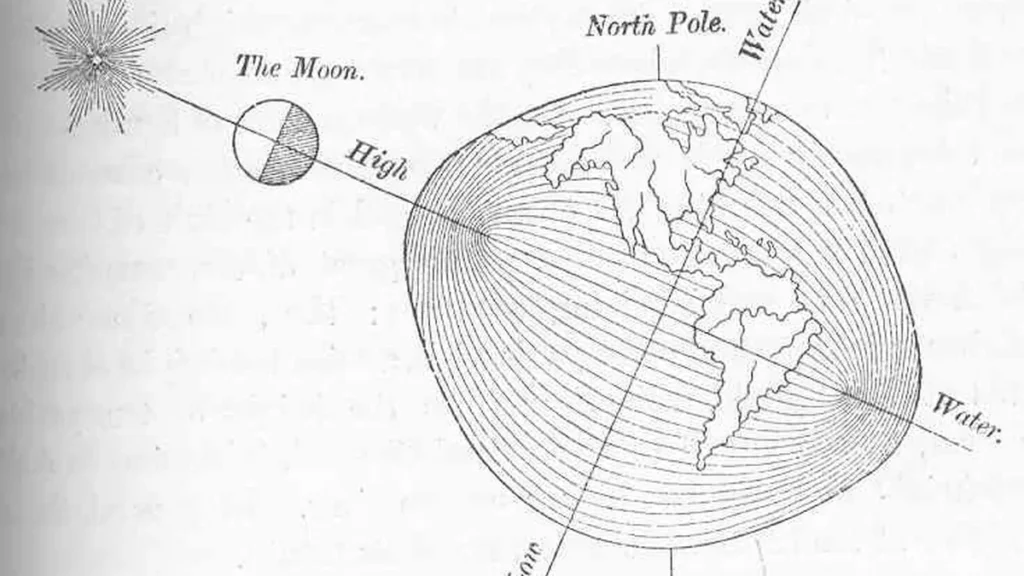
Muhittin Cenk Eser, a mathematician at Freie Universität Berlin, published a study in 2026 that merges Newtonian gravity and Einstein’s general relativity into a single mathematical model to search for relativistic traces in lunar tides. Newtonian gravity has predicted lunar and solar tides accurately for centuries, while general relativity describes gravity as dynamic and wave-based. The study tries to see if Einstein’s waves leave traces in the well-measured Earth–Moon system.
The paper is titled Frame Degeneracy and Sine-Quadrature Residuals in Lunar Tidal Modeling and appeared in The Astrophysical Journal in 2026 with DOI 10.3847/1538-4357/aeacd5. Eser, who works in the Department of Mathematics and Computer Science at the university, extended classical lunar tide modeling to include the cross polarization of gravitational waves. Both Universe Today and Phys.org name him as the study’s author.
Eser said the study makes no claim of discovering a new gravitational effect but demonstrates a targeted method for looking for one. He emphasized that researchers already understand and measure Earth–Moon tides precisely, making the system a useful place to search for small deviations from Newtonian predictions. “Our work brings both perspectives together and asks what traces of this might be found in high-precision measurements,” Eser said via a Freie Universität Berlin press release.
One issue the study addresses is separating possible added signals from measurement mistakes, reference-frame choices, and uncertainty about where the Sun, Moon, and Earth are located. The paper says researchers must control reference-frame selection, position-computation uncertainties, and systematic measurement errors before any remaining signal can be treated as a real physical effect. The work provides a quantitative basis for future searches for very small deviations from classical Newtonian descriptions of tides. “We are not claiming to have discovered a new gravitational effect,” Eser said.
Those future searches could use high-precision measurements of gravity and tides, geodetic observations, and lunar laser ranging. Lunar laser ranging sends laser pulses to reflectors on the Moon to measure the Earth–Moon distance precisely. Phys.org lists the method among the measurement approaches that future searches for tidal deviations could use.
Phys.org notes the method could open a new way to test general relativity by looking for possible signatures in immediate astronomical neighborhood rather than only through large cosmic events such as black hole or neutron star mergers. The outlet contrasts this local approach with past gravitational-wave astronomy, which has focused on distant mergers of black holes and neutron stars.
Universe Today explains that gravitational waves were originally predicted by Einstein’s Theory of General Relativity as ripples in spacetime caused by the merger of massive objects, and detection efforts have recorded thousands of GW events so far, most caused by mergers of black holes or neutron stars. GWs can also result from smaller gravitational interactions such as those produced by the Earth, Moon, and Sun. This possibility motivates looking for relativistic traces in the local Earth–Moon system rather than only in distant cosmic events.
Newton’s theory of gravity, published in Philosophiæ Naturalis Principia Mathematica in 1687, accurately described the motion of Earth’s tides and remained scientific canon for over three hundred years until Einstein introduced general relativity. Universe Today traces the historical arc from Newton’s 1687 magnum opus through more than three centuries of dominance to Einstein’s introduction of general relativity.
Universe Today notes that while Newtonian gravity calculates the Sun’s and Moon’s pull on tides with high accuracy, general relativity provides a fuller picture that includes gravitational waves. This contrast between the centuries-old tidal theory and the newer dynamic description of gravity underlies Eser’s effort to merge them into one testable model.


Join the discussion