Key facts
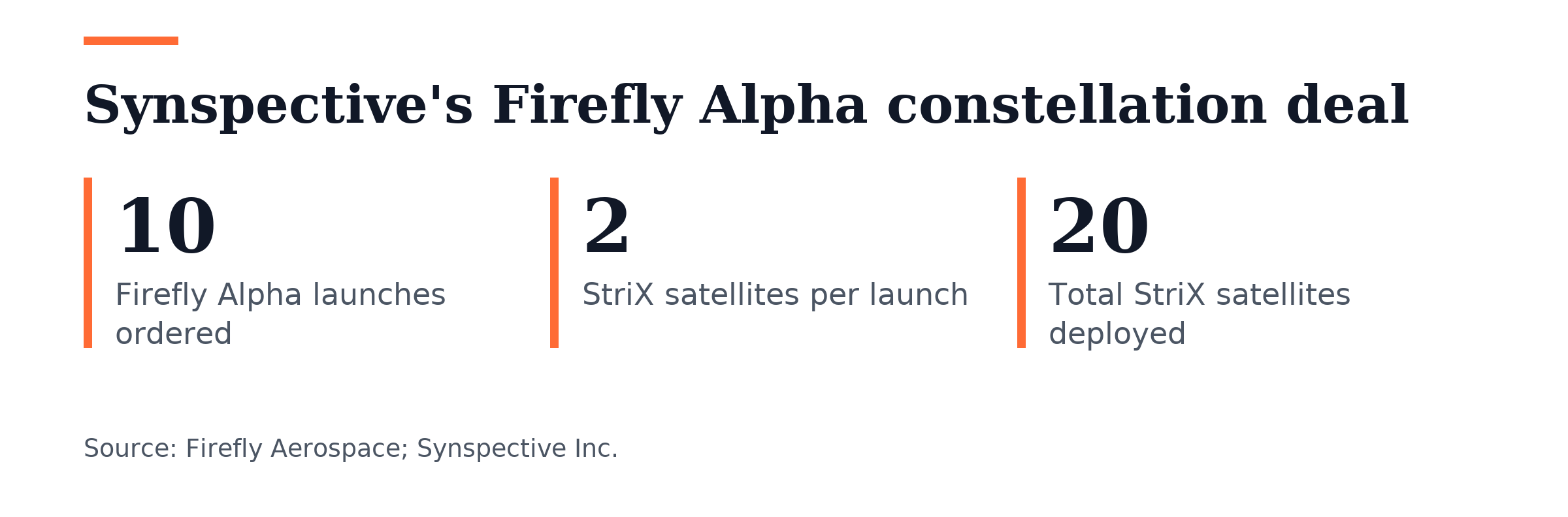
- Synspective Inc., a Japanese synthetic aperture radar provider, ordered up to 10 Firefly Alpha launches with missions planned through 2030.
- Synspective is a new international launch customer for Firefly Aerospace.
- Firefly will launch from Pad-0A at Wallops Flight Facility in Virginia and Space Launch Complex 2 at Vandenberg Space Force Base in California.
- Firefly states Alpha can reach low Earth orbit with 1,000 kg and describes this as 1-ton payload capacity.
Synspective Inc. ordered up to 10 Firefly Alpha launches with missions planned through 2030, the Japanese synthetic aperture radar provider and Firefly Aerospace announced Nov. 10, 2026, from Cedar Park, Texas. Both companies published press releases that day.
SAR satellites gather images of Earth‘s surface regardless of time or weather. Synspective develops and operates these satellites and provides data analytics for high-frequency, high-resolution Earth observation, serving disaster response, national security, and energy and infrastructure monitoring. Synspective’s own release describes the company and constellation behind the StriX satellites.
The deal covers up to ten dedicated Alpha missions ending in 2030. Synspective becomes a new international launch customer for Firefly Aerospace. Jason Kim, Firefly’s CEO, said the company is proud to add Synspective as an international customer. Synspective’s own release described Firefly as a long-term customer.
Every Firefly Alpha mission will carry two Synspective StriX SAR satellites, deploying up to 20 total satellites through 2030. Firefly dedicates each mission to Synspective’s payload. Firefly states Alpha can carry 1,000 kilograms to low Earth orbit, allowing two StriX satellites per flight. Synspective says flying two satellites at once doubles the number deployed per launch versus single-satellite missions, and Firefly describes the 1,000-kilogram capacity as 1-ton payload capacity.
The two-satellite cadence doubles Synspective’s deployment pace compared to single-satellite missions. Firefly and Synspective both describe the two-satellite cadence as a faster way to grow the StriX fleet. Synspective’s own release calls it an efficient path to scale the constellation. Dual-coast launch access gives Synspective flexible access to a range of orbital inclinations for its StriX constellation.
Firefly will launch from Pad-0A at Wallops Flight Facility in Virginia and Space Launch Complex 2 at Vandenberg Space Force Base in California. The agreement calls for launches from two U.S. coasts. Firefly says this dual-coast setup gives Synspective access to different orbital inclinations while building the constellation. Wallops and Vandenberg sit on opposite U.S. coasts.
Dr. Motoyuki Arai, Synspective’s founder and CEO, said scaling the constellation requires a diverse and resilient set of launch partners. Arai said Synspective needs several launch partners to grow at the speed its customers want. “Alpha’s payload class is well suited to our upcoming satellites, and its dual-coast access gives us valuable flexibility across orbital inclinations,” Arai said. He praised Firefly for working through development challenges and building an Alpha track record.
Jason Kim called the Synspective agreement a landmark showing growing customer confidence in the Alpha Block II vehicle and said Alpha fits customers seeking direct access to orbit. Kim made the remark in the Nov. 10, 2026 announcement as Firefly introduced Synspective as another international launch customer. “We’re proud to onboard Synspective as a long-term customer and accelerate their ability to rapidly scale their constellation,” Kim said.
Synspective’s StriX constellation is built to quickly monitor and confirm ground changes during national disasters such as earthquakes and floods. Its SAR satellites also track natural resources and urban development to support sustainable use of land and water. Firefly’s release explains the Earth-observation uses of the satellites being launched, tying launch cadence to disaster response. The same announcement frames the constellation as supporting efficient resource utilization alongside disaster monitoring, and SAR imaging works through clouds and darkness, which suits disaster monitoring.
Firefly’s dual-coast access from Wallops and Vandenberg complements Synspective’s existing launch arrangements as the StriX constellation is built out. Synspective frames Firefly as an addition to its current launch portfolio rather than a sole-source replacement.
Synspective is also a major Rocket Lab customer. It signed the largest commercial Electron contract last month for 20 launches, adding to two previous 10-launch deals.
Firefly has not set a date for the next Alpha launch, which will fly the full Block II configuration for the first time. During Q2 investor remarks, Jason Kim said the next Alpha flight targets the fourth quarter of 2026. The Synspective agreement runs through 2030, but the immediate Alpha schedule remains unfixed ahead of the Block II debut. The Block II vehicle is the version of the Alpha rocket that Kim cited as evidence of growing customer confidence, and its first full-configuration flight has no date yet.
Firefly Aerospace was established in 2017 and co-locates engineering, manufacturing, and test facilities in central Texas. The company was founded in Texas.
The agreement marks a cross-border customer relationship between a Japanese Earth-observation operator and a U.S. launch provider. Synspective gains dedicated U.S. launch capacity through 2030. Firefly gains a new international customer for its Alpha rocket. The deal gives Japan’s StriX operator access to two American spaceports.




Join the discussion