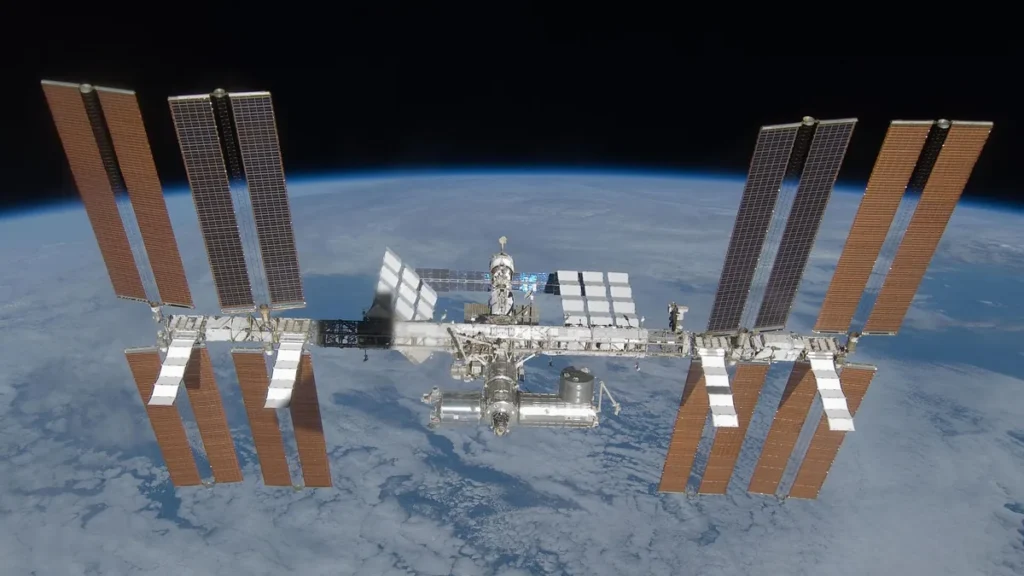
Key facts
- NASA astronaut Chris Williams and Roscosmos cosmonauts Sergey Kud‐Sverchkov and Sergei Mikaev launched from the Baikonur Cosmodrome in Kazakhstan on Nov. 27, 2025 aboard the Soyuz MS-28 spacecraft.
- NASA will welcome home the six-member Expedition 74 crew at a public event at Space Center Houston at 6 p.m. CST on Tuesday, Nov. 17, after their long-duration International Space Station mission.
- The Soyuz MS-28 mission was the first spaceflight for Chris Williams and Sergei Mikaev and the second space journey for Sergey Kud‐Sverchkov.
- Meir, Hathaway and Adenot launched on Feb. 13 aboard a Dragon spacecraft for the SpaceX Crew-12 mission from Space Launch Complex 40 in Florida.
NASA will welcome the six-member Expedition 74 crew home at a public Space Center Houston event at 6 p.m. CST on Tuesday, Nov. 17, 2026, following the crew’s long-duration International Space Station mission.
NASA astronauts Jessica Meir, Jack Hathaway and Chris Williams, ESA astronaut Sophie Adenot, and Roscosmos cosmonauts Sergey Kud‐Sverchkov and Sergei Mikaev will share mission highlights at the welcome event. Meir, Hathaway and Adenot flew to the station on Feb. 13, 2026 as part of the SpaceX Crew-12 mission, launching from Space Launch Complex 40 in Florida aboard a Dragon spacecraft. Williams, Kud‐Sverchkov and Mikaev departed aboard the Soyuz MS-28 spacecraft from Kazakhstan’s Baikonur Cosmodrome on Nov. 27, 2025. NASA said the Soyuz MS-28 trio was part of Expedition 74, and ScienceDaily confirmed the launch date.
The SpaceX Crew-12 mission lasted 237 days, covering more than 100 million miles and circling Earth more than 3,792 times. NASA said the Crew-12 trio spent more than seven months aboard the station before splashing down on Oct. 8 off the coast of Los Angeles. Williams, Kud‐Sverchkov and Mikaev came home on July 26, 2026, touching down under parachutes southeast of Dzhezkazgan, Kazakhstan, following 241 days in space, 3,856 Earth orbits and more than 102 million miles traveled. ScienceDaily reported the touchdown at 5:27 a.m. CDT on July 26 after station departure at 2:03 a.m., and said the crew later flew to Houston.
Chris Williams and Sergei Mikaev were first-time fliers on the Soyuz MS-28 mission, while Sergey Kud‐Sverchkov was making his second spaceflight. On Crew-12, Meir was flying for the second time and Hathaway and Adenot were first-time fliers.
NASA said Expedition 74 crew members devoted more than 1,400 hours to scientific research and technology demonstrations aboard the station. The effort included 3D-printing tests, human health studies, pharmaceutical research, plant studies, quantum instrument upgrades, spacecraft management and station maintenance. Tests of metal and tissue 3D-printing technologies advanced in-space manufacturing as part of the research and technology demonstrations credited to the crew.
The crew supported studies of human health during long-duration spaceflight, including blood flow research, piloting assessments under changed gravity and activation of a compact exercise system. NASA said these health studies were part of the crew’s research program during the long-duration International Space Station mission. The agency said the crew evaluated life-support and environmental systems needed for Artemis exploration missions, work that helps build a foundation for long-duration missions to the Moon and Mars under Artemis.
The crew pursued pharmaceutical work on the station. The work involved protein crystallization for cancer drugs and efforts to improve tumor targeting and grow therapeutic stem cells. NASA described this pharmaceutical work as part of the crew’s research and operational achievements aboard the International Space Station.

The astronauts also tended the first plants studied outside curated systems aboard the station. Crew members upgraded an instrument to advance understanding of matter and support development of new quantum technologies. NASA included this plant research and the instrument upgrade in its list of Expedition 74 scientific and operational achievements.
The crew managed visiting spacecraft and carried out essential maintenance to support continued operation of the orbiting laboratory. NASA said these operational tasks supported the orbiting laboratory alongside the crew’s dedicated research hours. Expedition 74 connected with students and audiences worldwide through live educational events, outreach activities and imagery sharing that highlighted scientific discovery and international collaboration. NASA said these outreach efforts extended beyond the crew’s research and operational achievements during the long-duration mission.
During the 241-day flight, Williams completed two spacewalks. The work included upgrades to the station’s electrical power system and repairs to a faulty Canadarm2 arm joint. ScienceDaily reported that Williams also contributed to cancer treatment research and investigated improved production of materials for high performance computers and electronics during the flight.
NASA said people have lived and worked continuously aboard the station for more than 26 years. Media representatives may request an in-person interview with the astronauts by 5 p.m. on Monday, Nov. 16 through the JSC Newsroom at jsc-newsroom@mail.nasa.gov, with crew availability before the Nov. 17 event. Andrey Fedyaev was part of Crew-12 but will not attend the Space Center Houston welcome event. NASA said Fedyaev would not be at the Nov. 17 event, noting his absence in an announcement about the Crew-12 members who launched on Feb. 13 and returned on Oct. 8.



Join the discussion