
Key facts
- NASA picked Viasat Inc. for Phase 1 of NEXUS under a fixed-price contract capped at $460.9 million.
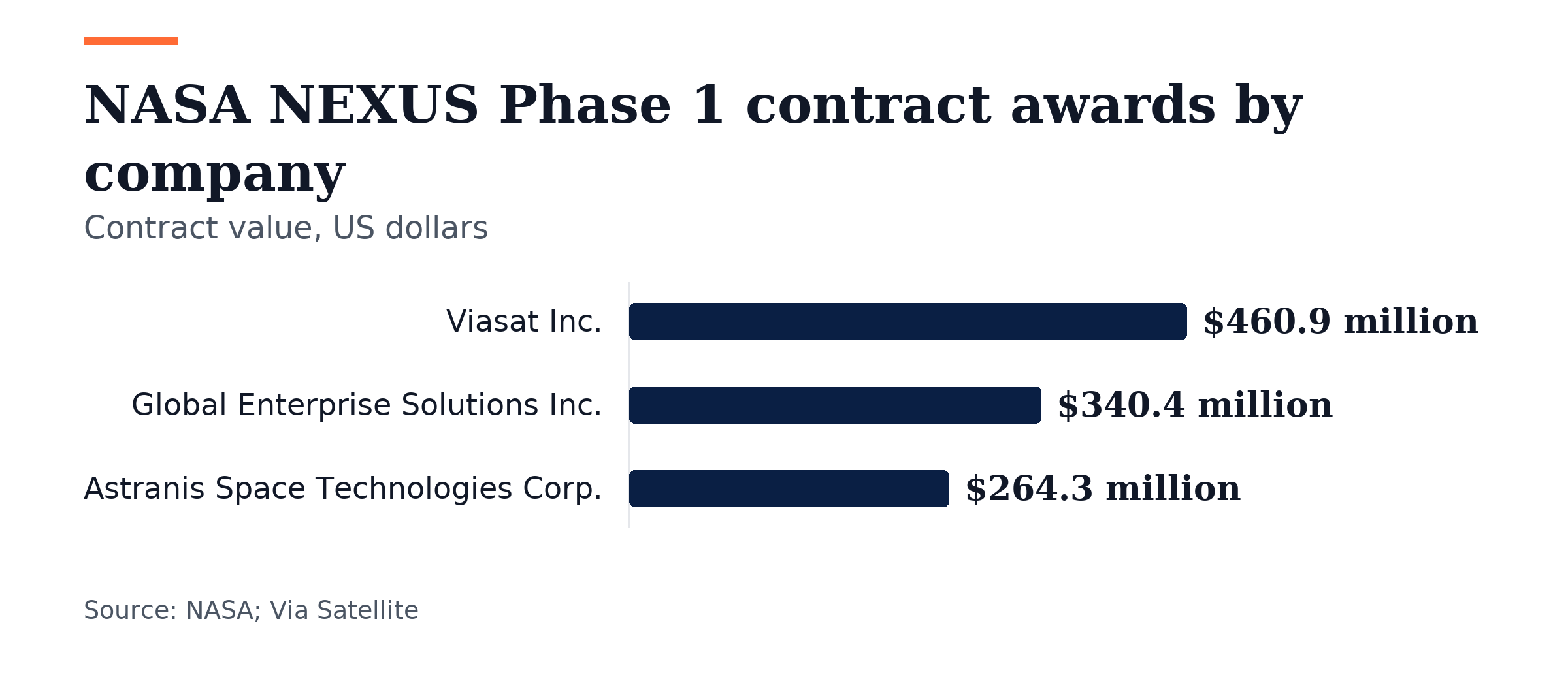
- NASA chose three companies for the first NEXUS phase, awarding Viasat Inc. $460.9 million, Global Enterprise Solutions Inc. $340.4 million, and Astranis Space Technologies Corp. $264.3 million.
- NASA is moving to commercial networks as TDRS retires.
- The initial work period for the NEXUS Phase 1 contracts runs from Nov. 4 through May 3, 2027.
NASA selected Viasat Inc. for Phase 1 of its NEXUS Ka-band, or high-frequency satellite radio, relay program on Nov. 4, 2026, awarding the company a fixed-price contract capped at $460.9 million. Viasat announced the selection on Monday, Nov. 9, 2026. The award falls under Appendix E of the Broad Agency Announcement for Next Space Technologies for Exploration Partnerships-3.
For the first NEXUS phase, NASA picked three companies on Nov. 4, 2026: Viasat Inc. at $460.9 million, Global Enterprise Solutions Inc. at $340.4 million, and Astranis Space Technologies Corp. at $264.3 million. The combined procurement totals $1.07 billion in Ka-band relay contracts. The firm-fixed-price contracts run from Nov. 4, 2026 through May 3, 2027, and priced options can extend the effort through 2029.
NASA is purchasing commercial capacity for 15 years while the TDRS relay network retires, and the shift covers legacy TDRS users. NEXUS is part of the Communications Services Project under NASA’s Space Communications and Navigation division, part of the agency’s move away from government-owned relay assets toward commercial space communications infrastructure.
The TDRS network relays data for missions including the International Space Station and the Hubble Space Telescope. The fleet stopped adding new missions in late 2024 and is expected to keep serving current missions into the mid-2030s.
NASA’s request seeks an end-to-end Ka-band relay service compatible with legacy TDRSS users across a span of at least 15 years, so current spacecraft can keep flying without hardware changes. NASA needs Ka-band services for select in-orbit missions that cannot feasibly modify flight hardware or switch to commercial services they are not compatible with. NASA wants to buy end-to-end Ka-band relay services as one customer among many in a commercial marketplace, without asking current spacecraft to change any onboard hardware. This need exists alongside commercial capabilities that industry partners are developing.
Viasat proposes a constellation of small GEO relay satellites compatible with legacy Ka-band transponders, where GEO means geostationary orbit. The company’s team will develop an end-to-end architecture for Ka-band relay connections with legacy TDRS missions during Phase 1. The design includes dedicated small GEO relay satellites along with ground systems, integration, launch management and operations.
It will meet NASA legacy requirements. It will also offer a scalable end-to-end service for future government and commercial customers. Viasat’s GEO relay solutions will support real-time telemetry, tracking and command for a low Earth orbit spacecraft at any point in its orbit, and its integrated segment will provide assured on-demand connectivity for human spaceflight missions and uncrewed satellites.
Under the BAA, the first phase lasts six months and covers concept maturation and risk reduction. One option runs up to two years and covers system integration, a flight demonstration, and checks that verify and validate capability. A third option runs up to six months for more demonstration, anomaly resolution, and service validation.
NASA may provide funds up to the award limit to shift the work from concept studies to an in-orbit flight demonstration. Future NEXUS phases across the next three years will fund spacecraft development, a launch, and an in-orbit demonstration of a high-performance backward-compatible relay network, to show that commercial space communications work before NASA formally decommissions TDRS.
John Reeves, Vice President of Space and Mission Systems at Viasat Government, said NEXUS shows a major evolution toward space communications services provided by commercial companies. He said Viasat’s expertise will supply resilient Ka-band relay capability for legacy NASA missions and future ones.
Viasat’s NEXUS participation grows out of work with NASA’s Space Communications and Navigation division on multiple programs. The agency awarded CSP contracts to SES and also to Viasat in 2022 to look at commercial replacements for TDRS, and those earlier agreements laid groundwork for the current round of Ka-band relay competitions.
Viasat launched the Maxwell spacecraft on Oct. 20, 2026 at 7:04 a.m. ET from Cape Canaveral Space Force Station, flying as part of the Bandwagon-5 rideshare mission with SpaceX. The October 2026 flight is Viasat’s second NASA CSP demonstration mission. Its first demonstration flew a launch telemetry relay solution on Blue Origin’s New Glenn launch during November 2025.
The Maxwell demonstration builds on two CSP contract awards worth $81 million and includes five months of testing in orbit through March 2027. Rocket Lab Corporation built the spacecraft at its Long Beach, California facility and supplied a new L-band radio.
Maxwell’s payloads include a Ka-band terminal for ViaSat-3’s network and an L-band terminal for Viasat’s global network. Demonstrations will use Viasat’s Real-Time Earth Ground-Station-as-a-Service for direct links to the ground in S-, X-, and Ka-band communications through March 2027. Viasat’s Ka-band and L-band services will provide low Earth orbit operators with real-time, low-data-latency communications for time-sensitive operations. The services aim at NASA needs and the growing market for on-demand links in low Earth orbit for government and commercial missions.
Viasat finished buying Inmarsat in May 2023. The NEXUS award follows Viasat’s Maxwell flight trials to show space-to-space links, and its integrated segment will provide assured on-demand connectivity for human spaceflight missions and uncrewed satellites.




Join the discussion