Key facts
- The Oort Cloud is a roughly spherical cloud of trillions of icy cometary bodies extending up to 1.6 light years from the Sun, and no direct observation of it is possible with present imaging technology.
- Muller says he still supports the Nemesis hypothesis, is not sanguine about directly observing Nemesis, and asserts there is no clear evidence against it.
- If Nemesis exists, it probably lies close to the plane of the ecliptic and would appear as a dim star of 8th or possibly 9th magnitude, making it difficult to spot and impossible to see with the naked eye.
- Muller says the next comet shower capable of causing serious damage to Earth should not arrive for another 12 to 15 million years.
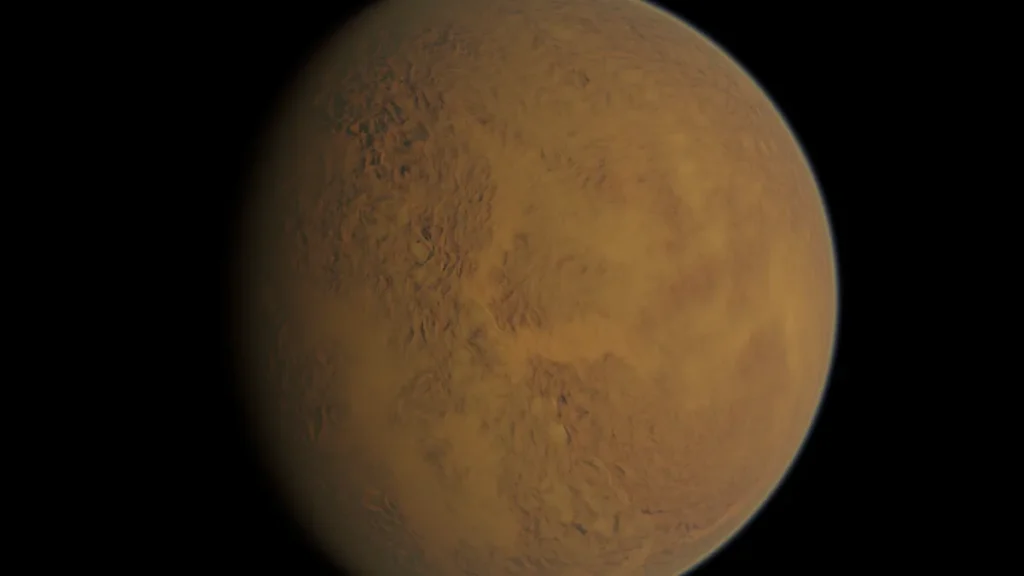
Physicist Richard Muller of the University of California Berkeley says the Sun may still have an unseen low-mass red dwarf companion called Nemesis, with both stars orbiting a shared center of gravity, an idea he first proposed in 1984.
Muller says Nemesis is not a random passing star but a bound companion whose elliptical path repeatedly brings it into the Oort Cloud, disturbing the cometary bodies there. Following an eccentric oval orbit, it periodically perturbs billions of comets in the outer solar system, with the strongest showers at closest approach. Each close approach can trigger a shower deflecting the maximum number of comets toward the inner solar system._
Muller estimates the next shower capable of serious damage to Earth will not arrive for another 12 to 15 million years. He says the companion must be at least five percent of the Sun’s mass, probably lies close to the plane of the ecliptic, and would appear as a dim star of 8th or possibly 9th magnitude, impossible to see with the naked eye and probably lost in a crowded field of other stars. Muller says he still supports the Nemesis hypothesis, is not sanguine about directly observing Nemesis, and asserts there is no clear evidence against it._
A present-day companion could also be a brown dwarf, an object too big to be a planet and too small to sustain hydrogen fusion, glowing softly in infrared and almost invisible in visible light. Discoverwildscience frames a hidden twin as a possible factor in Earth’s habitability, balancing the frequency of catastrophic impacts against the occasional evolutionary reset they provide.
Muller says Nemesis accounts for 250 million years of periodic Earth impacts, citing a 1982 Science paper by David Raup and Jack Sepkoski that found a strong 26-million-year period in extinction data. He links one extinction peak 66 million years ago at the KT boundary to a companion passing near the Oort Cloud on that cycle. Most scientists think the KT extinction was probably caused by a large asteroid striking the Yucatan Peninsula. Muller disputes the asteroid consensus, saying Walter Alvarez could not tell whether the impactor was a comet or an asteroid._
Researchers have found no evidence of Nemesis to date, and many lines of evidence including crater counts have thrown its existence into doubt. Scientific analysis no longer supports the idea that Earth’s extinctions happen at regular repeating intervals. The hypothesis has fallen out of favor since 1984, after multiple surveys and studies found no such star. The Sun is currently solitary, and a present-day companion could have destabilized planetary orbits and made Earth inhospitable to life.
Extensive sky surveys including infrared missions built to find dim cool objects have not found convincing evidence for a Nemesis-like star on the proposed orbit. NASA announced in 2014 that the WISE survey ruled out any object matching the definition of the hypothesized Jupiter-mass Tyche companion; the mission was capable of proving or disproving that hypothesis. Infrared surveys of the past couple of decades have found many cool, dim objects within a few dozen light-years, but no clear massive companion in an obvious bound orbit around the Sun.
The Oort Cloud is a roughly spherical cloud of trillions of icy cometary bodies extending up to 1.6 light years from the Sun, with no direct observation possible using present imaging technology. It is thought to be the source of long-period comets, though its exact size, shape, and population remain unanswered and are inferred mainly from highly eccentric comet orbits. Sean Raymond of France’s Bordeaux Astrophysical Laboratory says the cloud’s icy bodies come from planetesimals in the Sun’s disk, from other stars in the birth cluster, and from captured interstellar objects.
Room The Space Journal of Asgardia puts the rate at about one Oort Cloud comet a year entering the inner solar system, with passing stars occasionally tugging objects onto inward journeys lasting 1 million years or more. The Sun’s gravitational frontier extends to nearly 3.8 light years, or roughly 241,000 astronomical units, each the distance from Earth to the Sun.
The Sun orbits the Milky Way roughly once every 230 million years and is currently an isolated star, with the nearest star, Proxima Centauri, 4.2 light-years away. Many stars exist in binary pairs; the closest example, Alpha Centauri A and B, orbits at about 24 times the Earth-Sun distance, or 3.6 billion miles, making the Sun’s solitary status unusual.
About half of all Sun-like stars are in binary or multiple systems, a fraction higher for very massive stars, while roughly 60 percent of known stars are solitary, mostly small red dwarfs, and up to 80 percent of the most massive stars are in binary or multiple systems. Computer models of star formation show that collapsing gas clouds often break apart into several clumps, and each clump can light up as a star.
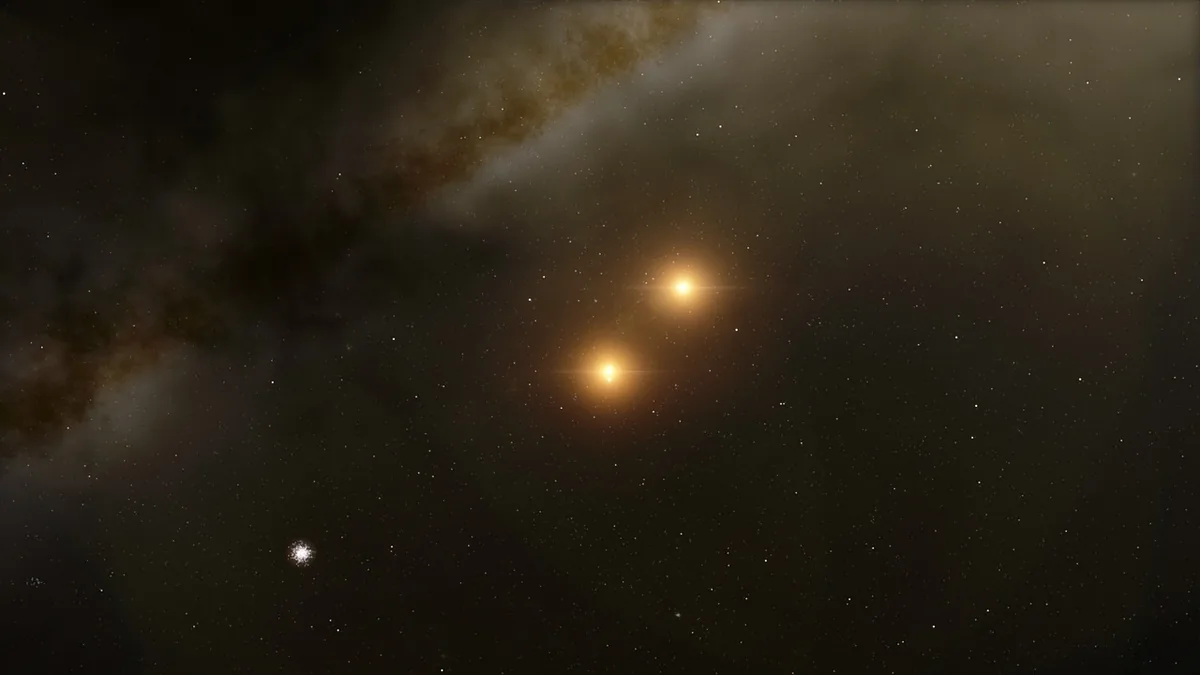
Gongjie Li of the Georgia Institute of Technology says it is definitely a possibility that the Sun was once a binary star because binary systems are common across the galaxy. Sarah Sadavoy of Queen’s University says that if the Sun formed with a companion, it was lost, a separation that happens quickly compared with stellar lifespans.
The strongest known candidate for the Sun’s long-lost sibling is HD 186302, a G-type yellow dwarf about 185 light-years away in Pavo, with roughly 97 percent of the Sun’s mass and 95 percent of its radius. Researchers started with more than 17,000 stars in the AMBRE survey, narrowing by metallicity to 55 candidates, then to 12 by chemistry, then to four by age: HD 52456, HD 126829, HD 176535, and HD 186302. Gaia DR2 trajectory modeling left only HD 186302 matching both the chemical and orbital criteria, and astronomers have not confirmed whether it hosts planets.
A 2026 theory from Harvard scientists Avi Loeb and Amir Siraj proposes that the Sun may once have had a binary companion of similar mass in its birth cluster, which could explain the Oort Cloud and suggest Planet Nine was captured rather than formed in the solar system. Passing stars in the birth cluster would have removed any early companion through gravity after the solar system captured its outer envelope of objects, including the Oort Cloud and the Planet Nine population. The Sun’s birth cluster may have spawned between 2,000 and 20,000 stars about 4.6 billion years ago.
In 2020, Harvard astrophysicist Amir Siraj suggested the Oort Cloud might contain an imprint of a former companion star, potentially producing more dwarf planets like Pluto and helping capture a Neptune-sized Planet Nine. He says it is hard to produce the observed number of objects in the furthest reaches of the Oort Cloud without a companion star._
Caltech planetary scientist Konstantin Batygin says a binary companion is not required to explain the Oort Cloud, which can be explained by the Sun forming in a cluster with Jupiter and Saturn ejecting objects. His simulations suggest a companion could trap scattered objects in the inner Oort Cloud, and he says Planet Nine can be explained by passing stars in the birth cluster rather than requiring a binary companion. Batygin also suggests the Sun’s tilt of about seven degrees relative to the plane of the Solar System might be naturally explained by the gravitational pull of an early companion, an effect seen in other binary stars throughout the galaxy.
Avi Loeb said on Nov. 4, 2026 that binary systems are far more efficient at capturing objects than single stars. Amir Siraj said previous models had difficulty producing the expected ratio between scattered disk objects and outer Oort Cloud objects, and that the binary capture model offers significant improvement. Siraj also said objects in the outer Oort Cloud may have played roles in Earth’s history, possibly delivering water and causing the extinction of the dinosaurs, while Loeb said the model predicts there should be more objects with a similar orbital orientation to Planet Nine._
The Vera C. Rubin Observatory, which saw first light in early 2021, is expected to determine whether Planet Nine exists and where it came from, and to map the Oort Cloud in detail over ten years to look for a binary companion’s thumbprint. Astronomers hope these detections will clarify the structure and population of the distant cometary reservoir, and Rubin offers the best near-term chance of characterizing the cloud by detecting more long-period Oort Cloud comets._
The European Gaia mission is mapping the positions, motions, and brightness of well over a billion stars, and researchers are using it with chemical fingerprints to search for solar siblings that share the Sun’s composition and birthplace. A few promising candidates have been found, but none has been confirmed as a definitive solar sibling. Room The Space Journal of Asgardia lists 3I/ATLAS, which passed through the solar system in 2025, alongside 1I/’Oumuamua, detected in 2017, and 2I/Borisov, detected in 2019, as visitors from other planetary systems.
Avi Loeb and Amir Siraj propose that such a companion helped capture the Oort Cloud and Planet Nine, while Konstantin Batygin says both can be explained without one. Rubin is expected to map the Oort Cloud in detail over ten years, and Gaia continues its search for confirmed solar siblings._




Join the discussion