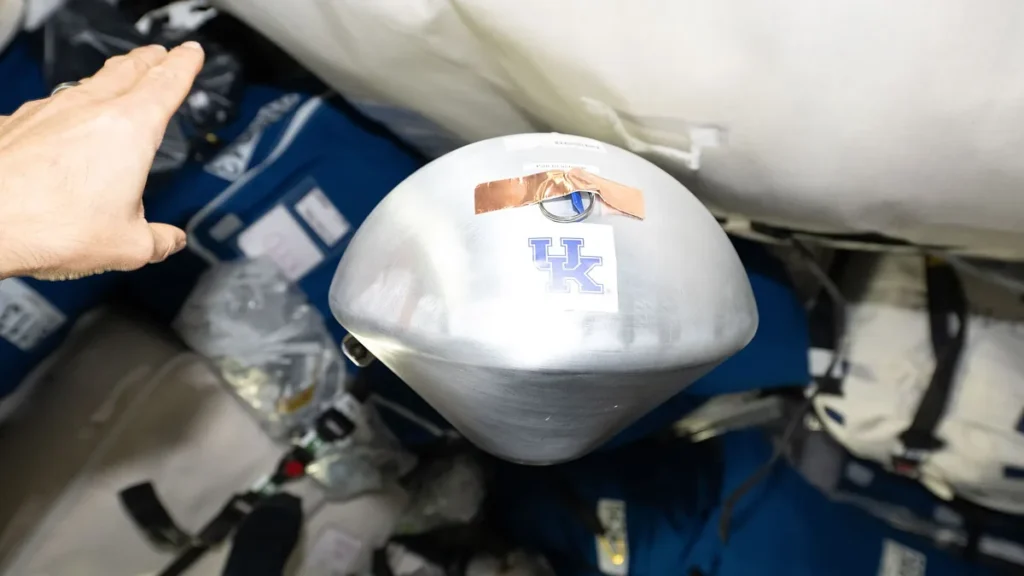
University of Southern Queensland researchers recorded a spacecraft breaking apart in the atmosphere above the Pacific Ocean on Oct. 12, 2026, using an airborne imaging spectrometer during the Kentucky Re-entry Probe Experiment-3 campaign, the university announced from Toowoomba, Australia, on Thursday, Nov. 5, 2026.
University of Southern Queensland said the flight gathered real-time spectral readings as 12 experimental capsules came back through the atmosphere under the Kentucky Re-entry Probe Experiment-3 campaign. 11 capsules tested thermal protection systems for the University of Kentucky, and the University of Stuttgart contributed one capsule assessing heat-shield materials in severe aerodynamic heating. The Kentucky capsules built on operational testing flown from the International Space Station during earlier KREPE missions.
Dr. Byrenn Birch fitted four observation payloads on the aircraft with researchers from the University of Kentucky and the University of Stuttgart, and with Zafiro Systems. The group flew from Rarotonga in the Cook Islands on a modified business jet backed by iLAuNCH, the Australian government’s Trailblazer program run by the university. The crew had only two days to fit scientific equipment in the aircraft, then align instruments and configure computers, GPS systems and timing equipment for the brief re-entry. Every team in the campaign spotted the craft soon after it rose above the horizon.
The centerpiece was a custom-built CTIS — a computed tomographic imaging spectrometer that records spatial and spectral information together — developed under an Australian Research Council Discovery Early Career Researcher Award, and it separated multiple breaking fragments at once. Ordinary cameras record three primary color channels, while the UniSQ instrument gathers spatial and spectral data across more than 500 wavelengths at once in one exposure. The package added a tracking camera and a conventional slit imaging spectrometer, plus a filtered camera set to follow carbon emission signatures from heat shields breaking apart. Because it gathers spatial and color data in one frame, researchers can tell light from individual objects apart when many fragments appear together, a capability with potential uses in hypersonic flight testing and aerospace engineering, plus space situational awareness, which means tracking objects in orbit and as they re-enter.
The university said analysis of the hyperspectral data will refine computer models of how spacecraft break up aerodynamically, help qualify novel thermal protection systems and support tracking of orbital debris survival. It also said detailed examination of the KREPE-3 information is continuing, and that the information may help researchers build better spacecraft, sharpen forecasts of re-entry and create tools that reduce danger to people and the environment. The iLAuNCH media release calls the capture a world-first demonstration of what Australian-developed technology can offer future international aerospace research, and said it helps move advanced Australian research from the laboratory into real aerospace capabilities.
University of Southern Queensland research released on Feb. 16 and 18, 2026 found that even large space objects can retain as much as 40 per cent of their mass through re-entry. The same work found that around 98 per cent of rocket bodies over 500kg fly over Australia while in orbit. Dr Byrenn Birch said debris shows that melted metal from one section of a satellite or rocket can influence other fragments during breakup, overturning the idea that liquefied material is done for good. The research also said current forecasting rests on simplified models with large uncertainty that may miss important physics during severe heating and aerodynamic forces, and because no single facility anywhere can fully recreate re-entry heat and airflow, the work depends on specialised experiments in Australia and Germany.
The Australia–Germany research said UniSQ will run aerodynamics simulations in its HypR group hypersonic wind tunnel, while the PWK4 plasma wind tunnel at University of Stuttgart, run by HEFDiG, will reproduce re-entry heat to show how materials melt. The team pairs Dr Byrenn Birch and Professor David Buttsworth with two early career researchers through the Australia–Germany Joint Research Cooperation Scheme of Universities Australia and the German Academic Exchange Service. The iLAuNCH release said the effort demonstrates why funding advanced research and global partnerships matters for Australia’s work in hypersonics, spacecraft re-entry research and advanced imaging technologies.
University of Southern Queensland has flown similar airborne re-entry imaging before. A team led by Associate Professor Fabian Zander recorded the return of Varda Space Industries’ W-2 capsule and the spacecraft that carried it over South Australia on March 3, 2025. It landed at 1.02am local time on a Friday after spending 45 days in orbit, on a Southern Launch mission with an Air Force Research Laboratory spectrometer and a heatshield developed with NASA. Dr Andrew Lock led a ground group at two sites roughly 125km apart, while Zander and Birch flew on a private jet funded through the UniSQ-led iLAuNCH Trailblazer program.
Dr Byrenn Birch said researchers from Australia deliver technologies to major international aerospace missions with capabilities found nowhere else. Birch, a senior lecturer in thermofluids engineering at the university, described the KREPE-3 flight as a chance to demonstrate Australian technology alongside leading international spacecraft re-entry researchers.
Associate Professor Fabian Zander said filming the March 2025 re-entry event as it happened gives researchers a rare opening to test and improve scientific models. Zander led the airborne effort on that mission with Dr Byrenn Birch.


Join the discussion