Key facts
- Thermodynamics and entropy normally block a non-rotating black hole from splitting because forming two smaller black holes would lower total entropy.
- The two newborn black holes must move apart instead of falling back together, and this rule leaves room only for holes spinning near their maximum possible rate.
- If a black hole splits, its horizon traces a shape through space and time that looks like trousers, with one top part splitting into two legs.
- Thermodynamic permission or favor for a split does not by itself prove that the breakup can physically take place.
A team at the University of Southern Denmark, the University of Naples Federico II, and a joint CNRS and Sorbonne Université laboratory in Paris found a possible opening in the rules that keep black holes intact on November 2, 2026, suggesting that black holes spinning fast could split into two.
Giacomo Cacciapaglia, Manuel Del Piano, Francesco Sannino and Vania Vellucci wrote the paper. They work at the University of Southern Denmark, the University of Naples Federico II, and a joint CNRS and Sorbonne Université laboratory in Paris.
Giacomo Cacciapaglia works as a researcher with the French National Centre for Scientific Research at the Laboratoire de Physique Théorique et Hautes Énergies, a joint CNRS and Sorbonne Université laboratory in Paris. Francesco Sannino directs the Quantum Field Theory Center at the University of Southern Denmark, and he also holds positions at the Danish Institute for Advanced Study and Durham University.
The laws of thermodynamics and entropy normally stop a non-rotating black hole from dividing because two smaller holes would leave less total entropy than the original. The area theorem put forward by Hawking in 1971 says a black hole’s event horizon surface area can never shrink. Researchers studying the GW250114 gravitational-wave collision confirmed this law with high precision last year.
In general relativity, the horizon area of a non-rotating black hole increases as the square of its mass, so splitting it into two would leave the total area below the original. Physical law demands that total entropy not decrease, so a stationary black hole does not split. Compared with a non-rotating black hole of the same mass, a rotating black hole holds less entropy and a smaller horizon area, and that stored energy alters the conditions for possible final states.
When a rotating black hole splits and converts its spin into orbital motion for two fragments moving apart, the entropy of the two resulting black holes can match or exceed the value it started with. Turning spin into outward motion supplies the entropy needed to avoid a net decrease when the horizon splits.
The two newborn black holes have to move apart instead of falling back together, and gravity pulls the newly formed twins toward each other, so the fragments need outward momentum and energy to escape. This rule leaves room only for holes spinning near their maximum possible rate. Francesco Sannino said, “But the two resulting black holes must also be able to separate rather than immediately fall back together.”
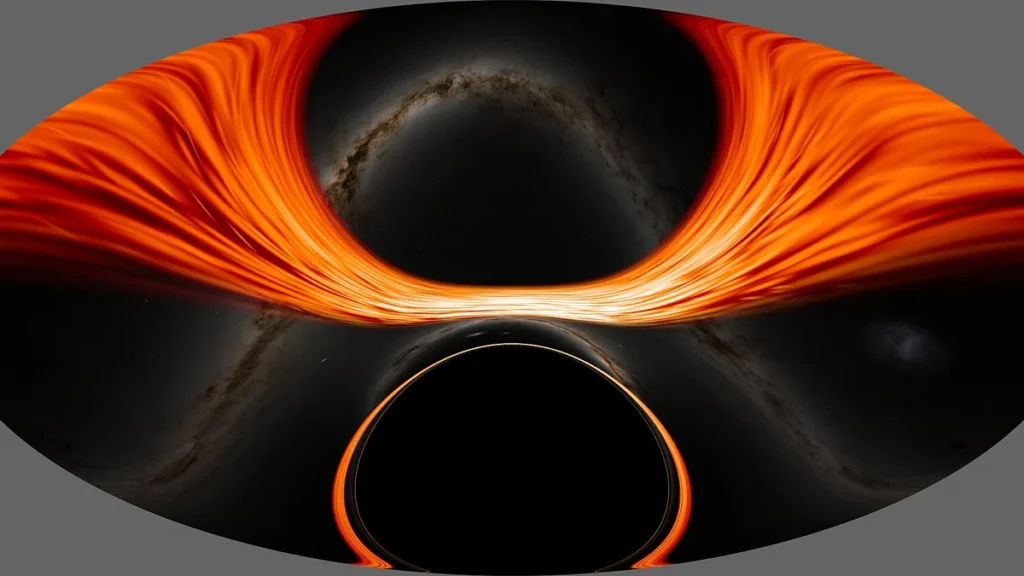
When a black hole splits, its horizon follows a shape through space and time resembling trousers, with one upper section dividing into two legs. The boundary starts as one structure and then splits into two separate branches over time.
This research describes theoretical possibilities in alternative gravity and exotic conditions, and a mathematical opening does not mean nature uses it. Even if thermodynamics permits or favors a split, that does not by itself prove the breakup can physically take place.

Theories that include extra spatial dimensions allow black-hole-like objects to become unstable and break apart, and splitting is more favorable when the resulting objects differ greatly in size. The writers label these outcomes as theoretical possibilities instead of confirmed descriptions of the universe. In higher dimensions, gravity permits elongated objects called black strings that can develop bulges joined by thin necks like beads on a thread.
One alternative-gravity case describes a black hole with ten solar masses shedding a second black hole of roughly 20 billion kilograms while raising total entropy. The team expects small primordial black holes to split more easily than far larger astrophysical black holes. Primordial black holes are hypothetical objects from the early universe.
As of October 25, 2026, astronomers had not observed a black hole dividing into two, and the researchers said they could not give a general probability for such an occurrence. Francesco Sannino said on October 29, 2026 that the team cannot yet give a single probability for a black hole to split, since the answer depends on how gravity behaves beyond Einstein’s theory.
When spin is near its maximum, the calculation still leaves intact the classical rule that bars genuine horizon splits under ordinary conditions. If the right conditions exist, vortices can form in unusual matter surrounding a black hole, changing its event-horizon shape and entropy in ways that could make splitting favorable.
A spinning black hole may amplify passing radiation by drawing on its rotational energy, and trapped radiation could build up enough intensity to create a separate black hole powered by the original’s spin instead of splitting it. Instruments such as the Fermi-LAT gamma-ray telescope might search for signals from small black-hole fragments created during mergers.
As of October 29, 2026, Hawking radiation from black holes remained unconfirmed, and primordial black holes from the early universe were also unverified. Sannino and colleagues looked at hypothetical black-hole morsels produced during mergers in a paper from 2025.
If astronomers detect a black hole shedding a smaller cousin, that observation could serve as a clue that Einstein’s theory of gravity needs revising. The study’s calculations offer another route for probing the limits of current understanding of gravity and black holes by testing where splitting restrictions fail.

Join the discussion