Key facts
- An international team published research in the Journal of Geophysical Research: Planets examining how seasonal changes affect Martian polar ice deposits in craters near the north pole.
- Researchers examined images of 36 craters within Mars's northern polar ice cap region taken by NASA's Mars Reconnaissance Orbiter HiRISE camera between 2006 and 2025.
- Bright deposits changed in 32 of the 36 craters, broadly indicating that ice deposits expand and shrink with the seasons.
- Frost coverage does not change in every crater from one Mars year to the next; only some craters show altered conditions while others keep frost extents similar or nearly identical.
A research team released findings in the Journal of Geophysical Research: Planets on how seasonal frost alters ice deposits in craters across Mars’s northern polar ice cap, drawing on images captured between 2006 and 2025. The investigation aimed to track whether polar ice on crater floors accumulated during winter and receded during summer, addressing a longstanding gap in knowledge about seasonal shifts in polar ice, particularly within craters.
The researchers analyzed 36 craters imaged by NASA’s Mars Reconnaissance Orbiter’s High Resolution Imaging Science Experiment, or HiRISE, camera. The imagery spans Mars Years 28 through 38, given that a Martian year runs 668 Earth days. In 32 of the 36 craters, bright deposits shifted, broadly indicating that ice deposits grow and contract with the seasons. Among the four remaining craters, researchers detected no brightness changes, and seasonal frost on the exterior of each crater may account for some of the observed shifts.
Not every crater shows shifting frost coverage from one Mars year to the next; some craters display altered conditions while others maintain frost extents that are similar or nearly identical. This uneven year-to-year pattern supports the notion that frost cycles operate locally rather than uniformly across the cap. According to the researchers, seasonal frost cycles and the long-term ice balance operate as localized processes rather than as cap-wide phenomena.
The research indicates that crater ice changes result from local climate shifts instead of from larger planetary climate shifts. Mars experiences far larger climate swings than Earth because its tilt varies much more, yet local climates can still generate changes independent of the larger picture. A crater holding more or less frost is not necessarily an indicator of a planet-wide shift. Identifying the triggers, whether seasonal or otherwise, is central to reconstructing Martian climate history, and local variation means individual crater changes do not signal a global shift.
The study‘s findings rest on image analysis, and researchers describe the localized explanation as likely rather than settled, though it provides motivation for future modeling of localized Martian climates. Improved understanding of seasonal shifts in polar ice deposits could assist scientists in gaining insights into long-term climate changes on Mars.
Both of Earth’s polar ice caps consist of water ice, whereas Mars’s north polar cap consists entirely of water ice and its southern polar cap consists of carbon dioxide, with the difference tied to altitude. Mars’s northern polar ice cap ranks among the most studied regions of the planet, primarily because of its water ice composition, making it a major focus of research. Mars and Earth share landforms and weather patterns, including changing seasons, volcanoes, canyons, dust storms, dust devils, and water ice, making the two worlds a natural point of comparison despite their vastly different atmospheres.
In a separate line of research, a University of Washington study published in npj Space Exploration found that the top layer of Martian polar ice at the north pole contains roughly 3% dust, far below the previous estimate of 25%. The error in the previous estimate stems from a calculation technique originally developed to study lunar regolith, the loose material covering the Moon’s surface. Pari Mohan, a recent University of Washington geoscience graduate, collaborated with Aditya Khuller to redo the calculations using a different method.
The revised method draws on an approach developed by Steve Warren, University of Washington professor emeritus of Earth and space science and an expert in analyzing snow and ice, which researchers used successfully for decades on Earth before the team adapted it for Mars. After adapting an Earth-tested snow and ice method for Martian conditions, the team applied the new framework to six locations at the Martian north pole. Aditya Khuller noted the significance of the finding: “We know there is water ice in the area surrounding the north pole of Mars.”
The lower dust estimate matters because dust darkens ice, altering how much sunlight reflects into space. As Khuller explained, “If it is dustier, the ice will be darker.” Major dust storms buffet Mars, and the dust darkens ice, changing how much sunlight reflects.
At Mars’s north pole, dustier ice layers sit between cleaner ice slabs, and those layers shift with the seasons. Dustier, darker ice forms in winter on Mars and vaporizes faster during summer, revealing cleaner, older ice. Beyond the poles, a dusty surface layer buries most of Mars’s ice. The layers hold a record of Martian climate from thousands of years ago, when scientists believe snowfall built the ice.
The cleaner, older ice below the surface could signal past atmospheric pressure changes that reduced dust storm effects. It remains difficult to determine precisely how dust becomes incorporated into north polar ice, though best estimates now suggest a lower dust proportion than expected. The Mars Phoenix mission successfully collected ice samples near the planet’s north pole in 2008, and the Phoenix sample and other samples that followed led scientists to realize that a layer of dust buried Martian ice.
NASA celebrated the 50-year anniversary of its first successful mission to Mars, and the Polar Lander went missing near the south pole in 1999 before Mars Phoenix successfully sampled ice near the north pole in 2008. Mars experiences major ice ages that deposited shallow ice across roughly one-third of the planet. The gravitational pull of its moon stabilizes Earth’s climate, while Mars, with only two small moons, oscillates wildly, which causes dramatic ice ages.
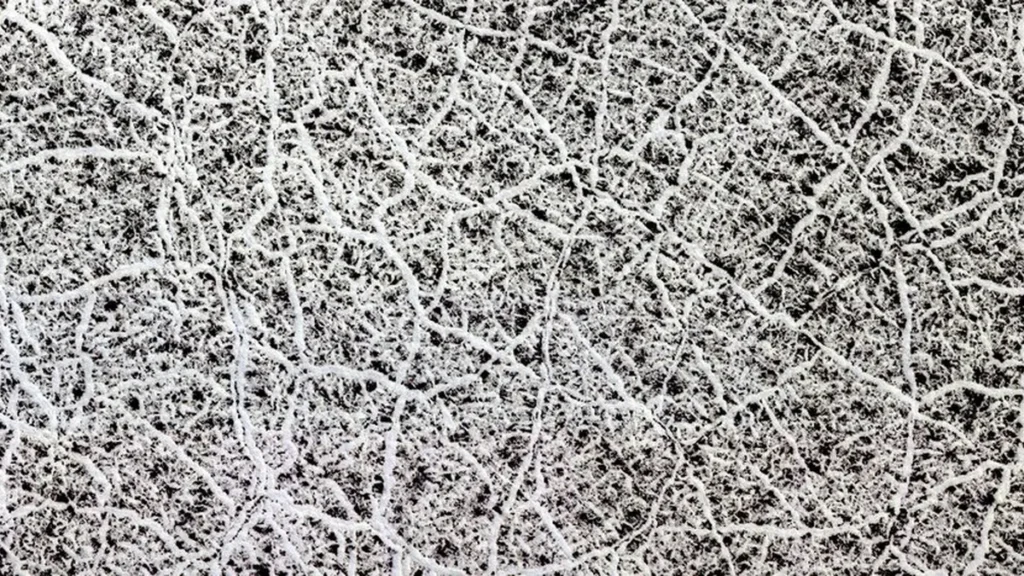
During past climates, ice filled many Martian impact craters, and some ice later flowed or slumped down crater walls toward the center, forming concentric wrinkles. Polygonal cracks in icy crater material arise because underground ice expands and contracts heavily during warming and cooling cycles. Smaller polygons nested inside larger ones are younger and have shallower cracks, while the large polygons have cracks that penetrate more deeply. Scientists can observe similar polygonal cracks in icy areas of Earth and other icy locations on Mars, highlighting another parallel between the two planets.
Dark dust and ice layers could trap sunlight to create meltwater pockets that might potentially shelter bacteria and simple life. Similar pockets of shallow, dusty meltwater found in ice on Earth are often teeming with life during the summer, and in winter the liquid water freezes and microbes become dormant until the next summer. Studying Martian ice is essential to investigating how Earth and Mars share weather and geological patterns despite having vastly different atmospheres.
Aditya Khuller hopes to apply the improved dust-analysis methods to other regions of Mars. The study offers motivation for future modeling work that could expand understanding of localized climates on Mars. Uncovering details about Martian climate deepens understanding, though answering questions about life may take years.


Join the discussion