Key facts
- The FY2027 Golden Dome request is $17.5 billion, with only $398 million in the regular base budget and roughly 97 percent depending on a second reconciliation package.
- The House is scheduled to return August 31 and the Senate September 14, and the chambers must reconcile competing continuing resolutions running to December 4 or December 11.
- The Congressional Budget Office estimated roughly 7,800 satellites are needed for continuous boost-phase coverage based on low-Earth-orbit geometry at 300 to 500 kilometers.
- Sen. Angus King said he wants to know what technology is being deployed, the cost, which parts of the country are protected and how decisions are made.
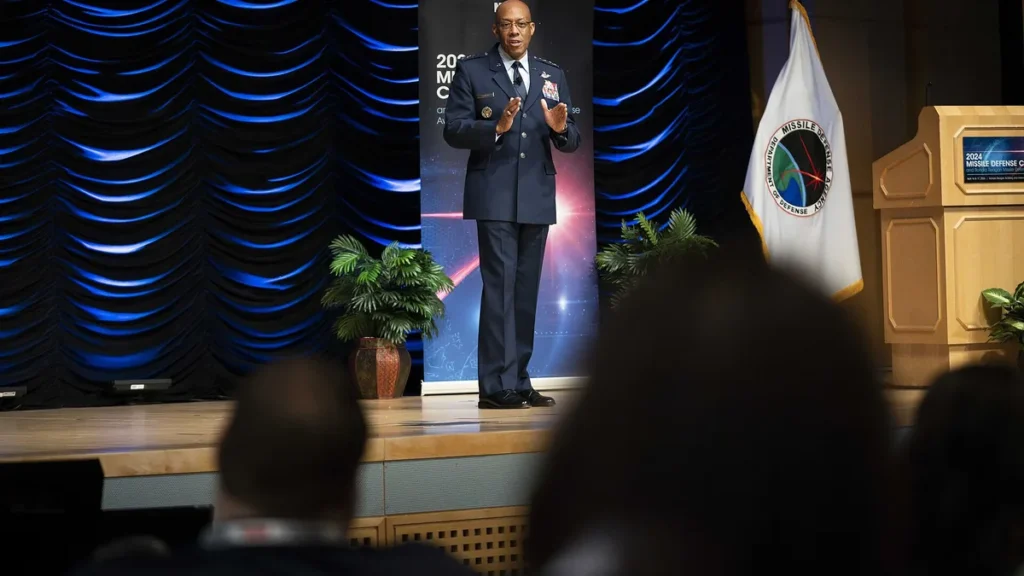
Momentus Chairman and CEO John Rood said Thursday that bipartisan support has not really been built for Golden Dome for America, while Jen Ross, who runs Breakwater Strategies and helped stand up the Space Force’s Commercial Space Office, said the program remains on track for a 2028 demonstration and that much of the technology needed for that milestone already exists.
Rood described the program as early still, perhaps chapter two or three of the journey. He credited Golden Dome’s structure, including a single program manager with unusual authorities modeled on Gen. Bernard Schriever’s ICBM effort, and said funding came through reconciliation rather than the regular budget. Rood also said Congress is late passing this year’s budgets and that there will probably be a big omnibus after the election, with the outcome anybody’s guess. He called Golden Dome a fraught journey, like the history of missile defense since the world’s first missiles in the ’40s.
Ross credited the program office with moving money quickly into the right hands and said she doubted politics would stop Golden Dome. She said she does not know if the word golden will always be in the front of dome but would not think any politician would say let’s not protect the homeland today.
The Pentagon puts Golden Dome’s architecture cost at $185 billion, with a first capability due in 2028. The Space Force is leading a prize competition among 12 companies to incrementally showcase space-based interceptor capabilities with the goal of an initial capability by 2028. Contractors completed Gate One focused on design and component-level testing, and providers appear to advance to Gate Two to build a prototype, Gate Three to prove capability in space, and Gate Four to show integration with the broader Golden Dome architecture. The Pentagon will not make operational requests for production capabilities until providers prove through the competition that capabilities are effective, scalable and affordable.
On Aug. 11, Gen. Michael Guetlein, who leads the Pentagon’s Golden Dome program, said uncertainty about the $350 billion reconciliation request could slow work on the homeland missile defense effort. Guetlein said that if Congress does not figure out funding for 2027, there is no Golden Dome because there is no funding. “Without continued funding, Golden Dome will stop with everything we’ve already built and delivered,” Guetlein said.
To fund the $185 billion program, the Pentagon has skipped the normal appropriations process and used reconciliation, which follows different rules and can pass both chambers by simple majority. Reconciliation is stalled in Congress; the House approved a slimmed-down $60 billion version of the White House proposal in July, and some Pentagon priorities could be funded through a separate $67 billion Iran war supplemental that is also in limbo.
The Senate passed a continuing resolution on Aug. 9 by a 90-6 vote to fund the government through Dec. 11, but that CR does not protect Golden Dome. Prospects for passing a standard appropriations bill by the end of the fiscal year on Sept. 30 have dimmed, with the House and Senate passing separate versions of a continuing resolution that would provide stopgap funding. The House returns Aug. 31 and the Senate Sept. 14, and the chambers must reconcile competing continuing resolutions running to Dec. 4 or Dec. 11. Neither CR version includes reconciliation money, so the Oct. 1 Golden Dome situation is unchanged regardless of which stopgap date prevails.
Sen. Mitch McConnell said at a June Senate appropriations defense hearing that it is safe to conclude there will not be another reconciliation bill. Guetlein said the program is in peril because the White House decided to seek the majority of 2027 funding via reconciliation, creating a tough budget environment as lawmakers remain cool to a third partisan-led defense-funding measure. He added that a continuing resolution does not help Golden Dome because he does not have a top line to fall back on to get a percentage of the continuing resolution.
The department is discussing contingency plans should reconciliation fail, including having the Space Force continue funding shared capabilities such as the Space Data Network and space-based missile warning and tracking satellites. Guetlein said no decisions have been made on any pathway, noting that capabilities are diversified and already requested by combatant commands.
For fiscal 2027, the Pentagon asked for $17 billion for Golden Dome inside a proposed $350 billion reconciliation package, while the regular base budget included only $400 million. Another account put the FY2027 request at $17.5 billion, with $398 million in the regular base budget and roughly 97 percent depending on a second reconciliation package.
As part of the One Big Beautiful Bill Act passed in 2025, Golden Dome received $25 billion, 90 percent of which it has since obligated. The first nearly $25 billion to bankroll Golden Dome technologies was appropriated via the reconciliation law in July 2025. Another account said 90 percent of roughly $24 billion allocated through last year’s reconciliation effort has been obligated.
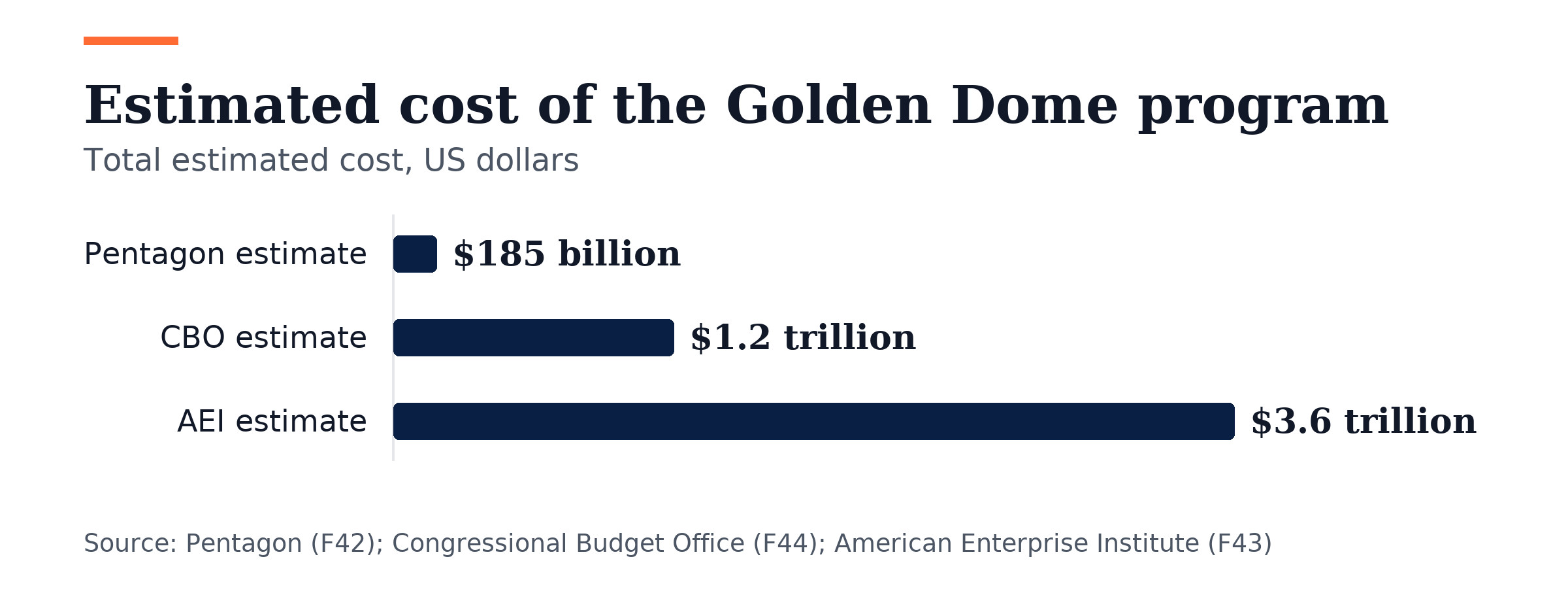
The Pentagon now puts the cost at $185 billion for an architecture running through 2035, which is $10 billion above the amount President Trump first set. Golden Dome’s price tag has swelled $10 billion over the original $175 billion goal. The Congressional Budget Office’s May 2026 analysis placed the 20-year cost of Golden Dome at $1.2 trillion, while Todd Harrison of the American Enterprise Institute estimated the full 20-year architecture at approximately $3.6 trillion. Guetlein pushed back on outside cost estimates, arguing analysts extrapolate the cost of existing systems across U.S. geography rather than pricing the architecture his office is actually building.
The Senate Armed Services Committee Strategic Forces Subcommittee is set to examine Golden Dome at a hearing scheduled for Sept. 29, chaired by Sen. Deb Fischer (R-NE) with Sen. Angus King Jr. (I-ME) as ranking member. In December 2025, members of both parties said they still had not received the detailed spending plan for the $25 billion, which covers broad categories including $7.2 billion for space-based sensors. A House Armed Services Committee aide said lawmakers have no cost figures and that the system remains more a set of options than a concrete acquisition plan.
Rep. Betty McCollum said Golden Dome is not a concept but plans, would probably be deployed in phases, and must become part of the base budget with total accountability. “If this is something we’re going to do, it has to become part of the base budget,” McCollum said. House Foreign Affairs Committee Chair Brian Mast predicted Golden Dome will become a source of argument among appropriators.
Twelve companies including Anduril, Lockheed Martin, Northrop Grumman, SpaceX, Raytheon, True Anomaly and Turion Space hold combined $3.2 billion in prototype agreements for space-based interceptors, and the Space Force awarded 20 contracts worth a combined potential $3.2 billion to those 12 companies. Guetlein expects all providers in the space-based interceptor competition to advance to the next stage, which involves building an on-orbit capability. Northrop Grumman committed to self-funding a space-based interceptor demonstration after CEO Kathy Warden said reconciliation funds opened up in the second quarter of 2026, partnering with Apex to target on-orbit capability by 2027.
SpaceX won two Space Force contracts totaling $6.45 billion in May 2026: $4.16 billion for Space-Based Airborne Moving Target Indicator and $2.29 billion for the Space Data Network Backbone. The company also won a $1.6 billion satellite launch contract covering all 18 satellite launches under National Security Space Launch Phase 3 Lane 1. L3Harris holds $955 million and Sierra Space $798 million to build 36 missile warning and tracking spacecraft for Accelerated Missile Defense Tranche 3, due to launch by the end of 2028.
Gravitics Inc. reported $30,000 in lobbying expenditures for Q3 and Q4 2025 and Q1 and Q2 2026 covering Orbital Tactically Responsive Space integration into Golden Dome. RTX Corp. spent $60,000 in the first quarter of 2026 and $90,000 in the second quarter of 2026 on lobbying covering Golden Dome for America alongside munitions, engines, radars and communication systems. Applied Intuition Inc. reported $60,000 in lobbying expenditures for Q1 and Q2 2026 covering funding for software tools for Golden Dome missile defense. Florida State University, Battle Creek Unlimited and Platform Systems Inc. disclosed lobbying tied to Golden Dome funding and mission opportunities in late 2025 and early 2026.
Joe Rickers of Lockheed Martin’s space business said the gap to close is data and interconnectivity across systems constructed separately over the years. Other panelists agreed the hard part is not engineering but connecting components bought under older contracts that never required open interfaces or shared telemetry. Guetlein described AI as a major aspect of Golden Dome, and the June 2026 White Sands test incorporated AI-enabled battle management systems. The Congressional Budget Office estimated roughly 7,800 satellites are needed for continuous boost-phase coverage based on low-Earth-orbit geometry at 300 to 500 kilometers.
Guetlein announced on Aug. 11 the launch of the Golden Dome for America Ecosystem Hub at hub.goldendome.mil to connect contractors, startups, venture capital firms, universities and research laboratories directly with program managers. In January 2026 Guetlein challenged the Missile Defense Agency to run a summer 2026 test, which agencies delivered from scratch in under six months as the most complex integrated missile defense test. The Pentagon’s independent Director of Operational Test & Evaluation did not oversee the June test; instead a separate entity leads validation efforts in close coordination with DOT&E.
The second Trump Administration proposed to develop a next-generation missile defense shield called Golden Dome for America. In May 2025, Russia and the PRC said that through Golden Dome the United States sought to undermine their ability to engage in nuclear retaliation. Trump said in May the Golden Dome architecture had been officially selected, would be fielded within three years, cost $175 billion, include satellite-launched interceptors and protect America close to 100 percent.
The fiscal 2026 NDAA enacted Dec. 18 requires the president to answer a dozen questions in an annual report, the first due with the fiscal 2027 budget request. Guetlein said secrecy is needed for security, that he hopes to say more publicly in 2026, and that he has met with several hundred industry executives. Sen. Deb Fischer said she is comfortable with the information she has received, while Sen. Chris Coons said the Pentagon owes a clearer path forward and plan.
A space-based boost-phase interceptor scheme, physicists said, would require thousands of armed satellites, perhaps tens of thousands, to defend around the clock against even a small number of incoming missiles. Guetlein said in April that Golden Dome production would not proceed unless armed satellites can be built and deployed affordably and at scale. He made the comments to the House Armed Services Strategic Forces subcommittee.



Join the discussion