Key facts
- The Pentagon released a high-resolution image of China’s top-secret spaceplane in an October 2026 Defense Intelligence Agency (DIA) report on space security threats.
- China’s spaceplane, designated Shenlong (or ‘Divine Dragon’), resembles the U.S. Space Force’s X-37B in design, featuring delta wings, a payload bay, a heat shield, and rear-mounted solar arrays.
- China has launched four Shenlong missions since 2020, with durations ranging from two days to nine months, and the current mission began in February 2026.
- China’s Shenlong spaceplane deployed unidentified objects in orbit, some of which emitted signals, but China has not confirmed their purpose or origin.
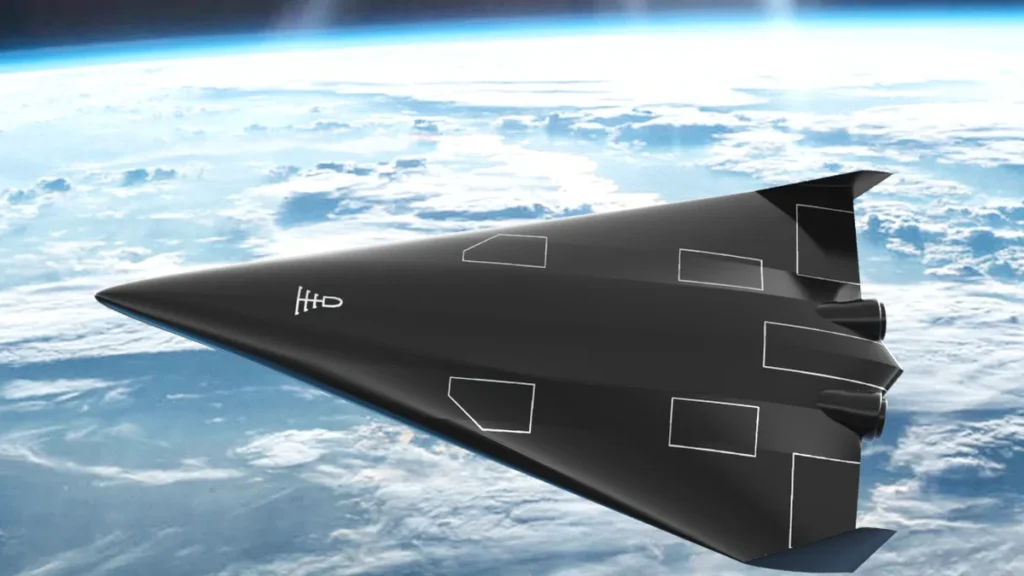
Pentagon released a high-resolution image of China’s Shenlong spaceplane on October 26, 2026, in an unclassified Defense Intelligence Agency assessment of space security threats..
The photograph was captured in 2024 by a commercial imaging satellite owned by Vantor, formerly Maxar, which provides reconnaissance imagery to U.S. military and intelligence agencies. Vantor’s Earth-imaging satellites can be aimed at objects in space, and the company is one of several supplying such imagery to American defense and intelligence customers. A U.S. Space Force official disclosed Maxar’s observation of the spacecraft at a 2024 conference in South Korea, and lower-resolution images showing the vehicle’s general shape had already circulated publicly, causing uncertainty about whether the craft was Chinese or an American X-37B. The Pentagon did not release the full-resolution image until the October 2026 DIA assessment, and the published photo shows an earlier orbital configuration rather than the vehicle’s current equipment or activities.
China’s spaceplane, designated Shenlong, or “Divine Dragon,” resembles the U.S. Space Force’s X-37B in design, with delta wings, a payload bay, heat shielding, and solar arrays at the rear. The China Academy of Launch Vehicle Technology, a state-owned entity responsible for civilian and military launch vehicles, manages the program. Shenlong also bears a resemblance to a smaller version of NASA’s Space Shuttle, using small wings, twin vertical fins, a rocket payload shroud for launch, satellite-like operations in orbit, and a runway landing after reentry.
China has flown four Shenlong missions since 2020, with mission lengths spanning two days to nine months. Shenlong’s debut orbital flight in 2020 lasted roughly two days and concluded with a landing at the Jiuquan Satellite Launch Center in the Gobi Desert. The second mission launched in August 2022 and lasted 276 days, while the third launched in December 2023 and lasted 268 days. The fourth mission began on February 7, 2026, and remains underway, and the flights have included orbital maneuvers, payload deployments, and formation flying, though China has not confirmed the objects released during flights or their purpose.
Shenlong flights have featured orbital maneuvers, capture and docking operations, formation flying, and vertical takeoff and horizontal landing. During the 2022 flight, the spaceplane maneuvered with a companion satellite and maintained station-keeping at around one kilometer separation before closing to within 100 meters. “In November 2022, this space plane appeared to maneuver with a companion satellite and conduct station-keeping at around 1 kilometre separation,” the Defense Intelligence Agency said. The U.S. military tracked the objects associated with the flight.
China has also deployed unidentified objects from Shenlong, some of which emitted signals, though Beijing has not confirmed their purpose or origin. The U.S. military tracked and cataloged the released objects, but China has not acknowledged their deployment.
The open payload bay suggests Shenlong may deploy or recover small satellites, but its exact capabilities—such as payload capacity, propulsion limits, or orbital flexibility—remain undisclosed by China. The design implies reusable orbital capabilities, but Beijing has released no technical specifications or mission details. It remains unclear whether China operates one Shenlong spaceplane or more than one vehicle. The Defense Intelligence Agency has not conclusively identified the photographed vehicle as Shenlong, and an open cargo bay neither reveals its contents nor establishes that it is an orbital weapon.
The Boeing-built X-37B measures about 8.9 meters long with a wingspan of roughly 4.5 meters, launches atop a rocket, flies without a crew, and lands autonomously on a runway. The United States Space Force flies two X-37B vehicles in rotation, and publicly stated goals for the program include testing reusable spacecraft technologies and flying experiments for later recovery and examination. Satellite tracking expert Jonathan McDowell said the Chinese spacecraft corresponds to the X-37B layout, with a central payload bay and a jettisonable rear service module carrying solar arrays, differing chiefly in wing shape and tilted rear fins. “The overall arrangement resembles the American vehicle, although differences in wing geometry show that the two spacecraft are not externally identical,” according to Army Recognition.
American officials have released photographs of the X-37B, published design and dimension details, and disclosed some experiments, though most X-37B activities remain classified. On its seventh flight, the X-37B conducted radiation-effects experiments and tested space-domain-awareness technology in a highly elliptical orbit. The Space Force has described an aerobraking sequence that uses atmospheric drag to alter orbit while saving fuel. Reusability permits engineers to inspect hardware after exposure to radiation, temperature swings, and other space conditions, but Beijing has not disclosed its refurbishment needs or turnaround times.
The Defense Intelligence Agency assesses China’s space program as the second-largest globally, with space considered a strategic priority for military dominance. China is developing counter-space weapons, including ground-based anti-satellite missiles and directed-energy weapons that use lasers or particle beams moving at light speed to disable targets. The report states that Beijing aims to become the leading power in space and to shape international norms to support China’s positions. Beijing also seeks to exploit other nations’ reliance on space-based systems to deter and counter Chinese military activity.
China operates more than 510 satellites for intelligence, surveillance, and reconnaissance (ISR) as of July 2026, using a mix of government and commercial assets to observe military activities, including American naval operations in the Indo-Pacific. The count includes government and commercial spacecraft rather than only dedicated military ones, and their military value depends on access, timeliness, and integration into decisions. China’s ISR network uses electro-optical imaging, synthetic aperture radar, and electronic or signals intelligence.
The Outer Space Treaty of 1967 prohibits placing nuclear weapons in orbit, but China and Russia oppose proposed arms control treaties that would restrict the weaponization of space. The Defense Intelligence Agency says Russia is developing a satellite designed to carry a nuclear weapon, and warns that such a weapon could result in the rapid loss of thousands of satellites and interrupt power grids globally if detonated at a sufficiently low altitude. No internationally agreed system exists for managing military activities in space, although China and Russia are pushing for arms-race-prevention rules. The report claims those proposed treaties refuse to acknowledge ongoing efforts to develop and deploy space weapons.
The Defense Intelligence Agency finds no evidence that Shenlong is carrying space weapons. The agency cautions that visual similarity to the X-37B and an open cargo bay do not establish a weapons mission or reveal the vehicle’s current activities.
Vantor said on X that the DIA report documents China’s expanding space presence, including reusable space systems, and features WorldView Space imagery of a Chinese spaceplane in orbit in 2024. Vantor, formerly Maxar, is one of several firms supplying reconnaissance imagery to the American military and intelligence agencies, and Vantor can aim its Earth-imaging satellites at objects in space. “Vantor is one of several companies that provide reconnaissance imagery of locations around the world to the US military and US intelligence agencies,” Ars Technica reported.




Join the discussion