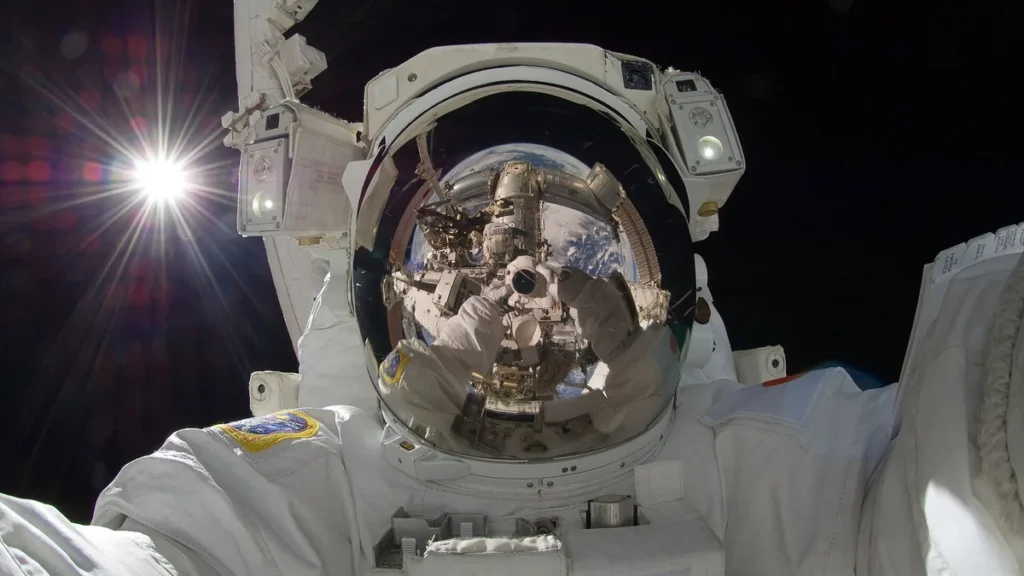
This is a new development in a story we reported earlier: NASA astronaut Menon and CSA astronaut Kutryk will install solar array Thursday.
Key facts
- On November 5, the crew will install array number eight, the final roll-out unit, on the 3B power channel.
- This excursion marked the 285th spacewalk supporting station assembly, maintenance, and upgrades.
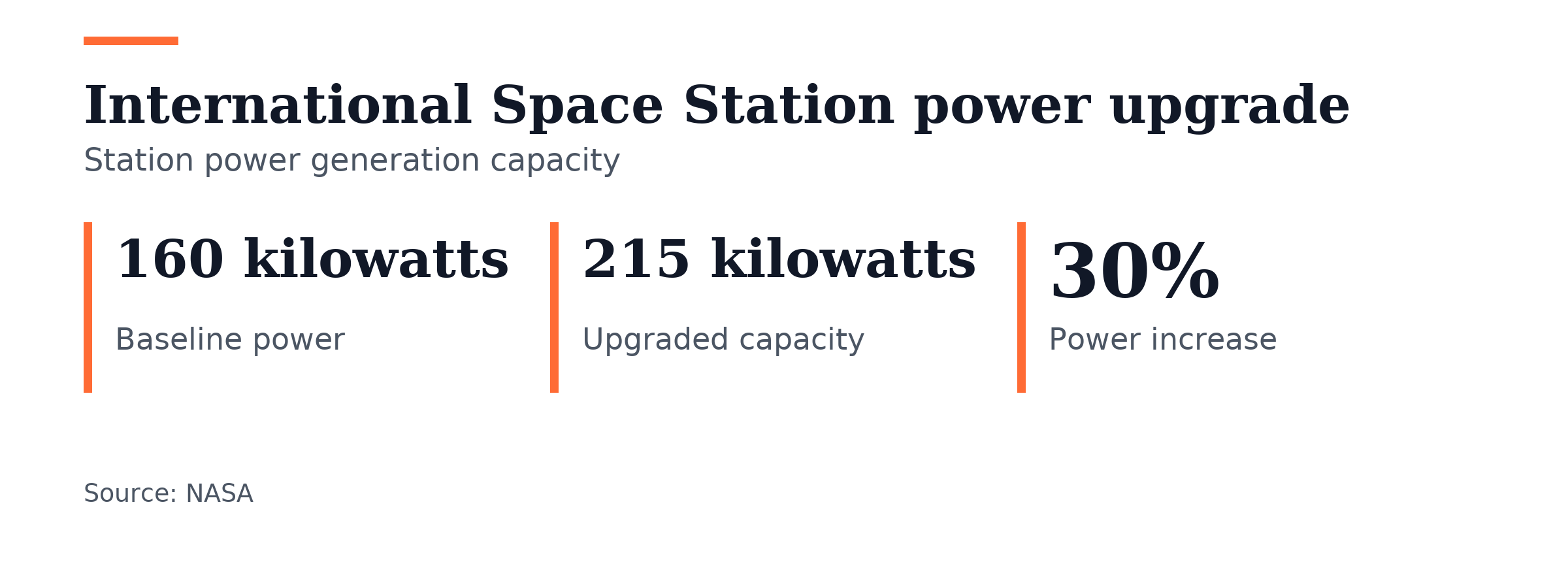
- The eight-array configuration will add up to 30 percent more available power, lifting generation from 160 kilowatts to about 215 kilowatts.
- Menon and Kutryk completed get-ahead tasks during the October 29 spacewalk to prepare for a planned November 5 spacewalk.
On October 29, 2026, at 3:08 p.m. EDT, NASA astronaut Anil Menon and Canadian Space Agency astronaut Joshua Kutryk concluded a spacewalk outside the International Space Station, marking the 100th U.S. spacewalk performed by ISS crew members. The crew installed a roll-out solar array on the 2A power channel during a seven-hour, 11-minute excursion. This was the fourth spacewalk for Menon and the first for Kutryk, and it marked the 285th spacewalk supporting station assembly, maintenance, and upgrades.
The new array is the seventh of eight roll-out solar arrays that will form an eight-array configuration, adding up to 30 percent more available power and lifting generation from 160 kilowatts to about 215 kilowatts. NASA said this seventh IROSA will provide additional power for critical station operations, including a safe and controlled deorbit. Tech Times reported that each roll-out array adds more than 20 kilowatts of generation capacity and carries a service life of more than ten years. The upgrade campaign traces to planning begun more than a decade ago when NASA saw the original arrays losing output faster than expected.
During the October 29 spacewalk, Menon and Kutryk also completed get-ahead tasks to prepare for a planned November 5 spacewalk. On November 5, the crew will install array number eight, the final roll-out unit, on the 3B power channel. NASA plans to provide live coverage of the November 5 spacewalk beginning at 6:45 a.m. After that spacewalk, all roll-out solar arrays will be installed, finishing the station’s power system augmentation.
According to Tech Times, the iROSA installation campaign began in June 2021 with the arrival of the first pair of arrays aboard the CRS-22 cargo mission. CRS-26 delivered the second pair in November 2022, CRS-28 brought the third pair in June 2023, and CRS-35 carried the fourth and final pair to the station. The CRS-35 mission lifted off at 6:33 a.m. ET aboard a Falcon 9 rocket from Florida’s Space Coast.
Tech Times reported that the Falcon 9 first stage booster, tail number B1096, made its eighth trip to space and returned to Landing Zone 40 fewer than eight minutes after liftoff. The same outlet said Dragon C211 carried over 6,300 pounds of NASA cargo on its fourth resupply flight and had flown on CRS-26, CRS-29, and CRS-33.
Tech Times explained that the roll-out arrays deploy using stored energy from carbon-fiber rods coiled under tension inside a cylinder, with no motor or explosive charge needed, allowing large arrays to stow compactly for launch. The technology originated with Deployable Space Systems, which Redwire Space acquired, and a 2017 demonstration proved it. NASA installs each iROSA on top of an original solar wing from the 2000-to-2009 generation that has lost output to radiation and thermal cycling, avoiding complex removal work on the aging wings.
Tech Times reported that the Cargo Dragon capsule was set to dock at the Harmony module’s space-facing port on October 15 at about 11 a.m. ET after roughly 52 hours of autonomous transit. The astronauts were scheduled to monitor the approach and docking. The capsule was planned to stay attached for about one month, then undock and splash down in the Pacific Ocean carrying science samples and used hardware back to Earth.
Tech Times emphasized that no other operational cargo vehicle can currently return pressurized cargo from the station to Earth, making Dragon unique for downmass and essential for preserving the scientific value of microgravity research samples. The CRS-35 flight came two weeks after Crew-13 delivered a four-person crew on October 1, and it followed CRS-34’s May 2026 launch carrying about 6,500 pounds of cargo.
The fully augmented station will have electrical capacity to support research tempo and commercial use through the planned early-2030s deorbit. Completion of the iROSA campaign leaves the station’s power infrastructure fully upgraded for the first time in its 26-year history, aligned with current science and commercial needs.
Besides his NASA duties, Menon serves with the U.S. Space Force. The same outlet reported that Joshua Kutryk is the fifth Canadian ever to perform a spacewalk and the first Canadian to conduct one in the past seven years. Florida News also contrasted the shuttle-era total of nearly 300 spacewalks with the station-based count, explaining that Spacewalk 100 refers specifically to excursions from the Quest airlock without a shuttle.
WESH estimated the spacewalk would run about six hours and 45 minutes before it ended.


Join the discussion