Key facts
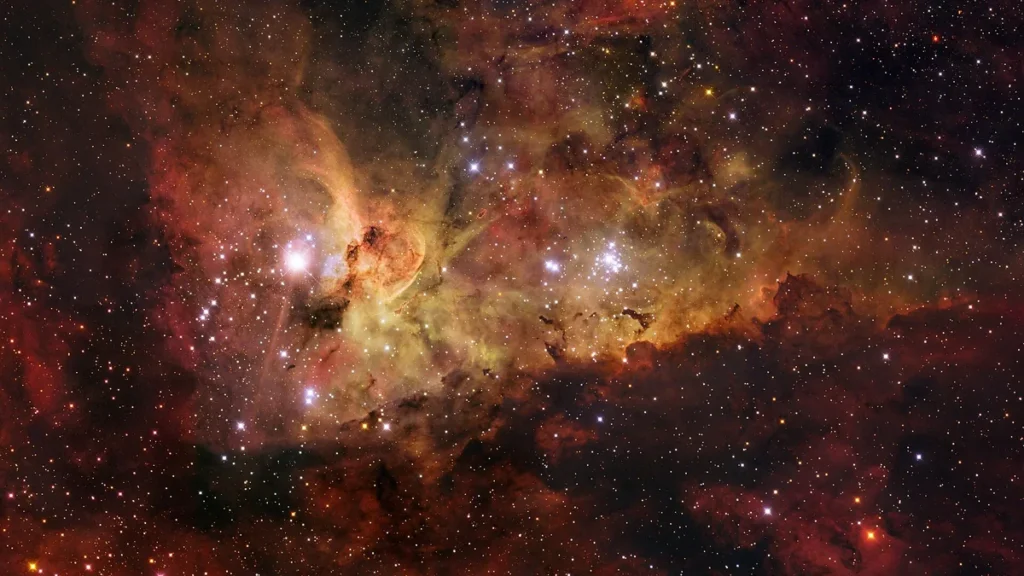
- Webb's Near-Infrared Camera (NIRCam) captured the image, revealing intricate structures carved by radiation and winds from massive stars.
- Pale blue areas mark ionized hydrogen clouds, and smoky orange regions glow in infrared from polycyclic aromatic hydrocarbons, which are carbon-based molecules.
- Cool molecular hydrogen forms dark red filaments in N159, creating dense structures that protect newborn stars from harsh radiation and winds.
- The observations detected very dim stars with masses less than one-tenth of the Sun's mass.
Astronomers using the NASA/ESA/CSA James Webb Space Telescope captured a new view of N159, a rich HII complex in the Large Magellanic Cloud about 161,000 light-years from Earth. The distance and location appear consistently across the coverage of the Webb image. The Sci.News report describes the observation as a spectacular look at one of the richest HII complexes in the Large Magellanic Cloud.
The research paper behind the observation appeared on arXiv.org on September 22, 2026. The study carries the title Sequential Star-Formation and the Near-Infrared Stellar Populations within N159 and the arXiv identifier 2609.27126, with Nolan Habel and colleagues as authors. The preprint precedes the Webb image release and provides the detailed analysis behind the observation.
Webb’s Near-Infrared Camera (NIRCam) captured the image, revealing intricate structures carved by radiation and winds from massive stars across the complex. The instrument resolves fine details in the gas shaped by feedback from massive stars across the star-forming region. Researchers use NIRCam to study the gas shaped by massive stars.
The N159 complex stretches across approximately 230 light-years and is less than 3 million years old. The image covers a span of roughly 230 light-years across the star-forming region. Because it is less than 3 million years old, it ranks among the young star-forming regions of the Large Magellanic Cloud.
Stars at early stages of evolution number in the thousands within the complex. The observations detected dim stars with masses less than one-tenth of the Sun’s mass, reaching into the low-mass regime of the stellar population in the nebula.
The research team separated young stars embedded in birth clouds from older evolved populations, and the data distinguish nascent stellar objects from fully evolved stars within the same complex. Star formation appears earlier in the western part of N159, where young stellar objects are more concentrated than in the east. The uneven distribution indicates different evolutionary phases across the complex at the same time.
In stellar nurseries such as this one, giant molecular clouds of cold hydrogen gas collapse under gravity, forming new stars
Dr. Nolan Habel, Sci.News: Breaking Science News
Webb’s image shows pale blue areas marking ionized hydrogen clouds, while smoky orange regions glow in infrared from polycyclic aromatic hydrocarbons, which are carbon-based molecules. The colors represent the chemistry of the nebula, with orange tracing carbon-based molecules and blue tracing ionized gas. Polycyclic aromatic hydrocarbons glow in infrared.
Cool molecular hydrogen forms dark red filaments across the center of the image. Those filaments create dense structures that protect newborn stars from harsh radiation and winds, but the protected features will eventually disappear, leaving finished stars in place.
Dark red filaments across the centre of the image are made of cool molecular hydrogen
NASA, KPVI
The Large Magellanic Cloud’s metallicity is lower than in the Milky Way, offering conditions resembling the early universe for HII region studies. The low metal content makes N159 a nearby analog for studying star formation under conditions like those in the early universe.




Join the discussion