Key facts
- A $30 million rescue mission contracted by NASA and led by Katalyst Space Technologies failed to raise the Neil Gehrels Swift Observatory's orbit after the LINK servicing spacecraft could not dock.
- Swift began its mission in November 2004 in a 600-kilometer circular low Earth orbit, and over two decades atmospheric drag gradually reduced the observatory's altitude to below 400 kilometers.
- The science operations team at NASA said the risk to Earth's population from the re-entry was very low.
- NASA's Neil Gehrels Swift Observatory concluded operations after the operations team at Penn State in University Park sent a command to end operations and prepare the spacecraft for re-entry.
NASA concluded operations of the Neil Gehrels Swift Observatory on Oct. 20, 2026, after the operations team at Penn State in University Park sent a command to end operations and prepare the spacecraft for re-entry, which the agency expects within the next few weeks.
Swift entered safe mode on Oct. 20, 2026, because increased atmospheric drag left it unable to maintain altitude. The observatory has no propulsion system of its own, so drag in low Earth orbit determined its fate.
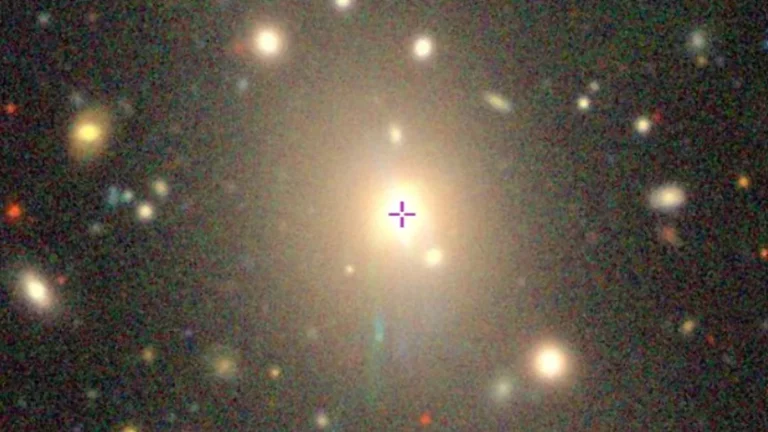
The end followed a failed $30 million rescue mission contracted by NASA and led by Katalyst Space Technologies. NASA signed the contract with the Arizona-based startup on Sept. 25, 2025. The LINK servicing spacecraft could not dock with Swift, and NASA formally ended its participation on Sept. 3, 2026. LINK re-entered Earth’s atmosphere on Sept. 25, 2026.
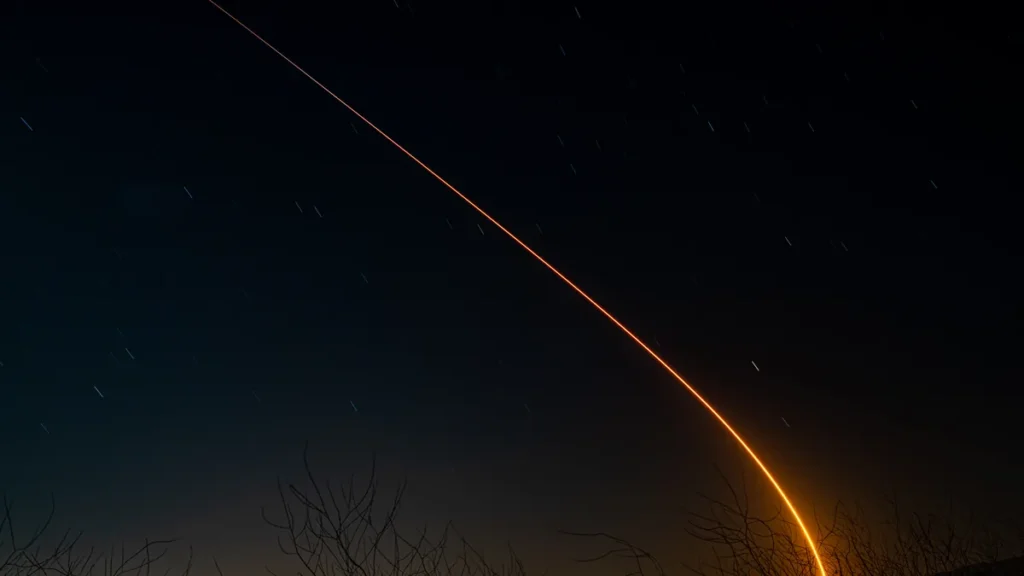
LINK launched from Kwajalein Atoll on a Northrop Grumman Pegasus XL rocket in July 2026, about 10 months after the contract award. The nearly half-ton vehicle carried electric thrusters, robotic arms, and large deployable solar arrays. Two of LINK’s three reaction wheels, which control spacecraft attitude, failed, leaving the helper satellite unable to move safely into position to capture Swift.
Before controllers aborted the docking attempts to avoid collision risks, LINK approached within 7.5 to 9 miles (12 to 15 kilometers) of Swift. Telemetry anomalies and thruster alignment discrepancies arose during the final approach, preventing a secure mechanical latch on the spacecraft’s aft ring. The vehicle also developed communications losses and an attitude-control anomaly.
NASA and Katalyst abandoned the planned grapple and boost and reduced the mission to technology demonstrations. After deciding to stop docking attempts, Katalyst repurposed LINK for non-contact proximity inspections of Swift to gather diagnostic flight data to help improve future autonomous servicing technology.
Katalyst chief executive Ghonhee Lee said time constraints forced safety compromises that contributed to the mission’s failure. Shawn Domagal-Goldman, director of NASA’s Astrophysics Division, described the rescue effort as a high-risk, high-reward mission.
Swift launched into orbit on Nov. 20, 2004, and began operations the following month in a 600-kilometer circular low Earth orbit. Over two decades, atmospheric drag gradually reduced the observatory’s altitude to below 400 kilometers. NASA built the mission for a two-year primary mission, yet it operated productively for more than 10 times that length, NASA’s Astrophysics Division director said; the agency renamed it in honor of Neil Gehrels in 2018 following his death. Development of the observatory cost $500 million, and it served as a cornerstone of NASA’s astrophysics fleet.
During its career the observatory detected more than 2,000 gamma-ray bursts, the most powerful explosions in the universe, and helped confirm theoretical models indicating that short bursts come from merging neutron stars. In May 2005, Swift detected GRB 050509B, a short gamma-ray burst lasting just 0.03 seconds, and detected 11 X-ray photons, making it the first short burst with a detected afterglow. Researchers have used Swift’s data to produce around 7,000 published scientific papers, and the archive holds about 12 terabytes of public data, including more than 1.5 million Ultraviolet/Optical Telescope images and multiwavelength spectra.
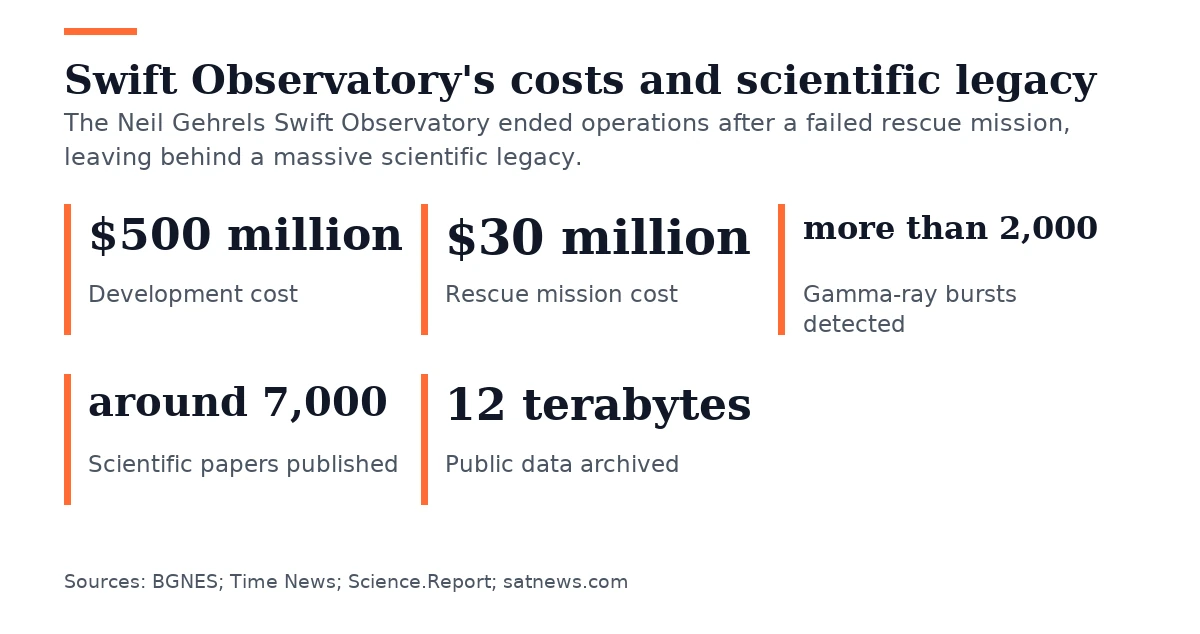
The observatory’s flexible scheduling system handled as many as 75 independent targets daily and let astronomers request target-of-opportunity observations of unexpected events, commanded from the ground within minutes.
Starting in December 2025, the Penn State operations team substituted roughly a quarter of planned science targets with drag-reducing pointing directions, and by February 2026 it had adopted that approach exclusively through late August. The pointing changes meant the observatory performed no pointed science observations from mid-February to late August 2026. Mission director John Nousek said the changes bought valuable time for the boost mission.
NASA resumed operations of two of Swift’s three telescopes in late August 2026, but the Burst Alert Telescope remained offline after being temporarily disabled in April 2026 to reduce drag. Recent solar activity increased atmospheric drag on Swift after observations resumed, causing the spacecraft to sink rapidly. NASA predicted that Swift’s critical altitude would reach about 185 miles, or 300 kilometers, during fall 2026.
NASA’s science operations team said the risk to Earth’s population from the re-entry was very low. Radar networks on the ground are tracking the telescope’s orbital decay as it heads toward an uncontrolled re-entry over the ocean. Swift reached 171 miles (275 kilometers) on Oct. 20, 2026, could no longer compensate for increased atmospheric drag, and entered safe mode.
NASA said it will keep seeking new ways to respond quickly to cosmic events as the mission ends, relying on current missions to bridge the gap meanwhile. The agency described the conclusion as the planned end of an innovative mission. Swift formed part of an astrophysics revolution showing that rapid-response observations are critical to the entire community.

Join the discussion