Key facts
- The team built Dragonfly flight capabilities incrementally, beginning with single-rotor spinning, then a reposition flight and partial scouting flight, adding sensors at each step.
- The team generated simulated lidar terrain and real-time camera images using a GPU emulator rendering Titan scenes in 20 to 70 milliseconds, matching flight exposure times.
- Running the sequence on flight-like hardware let the team observe piece interactions, including millisecond data movement between lander processes.
- Zach Putnam said the tests validate that everything works together.
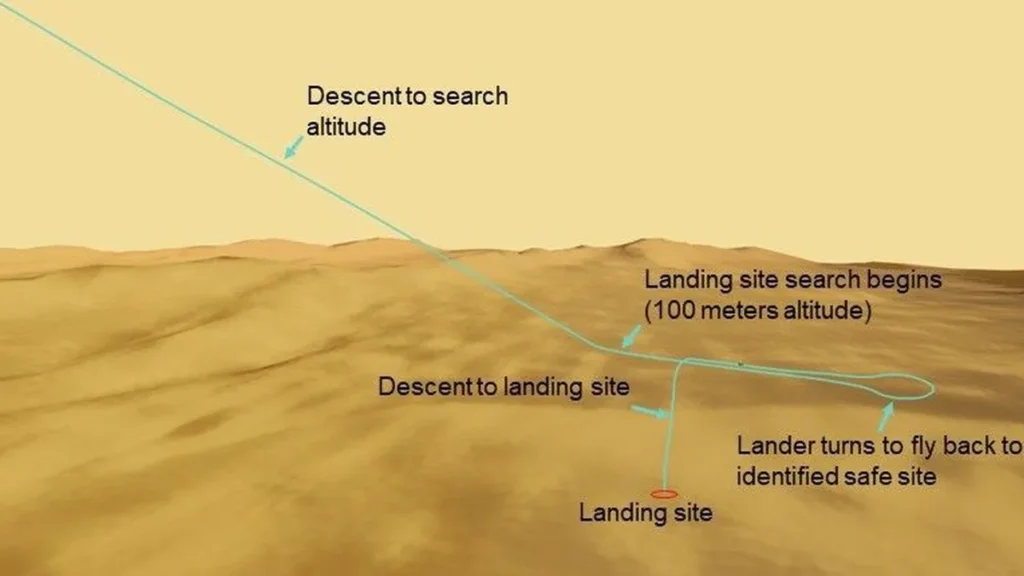
Dragonfly is a NASA New Frontiers mission led by the Johns Hopkins Applied Physics Laboratory, with Elizabeth Turtle as principal investigator. On Oct. 23, 2026, NASA said Dragonfly finished its first simulated flight over Titan-like terrain, picking out a safe landing site and carrying out a guided descent and touchdown at Johns Hopkins APL in Laurel, Maryland.
- No earlier than 2028: Launch
- 2034: Arrival at Titan
The test combined flight software and avionics with simulated data from Dragonfly’s Titan sensors, including navigation cameras, inertial measurement units, which track motion and orientation, and lidar, which maps terrain using lasers. NASA called the October 2026 exercise the most comprehensive test to date of the craft’s first flight in real time on flight-like avionics. It included most systems and maneuvers for arrival at Titan in 2034.
Zach Putnam, Dragonfly mobility subsystem lead engineer at APL, said the first flight is the most challenging because it uses every piece of flight sensor hardware on the lander. Putnam said, “Doing it incrementally is what enabled us to build these tests at all,” describing the step-by-step approach.
The team built Dragonfly flight capabilities incrementally, beginning with single-rotor spinning, then a reposition flight and partial scouting flight, adding sensors at each step. Adding lidar, which measures terrain altitude and slope to spot hazards, provided the final piece needed to fully simulate Titan encounters. The team generated simulated lidar terrain and real-time camera images with a GPU emulator that rendered Titan scenes in 20 to 70 milliseconds, matching the cameras’ flight exposure times. Running the sequence on flight-like hardware let the team observe piece interactions, including millisecond data movement between lander processes.
Zach Putnam said the tests validate that everything works together. The team plans to fly the actual flight system with its avionics, along with other flight profiles and intentional faults, to check autonomous response. Putnam said autonomy is essential at Titan because Dragonfly must fly without real-time help from Earth.
Testing is underway for Dragonfly’s pose mechanism, which lowers the rotorcraft from its stowed spot inside the backshell to the release position as the craft descends at Titan. Engineers at Lockheed Martin in Colorado ran static and deployment tests with representative mass on the pose mechanism to check loads, lowering, and locking. The pose structure connects the backshell to an aluminum interface on the lander, lowering both before separation and powered flight at Titan.
Engineers test how Dragonfly’s backshell may swing beneath its parachute during deployment by tilting test hardware to different angles. The testing must confirm a critical transition works reliably nearly a billion miles from Earth.
Sandia completed the sixth and final solar-tower heat shield test campaign for Dragonfly, capping multiyear work begun in 2023 to qualify thermal protection. During each facility visit, the team ran four to eight tests on different heat shield segments under flight-like heating. Heliostats aimed sunlight at a 24-inch spot on top of a 200-foot tower, sending heat pulses above 4,500 degrees Fahrenheit, higher than predicted Titan entry conditions. Ken Armijo said, “These tests help build confidence in the heat shield system before it ever flies.”
NASA’s Ames Research Center developed PICA-D, Phenolic Impregnated Carbon Ablator-Domestic, which Sandia identified as Dragonfly’s heat shield material. NASA examined heat shield performance in flat segments, rounded shoulder segments, gap fillers, and pristine versus intentionally marred samples. Infrared cameras and instruments recorded how heat moved across curved shoulders, edges, and gaps in the material.
NASA selected Sandia’s National Solar Thermal Test Facility because it is the only ground qualification facility able to reproduce predicted Titan entry heat on a test article large enough for flight-like stresses. Ken Armijo said the NASA test series is bolstering Sandia’s engineering capabilities and created new testing possibilities for nuclear deterrence and commercial aerospace.
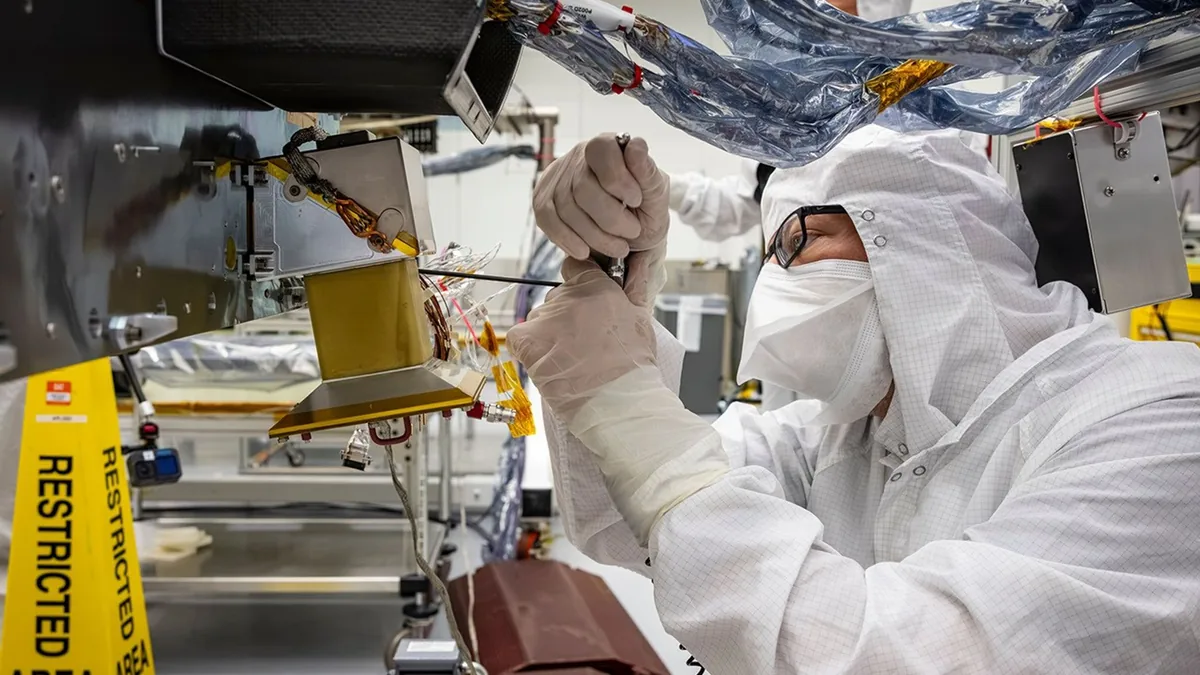
NASA Langley’s Transonic Dynamics Tunnel hosted five weeks of rotor tests from August into September, evaluating rotor arm stress and vibration effects in Titan-like conditions. The wind tunnel measures 16 feet high, 16 feet wide, and 20 feet long. In late December, the team completed aerodynamics tests on smaller-scale Dragonfly rotor models in the tunnel.
APL machinists cut Dragonfly’s first rotors on Nov. 1, 2024, from 1,000-pound aluminum blocks using waterjet paring and machining; parts arrived a month early. Engineers spin-tested the rotors at APL on a full-scale model representing half the lander before transporting them to Langley in late July.
Dragonfly rotors will next face fatigue and cryogenic trials at minus 290 degrees Fahrenheit before the team builds actual flight rotors. Dave Piatak said, “There’s no room for error, so any concerns with vehicle structural dynamics or aerodynamics need to be known now and tested on the ground.”
Felipe Ruiz, lead Dragonfly rotor engineer at APL, said controllers will adjust different rotor speeds on Titan to induce forward flight, climbs, descents, and turns, making wind tunnel tests vital to demonstrate the design. Rick Heisler, wind tunnel test lead from APL, said the wind tunnel tests validated the design approach and will generate high-fidelity data on loads, forces, and dynamics to predict Titan performance.
Dragonfly’s main parachute canopy will be about 50 feet (16 meters) wide and was airdrop-tested from a DHC-4 Caribou at Lake Elsinore, California, in August 2023. The DHC-4 Caribou flew to about 2,100 feet above the Lake Elsinore airfield for the tests. The main parachute uses finest-weave space-rated nylon, and tests compared 15 percent geometric porosity against the baseline 20 percent design. The Dragonfly Parachute Descent System is led by Airborne Systems North America, managed by NASA Langley, and overseen by APL.
Dragonfly will enter Titan’s atmosphere at hypersonic speeds in an aeroshell and descend for about an hour stabilized by a drogue parachute from roughly 87 miles (140 kilometers). The main parachute deploys at unusually low dynamic pressures, producing small inflation forces far below those for Mars spacecraft or Earth personal parachutes. Titan’s sea-level air is four times as dense as Earth’s air, and its gravity is 14 percent of Earth’s gravity, so parachute behavior seen on Earth happens in slow motion on Titan, taking nearly three times as long.
Launching no earlier than 2028, Dragonfly will begin a six-year voyage to Titan, Saturn’s moon, then dedicate three years to flights between multiple surface sites. Dragonfly will explore Titan’s chemistry, geology, and atmosphere to advance understanding of life’s chemical origins after a six-year voyage.
Dragonfly passed its Critical Design Review in April 2025. Elizabeth Turtle said the team worked well together under time pressure and that much remains to do before the 2028 launch.


Join the discussion