
Key facts
- UK researchers identified WD J1330+6435 as the first known green star, a white dwarf located 280 light-years from Earth.
- The green color of WD J1330+6435 arises from sodium in its atmosphere absorbing orange wavelengths, leaving a chartreuse glow.
- WD J1011+2845, located 48 light-years from Earth, may be the reddest star ever recorded, emitting a deep salmon-pink glow due to carbon molecules distorting its light beyond 600 nanometers.
- White dwarfs with hydrogen and helium atmospheres appear cyan or blue due to collisions between hydrogen molecules and helium atoms.
UK researchers at the University of Warwick identified WD J1330+6435, a white dwarf (a dense stellar remnant) 280 light-years from Earth, as the first known green star on Oct. 15, 2026. Mark Hollands led the study.
The same study found that white dwarfs can glow pink, cyan, yellow, purple and green, upending the idea that these stellar remnants are uniformly white. Published in RAS Techniques and Instruments on Oct. 15, 2026, the research examined spectral data, measurements of starlight split by wavelength, from more than 150 white dwarfs and used a human color-vision model to estimate how each would appear up close. Most white dwarfs remain white, but a subset displays unusual hues.
Most white dwarfs remain white. Of 151 white dwarfs within 65 light-years of Earth, only five showed unusual colors – three pink and two yellow – while the rest appeared white with a median temperature of 6,800 Kelvin. The researchers estimate that roughly one in 30 white dwarfs have odd hues.
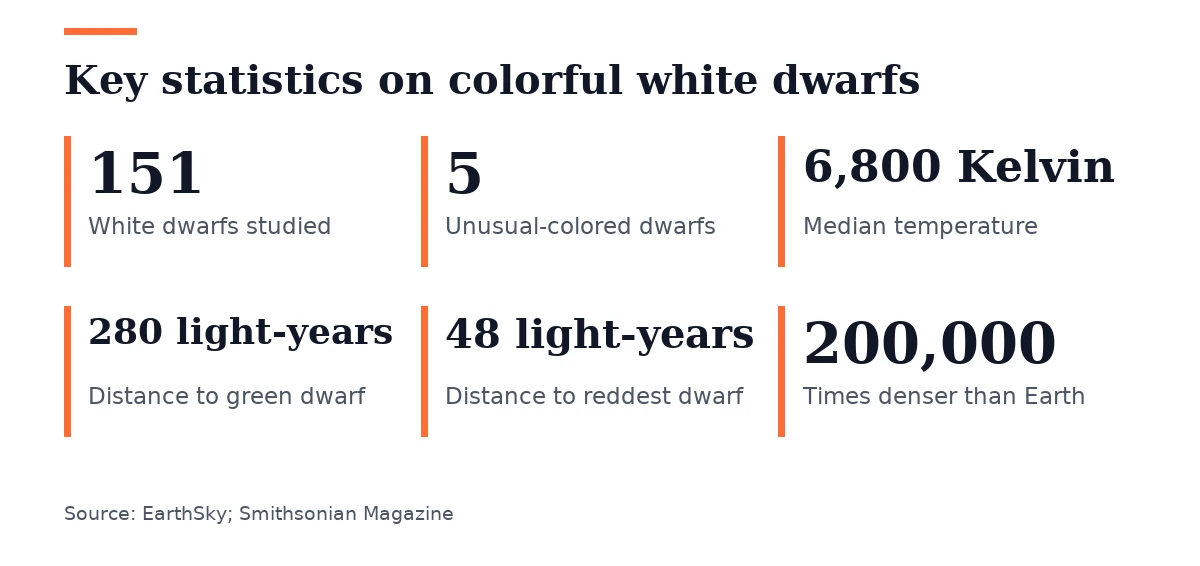
The colors depend on atmospheric chemistry and density rather than temperature alone. White dwarf atmospheres can reach about one gram per cubic centimeter, comparable to liquid water, so even trace amounts of calcium or sodium interact strongly with helium plasma, an ionized gas, and absorb more wavelengths than they would at lower densities. In WD J1330+6435, sodium absorbs orange wavelengths, leaving a chartreuse glow. “The traces of sodium in the atmosphere of this white dwarf absorb the orange part of the spectrum, leaving behind a ghostly green glow,” said Mark Hollands of the University of Warwick, who added to Reuters that “the sodium atoms no longer absorb one very narrow wavelength of orange – they absorb the yellows, oranges and some of the red wavelengths.”
Other extremes appeared in the sample. WD J1011+2845, 48 light-years away, may be the reddest star ever recorded, emitting a deep salmon-pink glow because carbon molecules squeeze nearly all its light beyond 600 nanometers. A deep convection zone brings carbon to the surface from far below. Carbon-rich white dwarfs tend to look pink or purple, hydrogen and helium atmospheres produce cyan or blue tones through collisions between hydrogen molecules and helium atoms, and atmospheres polluted by asteroid or comet debris tend to appear yellow.
Astronomers traditionally link stellar color to temperature, with cooler stars appearing orange or red and hotter stars white or blue.
White dwarfs are the hot, dense cores left when stars run out of fuel and blow their gases into space, and the Sun will become one someday. They contain roughly half the Sun’s mass but are only slightly bigger than Earth, making them up to 200,000 times denser than Earth. The coolest examples reach densities around 0.036 pounds per cubic inch, or one gram per cubic centimeter, millions of times denser than the Sun’s photosphere, and the extreme density lets trace elements interact strongly with helium plasma, producing color variations absent in less dense stars.
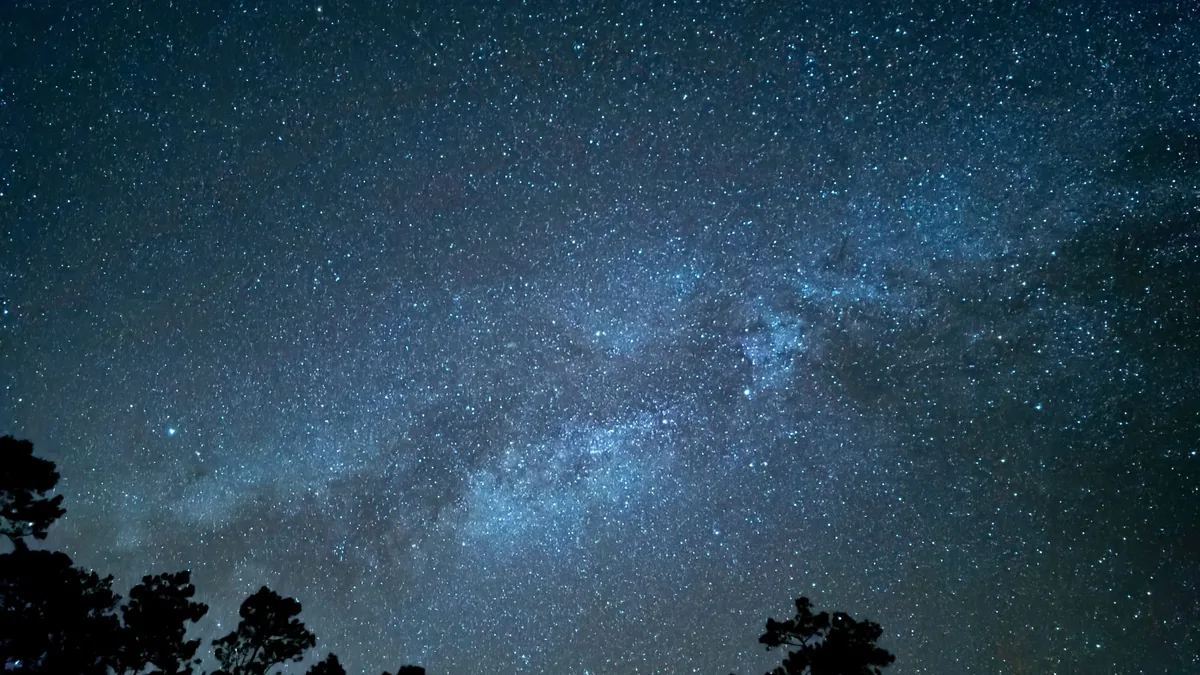
Since the stars are too distant to observe directly, the team reconstructed colors from existing spectral data and a model of human color vision. The researchers also noted that white dwarfs are not typically blue, even though surveys contain many blue examples, because hotter, bluer objects are easier to detect from greater distances.
Earlier work already hinted at structural variety. A 2023 study identified a white dwarf nicknamed Janus with one hydrogen side and one helium side, producing differing appearances on each face. This discovery highlights the structural diversity of white dwarfs, where compositional differences create visible contrasts on their surfaces.
Independent experts praised the approach. Agnès Kim of Penn State Scranton told CNN that translating spectra into human-visible color is a cool intersection of physics and biology, and she loves that some white dwarfs would look green or pink. Mark Hollands told CNN that most white dwarfs share the normal orange-white-blue range, but special cases have strange outer-layer physics causing large spectrum deviations, and he told Reuters that the universe is sometimes just as weird as anything science fiction can conjure up.
WD J1330+6435 appears to have accumulated rocky material from its surrounding planetary system, enriching its atmosphere with calcium, lithium and sodium. Smithsonian Magazine ties that chartreuse hue to the accretion of rocky debris, linking the color to external material rather than temperature alone.

Join the discussion