
Key facts
- A SpaceX Bandwagon-5 rideshare carried two NASA-funded commercial satellite communication demonstrations into low Earth orbit on October 20, 2026.
- Viasat's Maxwell spacecraft, built by Rocket Lab in Long Beach, California, lifted off from Cape Canaveral Space Force Station at 7:04 a.m. ET on October 20, 2026.
- The SES Space & Defense demonstration payload rode aboard Planet Labs PBC's Pelican-12 satellite on the Bandwagon-5 rideshare from Cape Canaveral Space Force Station in Florida.
- SES will use its O3b mPOWER medium Earth orbit fleet for high-rate data and geosynchronous satellites for low-rate data between the demonstration spacecraft and its Earth ground stations.
SpaceX‘s Bandwagon-5 rideshare carried two NASA-funded commercial satellite communication demonstrations into low Earth orbit from Cape Canaveral Space Force Station on Oct. 20, 2026, with payloads from Viasat and SES Space and Defense. The flight marked a dual demonstration of high- and low-rate commercial relay capabilities for NASA.
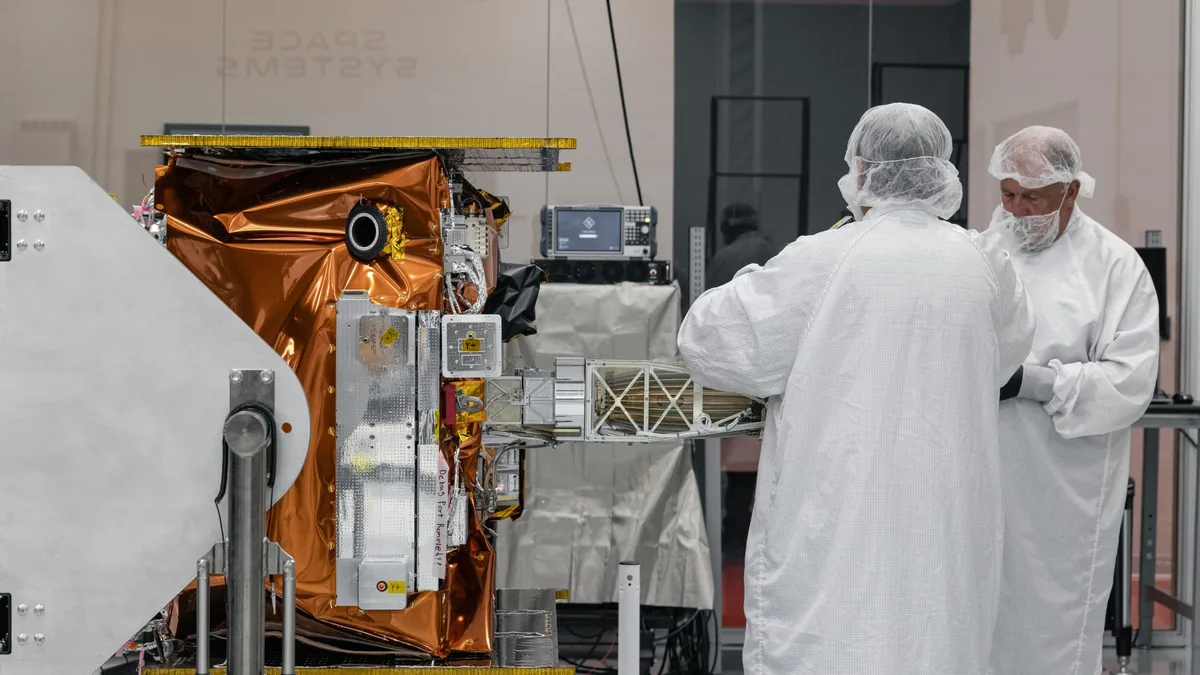
Viasat’s Maxwell spacecraft, built by Rocket Lab at its Long Beach, California facility, lifted off at 7:04 a.m. ET on Oct. 20, 2026. Rocket Lab constructed the spacecraft using in-house components such as solar panels, reaction wheels, star trackers, and flight and ground software. The spacecraft supplies power, communications, propulsion, and attitude control for the demonstration mission.
Viasat said the launch advances its demonstration mission for NASA’s Communications Services Project and supports the agency as it prepares to sunset the Tracking and Data Relay Satellite fleet. The company described the mission as a key milestone under its Communications Services Project contract awards.
Two Communications Services Project contract awards totaling $81 million fund the company’s communications services work. Viasat’s government space team plans on-orbit testing and demonstrations over five months through March 2027. This is Viasat’s second NASA Communications Services Project demonstration mission, after a November 2025 launch telemetry relay demonstration on Blue Origin‘s New Glenn rocket. Viasat called the on-orbit demonstration a key milestone in developing space-based communication services under its Communications Services Project contract awards.
Maxwell carries a Ka-band terminal for the ViaSat-3 network and an L-band terminal for its global L-band network. The spacecraft also supports direct-to-ground links using Real-Time Earth Ground-Station-as-a-Service for S-, X-, and Ka-bands. Rocket Lab supplied a new L-band radio for Maxwell to support telemetry, tracking and command relay demonstrations through Viasat’s L-band network.
Viasat will test high- and low-rate relay services using Maxwell, with autonomous technology routing data among the spacecraft, geosynchronous satellites, and Viasat’s global ground stations. NASA explained that high-rate links send large amounts of information while low-rate signals handle tracking and basic commands, both essential for reliable connections across the solar system.
Viasat said its Ka- and L-band space relay services will offer real-time, low-data-latency communications for time-sensitive low Earth orbit operations and support NASA plus the growing government and commercial low Earth orbit connectivity market. The company described the services on Oct. 21, 2026, as meeting NASA mission needs and serving the expanding government and commercial market for on-demand low Earth orbit connectivity.
Critical mission data is available on demand through Viasat’s geostationary-orbit relay solutions, the company said, while real-time telemetry, tracking and command reach a spacecraft anywhere along its low Earth orbit path. In its October 21, 2026, release, Viasat paired that point with details of a Ka-band terminal reaching ViaSat-3 and an L-band terminal tied to its global L-band network.
Viasat added that its solutions serve rapidly growing low Earth orbit operations that must transport mission data to Earth while balancing real-time demands, data latency, and continuous contact for command and control. The company made the statement on Oct. 21, 2026, in its announcement about the Maxwell spacecraft demonstration under NASA’s Communications Services Project.
In 2022, NASA’s Space Communications and Navigation division awarded $278.5 million to industry through the Communications Services Project for satellite service development. NASA’s Glenn Research Center in Cleveland manages the project, which will test state-of-the-art relay capabilities with industry through 2027.
NASA plans to gradually retire its Tracking and Data Relay Satellite fleet and transition future low Earth orbit missions to commercial alternatives. The agency said this award supports its decision to retire the fleet and move future low Earth orbit missions to commercial services.
NASA uses high-rate data links for large information such as scientific discoveries and 4K imagery, and low-rate signals to track spacecraft and send basic commands. The agency said its Communications Services Project efforts, together with work completed by commercial partners, will help it evaluate new ways to deliver critical information through space in real time.
The SES Space & Defense demonstration payload rode aboard Planet Labs PBC’s Pelican-12 satellite on the Bandwagon-5 rideshare from Cape Canaveral Space Force Station in Florida.
SES will use its O3b mPOWER medium Earth orbit fleet for high-rate data and geosynchronous satellites for low-rate data between the demonstration spacecraft and its Earth ground stations. The company will test high- and low-rate relay services designed to provide seamless, uninterrupted connectivity for spacecraft.
Planet’s Pelican satellite carries an internally developed Software Defined Radio and a folded optic flat slab tracking antenna for low-latency, high-throughput mission data backhaul. SES said this hardware enables a global capstone test to complete its Communications Services Project demonstration.
Earlier SES Space & Defense work demonstrated LEO Relay Service for mission backhaul and spacecraft health at low and high data rates using geosynchronous satellites and O3b mPOWER systems in medium Earth orbit.
SES will use the Pelican satellite to expand commercial service capability and complete a global capstone test for its Communications Services Project demonstration. SES Space & Defense said completing its demonstration will mark another key step for NASA’s Communications Services Project and advance validation of commercial capabilities for future operational support of near-Earth science missions.
“LRS enables low latency, persistent connectivity regardless of satellite location, enabling critical data backhaul, Telemetry, Tracking and Command (TT&C),” said Sam Sutton, vice president of Space Data Relay Services at SES Space & Defense.




Join the discussion