Key facts
- The RASC Observer's Handbook predicts the Orionid peak at 18 UTC on October 21, 2026.
- A bright waxing gibbous moon will be visible after midnight during the 2026 Orionid peak, with the full moon arriving at 4:12 UTC on October 25-26.
- Viewers should watch in the hours before dawn because bright moonlight dominates the rest of the night.
- Observers should expect roughly 10 to 20 meteors each hour beneath a dark, moonless sky, though the exact 2026 rate cannot be known.
The RASC Observer’s Handbook predicts the Orionid meteor shower peaks at 18 UTC on October 21, 2026, and viewers should watch the predawn sky in the dark hours before dawn.
The peak falls on the night of Wednesday, October 21 to Thursday, October 22, 2026, according to Sortiraparis, which describes this overnight span as the central night of the 2026 Orionid display. Because the maximum is broad, the nights of October 20-21 and October 22-23 are also worth watching, giving viewers leeway if clouds block the peak night. Sortiraparis reports the Orionids were active since October 2, 2026, as the peak approached, suggesting observers have about a week to scout locations, check weather, and set alarms.
EarthSky lists the overall duration as September 26 to November 22, defining that span as the period when Earth passes through the meteor stream in space. NASA says activity continues through November 7, 2026, which is an earlier end date than EarthSky’s figure. Sortiraparis attributes the November 7 end date to NASA and notes the peak occurs on the night of October 21-22. The two sources disagree on when the shower ends, so viewers can watch well into autumn even after the peak has passed.
A bright waxing gibbous moon will be visible after midnight during the 2026 Orionid peak, with the full moon arriving at 4:12 UTC on October 25-26. During the peak, the moon is estimated by the IMO and Star Walk to be illuminated between 70 and 80 percent. Sortiraparis describes this bright moon as acting like a giant streetlamp in the early evening, washing out faint meteors until it sets.
EarthSky says the radiant is highest around 6 a.m., making the dark hours before dawn the best time to watch. Sortiraparis recommends the final hours before dawn, ideally facing southeast, because Orion climbs higher as the night goes on. Newsday says after midnight or early predawn hours usually have less moonlight interference.
When watching before the moon sets, viewers should position themselves in the moon’s shadow to catch the most meteors. EarthSky notes that the bright waxing gibbous moon will be up during peak times and will set a few hours before dawn.
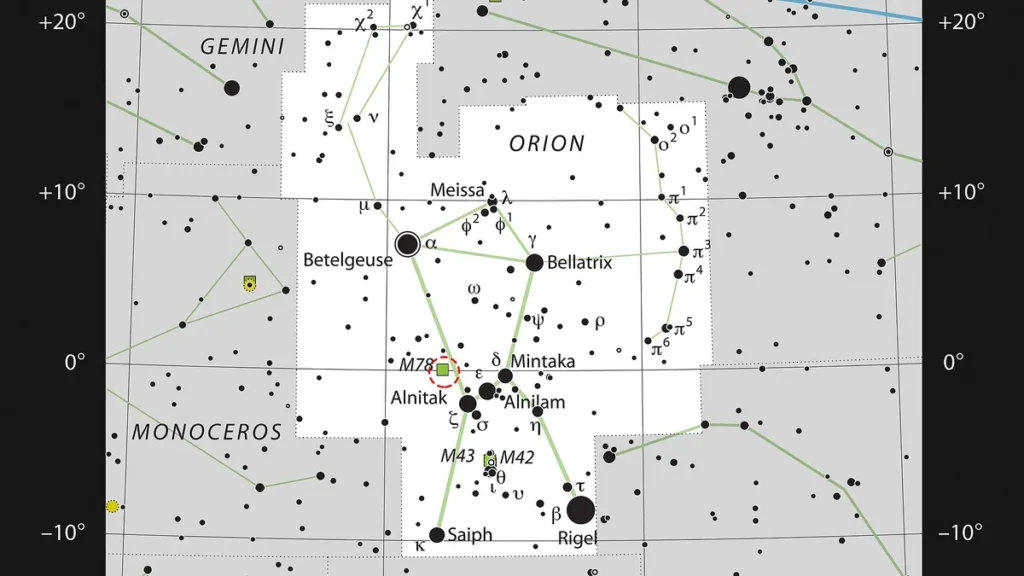
The radiant lies in the direction of Orion the Hunter, north of Betelgeuse, and stands highest around 6 a.m. The Orionid radiant rises before midnight, and Orion ascends in the east during the hours after midnight in October, placing the radiant in that part of the sky. EarthSky notes that this placement makes the dark hours before dawn the best time to watch, since Orion stands high in the sky by then.
Observers should expect roughly 10 to 20 meteors each hour beneath a dark, moonless sky, though the exact 2026 rate cannot be known. EarthSky cites the American Meteor Society, noting recent low to average activity after exceptional years of 50 to 75 per hour in 2006-2009, comparable to the Perseids. EarthSky uses this history to show that rates vary widely, advising viewers to expect only about 10 to 20 meteors per hour in 2026 under ideal dark conditions. Sortiraparis says the IMO expects about twenty per hour under pitch-black skies and about ten in a truly dark corner.
Newsday says up to 20 per hour in ideal conditions according to the AMS.
Orionid meteors plunge into the atmosphere at roughly 41 miles per second, or 66 km/s. EarthSky says perhaps half of Orionids leave ionized gas trails lasting a few seconds. EarthSky links these trails to the meteors’ extreme speed and notes that some bright fireballs also break apart. EarthSky says maybe half of Orionids leave persistent trains and some break up into fragments.
Sortiraparis says they streak at around 66 km/s and sometimes leave trails lingering a few seconds or produce pretty fireballs.
Most Orionids appear white or faintly yellow, but occasional ones show green or orange tints based on composition and atmospheric penetration. Green hints at nickel or magnesium, while orange or yellow suggests sodium or iron. Bright fireballs may show a brief sequence of colors as they break apart, and occasionally an Orionid is exceptionally bright and breaks up into fragments as it streaks through the sky.
The Orionids come from debris left by Halley’s comet, officially 1P/Halley, which travels around the sun every 76 years or so and was last seen in 1986. Halley’s comet will return in 2061, while the Orionid shower occurs every October regardless. Newsday reports that Halley’s comet passes near Earth every 75 years. Earth intercepts Halley’s path in late October each year as Earth travels through the comet’s dust trail.
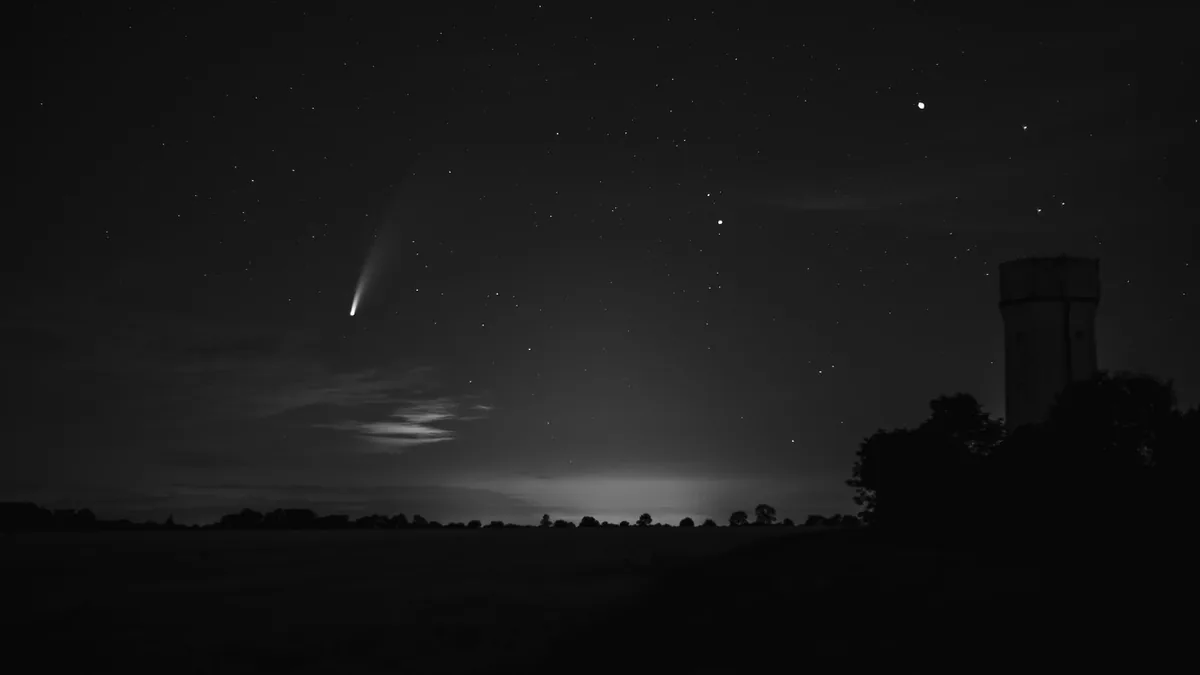
Sortiraparis says Earth travels through Halley’s dust trail every autumn and the comet will not return until 2061.
Halley’s comet expels dust particles from its nucleus like steam from a locomotive, leaving them in its path. Earth intercepts this debris trail in late October each year, and the expelled dust remains in the comet’s orbital path, forming the stream that produces the Orionid meteor shower. The grains are often smaller than a grain of sand. Sortiraparis explains that Earth passes through Halley’s Comet’s dust trail every autumn, and these tiny grains light up when they strike the atmosphere at high speed.
Halley’s comet measures 5 by 9 miles, or 8 by 14 kilometers, in size. It loses between 3 to 10 feet, or 1 to 3 meters, of material from its nucleus on each passage through the inner solar system. EarthSky pairs these dimensions with the per-passage material loss to show the nucleus can survive many orbits despite losing material each pass.
Halley’s comet is officially 1P/Halley, was the first comet to have its return predicted by Edmond Halley, and observers have sighted it since 240 CE. Its name honors its orbit calculator rather than its discoverer. The comet travels in a retrograde orbit tilted to Earth’s path, spends most of its time below the plane of Earth’s orbit, and is now near the head of Hydra at its farthest point from the sun, too faint to see. EarthSky notes that these orbital traits keep the comet out of view even though its debris creates the annual October shower.
The Orionids come from Halley’s comet particles on its inbound leg, while outbound-leg particles create the Eta Aquariid shower when Earth reaches that point in early May. Earth approaches the inbound particles from nearly the opposite direction, producing the fast speeds characteristic of Orionid meteors.
Observers need no telescope or binoculars, and observing is free. Sortiraparis recommends lying back and letting the eyes sweep a wide swath of the heavens. Newsday says finding a spot far from city lights helps observers see more of the faint streaks.
In central Paris, light pollution hampers viewing, and parks or high vantage points reveal only the brightest shooting stars. Better sites include Vexin Français Regional Natural Park in Val-d’Oise or Fontainebleau Forest in Seine-et-Marne. Sortiraparis says parks and high vantage points in Paris offer only the brightest shooting stars, so getting distance from the capital improves the experience. Checking the cloud cover forecast from Météo-France a few days before the peak is essential because clouds can ruin the view.
Eyes can take minutes to adjust to the dark. Newsday advises patience and finding a spot away from city lights and other light pollution.
The Orionids are viewable in both the northern and southern hemispheres after midnight, according to NASA. The All Saints’ Day holidays begin on Saturday, October 17, 2026, drawing families to pre-dawn viewing. Sortiraparis connects the shower timing to the autumn holiday period, when families are more likely to be awake before dawn.
The next major shower after the Orionids is the Southern Taurids, expected to peak on November 5 with a crescent moon. Newsday says this makes for favorable viewing conditions after the Orionid peak. The Leonids are expected to peak around November 17 and 18, 2026, with a relatively faint Moon.
The Association française d’astronomie and the Société astronomique de France regularly share observing tips and observing evenings. These French astronomy organizations are resources for observers who want tips and organized viewing events.
When Orionid debris enters Earth’s atmosphere, air resistance heats the particles until they burn up, and the surrounding air may glow briefly, leaving a fiery tail. Newsday presents this heating and glowing process as the physical cause of the fiery trails associated with shooting stars.





Join the discussion