
The article says you can observe the Wild Duck Cluster (M11) on the evening of October 17, 2026, and explains when, where and how to view it. The article provides viewing times, altitude, brightness, distance, age, size, star count and location tips.
Sunset on October 17, 2026, occurs at 6:17 PM local time for you at 40° N, 90° W. You’ll see the Moon is a waxing crescent with 45 percent illumination, rising at 1:59 PM and setting at 11:05 PM local time at those coordinates. You’ll find that M11 remains visible for several hours after sunset, sitting about 40 degrees high in the south one hour after dusk and still above 30 degrees in the southwest two hours after sunset.
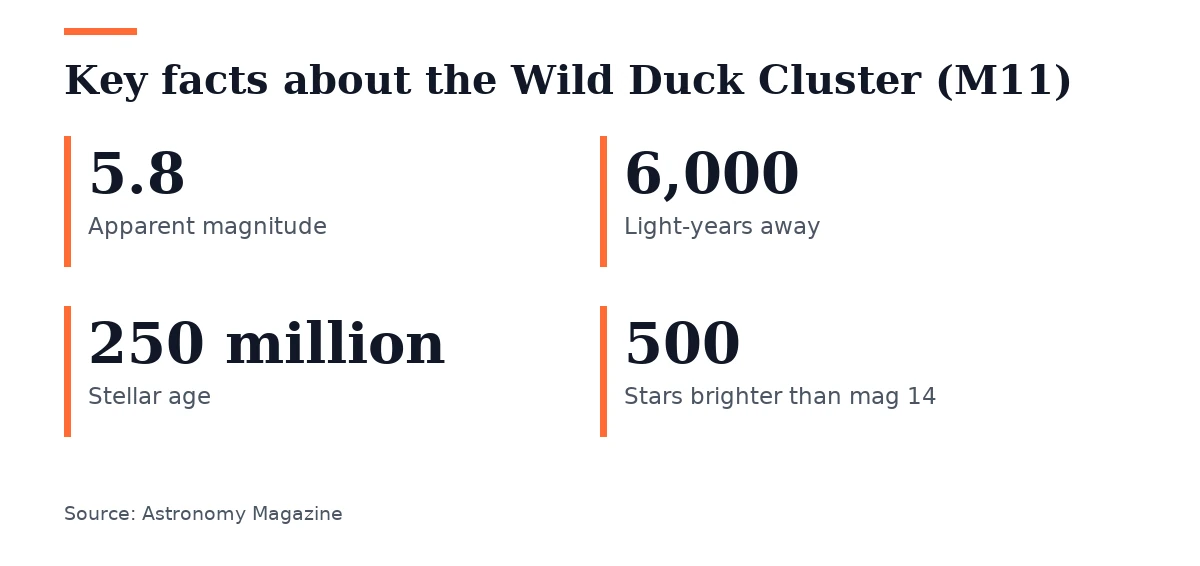
At magnitude 5.8 (a measure of brightness where lower numbers mean brighter objects), you’ll see that the Wild Duck Cluster shines with a brightness that makes its stars detectable in binoculars or a telescope. You’ll still see it even when the waxing Moon is nearby.
You’ll find that M11 lies about 6,000 light‑years from Earth (the distance light travels in one year) and scientists estimate its stars are roughly 250 million years old. You’ll see it spans approximately 14 arcminutes across the sky (about one‑quarter of a degree) and at least 500 of its members shine brighter than magnitude 14.
To find M11, you start at the tail of Aquila near Altair, then follow the curve of Lambda and 12 Aquilae before reaching Eta Scuti. You’ll find the cluster resides in the constellation Scutum the Shield.




Join the discussion