
Key facts
- To remain intact at its extreme spin, 491384 must possess substantial internal strength, suggesting a cohesive strength comparable to lightly cemented regolith or solid rock rather than a loose rubble pile.
- 2025 MN45 spins roughly 70 times faster than the gravitational spin barrier of ~2.2 hours, implying it must have internal cohesion comparable to solid rock (strength ≈9 MPa) rather than a rubble‑pile.
- A second ultra‑fast rotator, asteroid 566130, is about 2 kilometers (1.2 miles) across, spins once every 5.34 minutes and needs less than one megapascal of cohesive strength to stay intact.
The research team posted the research on 491384 and the new analysis pipeline to the arXiv preprint server with DOI 10.48550/arxiv.2610.07584, identifying asteroid 491384, which makes a full turn every 4.18 minutes. At 2.53 kilometers (1.57 miles) across, the asteroid is the biggest ultra-fast spinning asteroid ever reported.
The spin barrier is a well-known limit in asteroid science. Asteroids larger than about 150 meters are typically considered rubble piles, loosely bound chunks of rock that gravity alone keeps together. Spin them faster than roughly 2.2 hours and centrifugal forces should tear them apart. Asteroid 491384’s 4.18-minute rotation period exceeds that limit by a factor of more than 30, meaning the forces trying to pull it apart are orders of magnitude stronger than what gravity can resist.
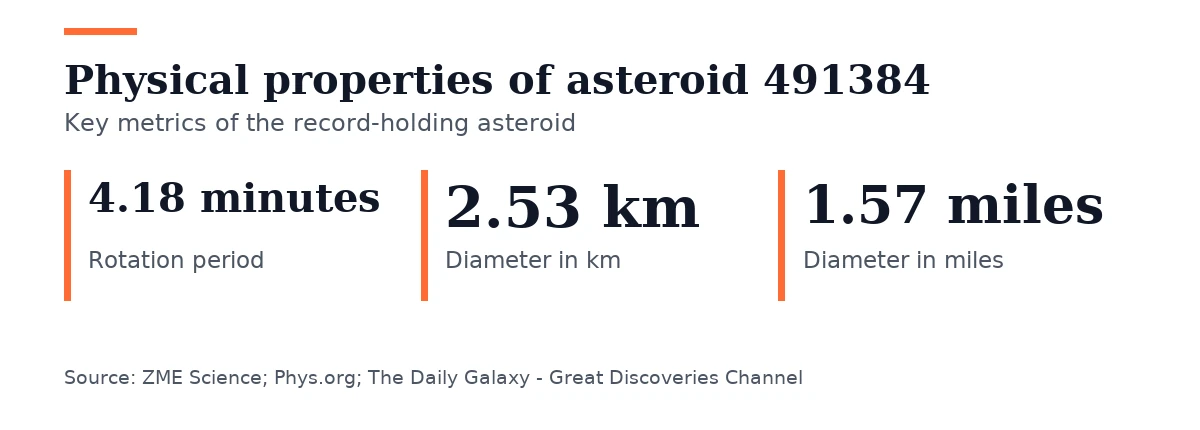
To survive such extreme spinning, 491384 needs internal strength like lightly cemented regolith or solid rock to hold together, instead of being a loose rubble pile. Color measurements place it in the C-type category, which are generally dark, carbon-rich objects, with a classification confidence of 97%. The researchers posted the research to the arXiv preprint server with DOI 10.48550/arxiv.2610.07584, providing a citable reference for the discovery and methods.
The discovery emerged from the Vera C. Rubin Observatory’s second data preview. A team led by Dmitrii Vavilov at the University of Washington created a tool that automatically examines how asteroids brighten and dim over time, fits those patterns to mathematical series, spots missing data, and generates several possible rotation speeds with confidence ratings. Because Rubin’s snapshots are irregular, raw light curves can produce false periods, so the team built automated vetters to separate genuine rotation from observational artifacts.
The tool was run on 9,417 asteroids that had at least 80 brightness readings apiece, gathered between April 2025 and January 2026. It cut an initial list of 1,487 apparent super-fast rotators down to 66 credible candidates. Among those were five ultra-fast objects, including 491384 and a second object, asteroid 566130, which measures roughly 2 kilometers (1.2 miles) wide and completes a spin every 5.34 minutes, needing less than 1 megapascal of cohesive strength to stay intact.
The Vera C. Rubin Observatory’s LSST Camera, the largest digital camera ever built, enabled the discovery of 2025 MN45 by capturing hundreds of observations across various nights and filters during its commissioning phase in April–May 2025. The commissioning phase used an unusual observing cadence of roughly 10 hours spread across seven nights, which proved ideal for detecting minute-scale brightness variations. “The discovery was enabled by the unusual observing cadence used during Rubin Observatory’s commissioning phase,” said Sarah Greenstreet, a lead author on the study.
The analysis also reexamined data from Rubin’s earlier commissioning phase in April and May 2025, during which astronomers identified asteroid 2025 MN45. That object measures roughly 710 meters (0.44 miles) across and turns once every 1.88 minutes, roughly 70 times faster than the gravitational spin barrier. The study on 2025 MN45 concluded it must have internal cohesion comparable to solid rock, with a strength of about 9 megapascals.
During that same commissioning window, astronomers found 19 asteroids rotating faster than the traditional spin barrier, including three with rotation periods shorter than five minutes. Spotted ultra-fast rotators have often been near-Earth objects, which feel stronger thermal pushes from sunlight. The main asteroid belt, where 2025 MN45 resides, is generally older and more collisionally evolved, making such extreme rotations there particularly unexpected.
2025 MN45 reflects about 0.15 of the sunlight that hits it, which is normal for rocky asteroids. Its actual size might be off by 20 to 30 percent if its surface turns out to be much darker or brighter than assumed. The Vera C. Rubin Observatory’s detection of 2025 MN45 and similar ultra‑fast rotators suggests they could be fragments from the dense core of a shattered larger asteroid. This hypothesis implies that the extreme rotation rates observed in these asteroids could be a relic of their violent formation from the remnants of a larger, more cohesive body.
If the measurements hold up, the fast spin of 491384 could reveal what forces keep an asteroid from flying apart when gravity falls short. That knowledge might lead experts to revise their models of internal strength and to rethink how they gauge the risks posed by rapidly rotating near-Earth objects. The discovery of 2025 MN45 and similar objects challenges existing theories of asteroid formation and evolution, suggesting that some asteroids keep coherent, rock-like interiors despite billions of years of collisions. This work could ultimately reshape how experts evaluate dangerous near-Earth objects.
The Vera C. Rubin Observatory’s Legacy Survey of Space and Time started on June 29, 2026. It aims to catalog as many as five million small bodies in the Solar System over the next ten years. While the main survey’s cadence will not typically capture such rapid rotations in a single week, the accumulated data over a decade is expected to reveal many more extreme objects statistically. The full survey will vastly increase the sample of asteroids available for spin-rate studies, potentially turning what now appears exceptional into a more common phenomenon.


Join the discussion