Key facts
- The Falcon 9 first-stage booster, tail number B1096, completed its eighth flight to space and back, landing at Landing Zone 40 adjacent to the pad fewer than 7.5 minutes after liftoff on October 13, 2026.
- Each IROSA blanket is capable of generating 20 kilowatts of electrical power.
- Dana Weigel said the new IROSA arrays have more efficient solar cells, higher energy density, and together generate more power than an original array did when it was new.
- The rollout solar arrays were built by Redwire Space and each is designed to deliver more than 20 kilowatts of power for over ten years.
On October 13, 2026, at 6:33 a.m. EDT, a Falcon 9 rocket lifted off from Pad 40 at Cape Canaveral Space Force Station, propelling a Cargo Dragon spacecraft toward the International Space Station. The Falcon 9 first‑stage booster, tail number B1096, completed its eighth flight to space and back, landing at Landing Zone 40 fewer than 7.5 minutes after liftoff.
Two minutes after liftoff, the Cargo Dragon, tail number C211, separated from the Falcon 9 upper stage to begin a two-day journey to the station. The spacecraft delivered more than 6,300 pounds of supplies, equipment and scientific experiments for NASA.
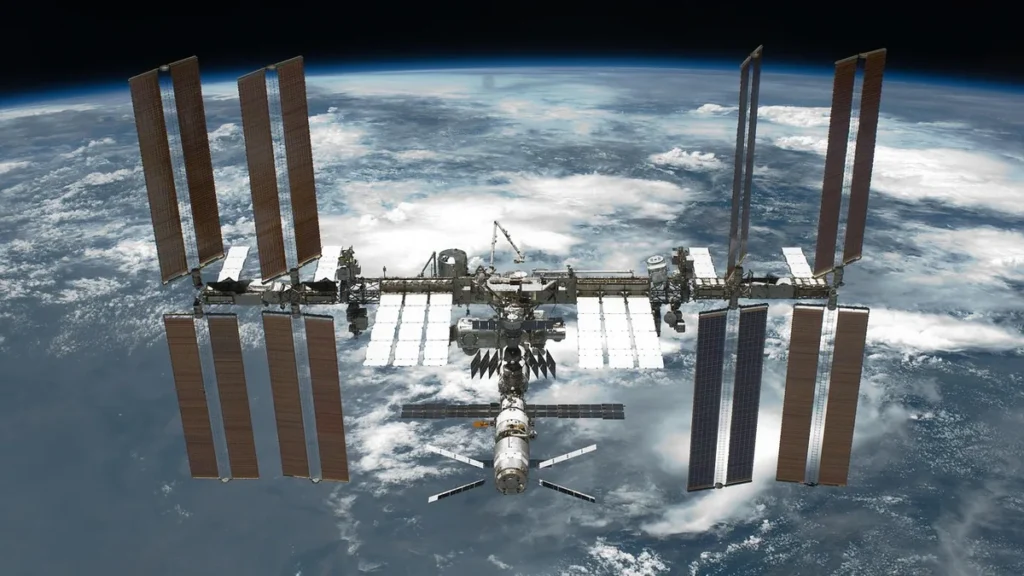
The Dragon’s unpressurized trunk carried two rollout solar array blankets with a combined mass of 2,635 pounds. Each IROSA blanket is capable of generating 20 kilowatts of electrical power.
Teams install the new IROSA arrays on top of and in front of the existing solar arrays, allowing the exposed part of the old arrays to continue generating power in parallel. Dana Weigel said the arrays have more efficient solar cells, higher energy density, and together generate more power than an original array did when new.
The new rollout solar arrays are the final sets in a major upgrade intended to compensate for age‑related degradation of the International Space Station’s original eight solar wings. The arrays were built by Redwire Space and each is designed to deliver more than 20 kilowatts of power for over ten years.
NASA has been preparing for the installation of the new rollout solar arrays through a series of spacewalks. Gaurang Patel, NASA’s operations integration manager for Low Earth Orbit Program, recalled that the ROSA technology was first demonstrated on the CRS‑11 mission in 2017, which led to efforts to leverage it for the ISS.
The legacy solar arrays lack standard upgrade interfaces, requiring teams to devise modification kits to safely mount the new ROSA units. NASA plans a variant of the ROSA technology to help power NASA’s Space Reactor 1 Freedom (SR‑1 Freedom) when it launches in 2028.
The Dragon spacecraft carries equipment to support more than 40 different scientific investigations aboard the International Space Station. Among the cargo is equipment to manufacture artificial retinas in microgravity, with the long‑term goal of helping restore eyesight on Earth.
The Cargo Dragon carried hardware for three‑dimensional heart‑tissue models that will aid large‑scale drug testing on upcoming space missions. On the station, investigators will study the formation of a novel glass type in microgravity conditions.
Researchers plan to examine brain organoids, small replicas of brain tissue, to seek therapy targets for Alzheimer’s, Parkinson’s and multiple sclerosis. Dragon was scheduled to dock autonomously with the station’s Harmony module at about 11:00 a.m. EDT on Thursday, October 15, 2026. SpaceX’s Dragon spacecraft successfully arrived at the International Space Station and docked at 10:27 a.m. EDT on October 15, 2026 with the space‑facing port of the Harmony module.
The Dragon spacecraft is slated to stay attached to the orbiting outpost until halfway through November, then descend for a splashdown off California’s shore. Starting its flight on October 13 at 6:33 a.m. EDT, the vehicle launched atop a Falcon 9 from Space Launch Complex 40 at Cape Canaveral Space Force Station, Florida.
The Dragon spacecraft flying on CRS‑35 is on its fourth flight, while the Falcon 9 first‑stage booster used for the launch is on its eighth flight. The Falcon 9 launch was timed to ensure the rocket climbed into the same orbital plane as the International Space Station, a requirement for rendezvous missions.



Join the discussion