Key facts
- Researchers discovered that black holes of vastly different masses follow a single scaling law when launching powerful jets, suggesting a universal mechanism that links accretion activity to episodic outbursts.
- The discovery was published in Nature Astronomy under the title "A universal critical accretion rate for black hole jet formation.".
- Two distinct jet-launching phases were identified: one early when the black hole feeds at extreme rates, and one delayed when the feeding rate drops to approximately 2% of the Eddington limit.
- The research was published in Nature Astronomy on September 17, 2026.
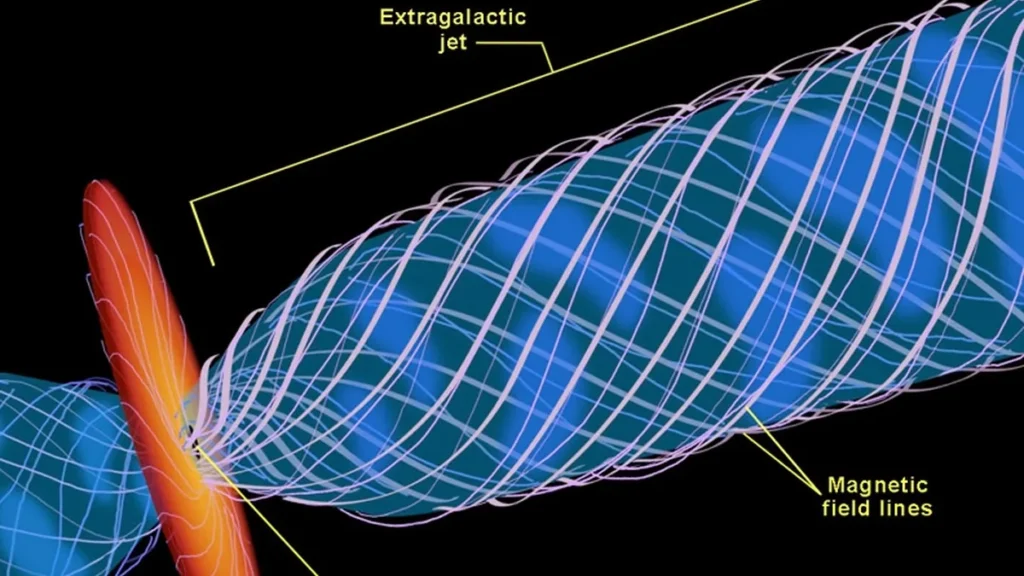
The team led by Dr. Adelle Goodwin of Curtin University’s International Centre of Radio Astronomy Research in Australia and Dr. Andrew Mummery of the Institute for Advanced Study in Princeton showed that black holes ranging from stellar to supermassive masses adhere to one scaling law when they launch powerful jets, pointing to a universal mechanism that connects accretion episodes with jet outbursts, a finding published in Nature Astronomy on 2026-09-17.
The study appeared in Nature Astronomy under the title ‘A universal critical accretion rate for black hole jet formation’ and carries the DOI 10.1038/s41550-026-02951-1. The Forrest Research Foundation backed Dr. Goodwin’s work without demanding a specific answer, supporting her pursuit of a challenging question. Professor James Arvanitakis, who directs the Forrest Research Foundation, said the discovery highlights why funding early‑career scientists who ask bold questions—without knowing where those answers will lead—is essential.
Knowing when delayed jets are likely to appear lets astronomers schedule radio‑telescope time more efficiently and avoid unnecessary follow‑up observations. The insight emerged during a conversation in a Madrid bar while Goodwin and Mummery attended a conference, where they noticed the jet‑launching rule seen in small black holes also applied to supermassive ones.
In stellar‑mass black holes within X‑ray binaries, the shift from soft to hard accretion states happens near 1%‑4% of the Eddington luminosity, averaging about 2%, the same level at which delayed jets form. A tidal disruption event occurs when a star wanders too close to a supermassive black hole, tearing the star apart; some debris falls inward while other material moves outward in outflows and jets.
These events shrink what would normally be a years‑long feeding phase for a supermassive black hole into just a few years, giving astronomers a rare real‑time view of the process. The Eddington limit marks the point where radiation pressure pushing outward exactly balances the inward pull of gravity. Delayed radio flares often rise much more steeply than the prompt ones, indicating ongoing energy injection from a compact jet.
The researchers looked at 20 tidal disruption events with data from observatories in Australia, the US, India, South Africa and orbiting instruments, then kept the 10 events with the clearest constraints on both feeding rate and radio outflow timing. From those 10 events they reconstructed 11 separate radio outflows, each with solid measurements of when the outflow launched and how quickly the black hole was feeding.
They identified two jet‑launching stages: an early phase when the black hole is consuming matter at extreme rates, and a later phase that turns on when the inflow has dropped to roughly 2% of the Eddington limit. That delayed phase appears when the accretion rate falls to about 2% of the Eddington limit, the same threshold already seen in stellar‑mass black holes in the Milky Way.
Using a suite of one million simulated tidal‑disruption disks built from an observed black‑hole population, the team found that roughly 42% would go through a super‑Eddington phase and about 40% would cross the 2% Eddington mark within a window of roughly 200 days to seven years. Independent observations show that delayed radio flares occur in about 40% of tidal disruption events, matching the simulation result.

Three of the twenty events lacked good late‑time optical or ultraviolet measurements, and eight more could not reliably constrain the accretion disk during the period when the outflow would have launched. As future surveys uncover more tidal disruption events, the link between how fast the black hole feeds and whether it launches a jet can help researchers focus on the systems most likely to produce detectable outflows.
By connecting the behavior of small black holes to that of supermassive giants, the results reinforce the idea that the same basic physical processes operate across vastly different mass scales. Prompt radio outflows appeared while the black holes were feeding at or above the Eddington rate, which the researchers interpreted as winds driven by super‑Eddington accretion. The low‑frequency part of the Square Kilometre Array Observatory will be located in Western Australia. The Australian government has contributed $387 million to the SKA project, whose total budget exceeds $2 billion.
"That tells us something fundamental about black holes: the physics does not seem to care how big they are."
Dr. Adelle Goodwin, ScienceDaily





Join the discussion