Key facts
- Researchers from ETH Zurich, DLR, and the Institute of Applied Geosciences used orbital gravity and magnetic data to identify a buried volcanic structure beneath the Dewar swirl on the lunar far side.
- The magnetization persists for hundreds of thousands to millions of years, far longer than the few‑day field expected from an impact, supporting a long‑lasting dynamo as the source.
- Estimates of the ancient lunar magnetic field strength are greater than 10 microteslas, with a model‑dependent minimum of 11.4 microteslas, compared to Earth’s present‑day field of about 50 microteslas.
- Lunar swirls can mark regions where ancient magnetic fields offered solar‑wind shielding, which is relevant for protecting future astronauts and lunar base concepts.
You may wonder whether the Moon ever had its own magnetic field. Scientists have debated this for decades. The Moon currently has no global magnetosphere, meaning it lacks a planet‑wide magnetic field.
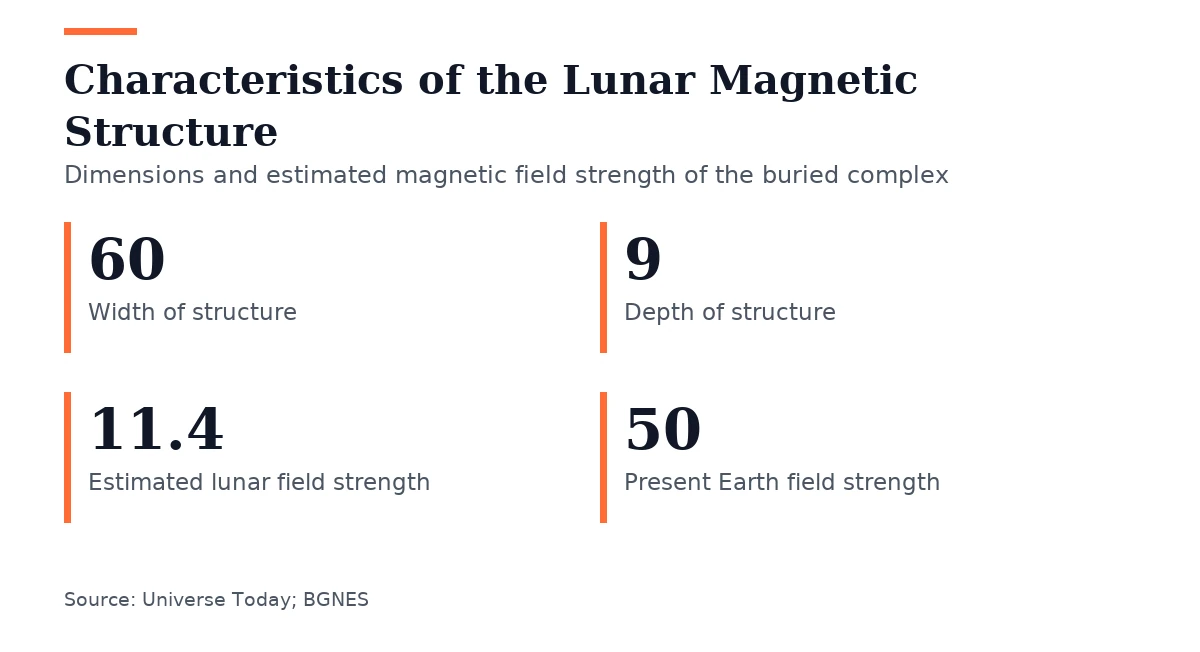
Researchers from ETH Zurich, DLR and the Institute of Applied Geosciences used orbital gravity and magnetic data to find a buried volcanic structure beneath the Dewar swirl on the Moon’s far side. This buried body of rock is dense and strongly magnetized. It measures about 60 kilometers (37 miles) across and extends roughly 9 kilometers (5.6 miles) below the surface.
Analysis shows the rock consists of solidified magma that formed around 4.2 billion years ago. Scientists interpret it as a buried volcanic complex.
The structure lies beneath the Dewar swirl, a bright, sinuous marking on the lunar surface. The swirl sits on top of ejecta from the South Pole‑Aitken basin dated to about 4.32 billion years ago and is covered by material from the Freundlich‑Sharonov basin dated to around 4.14 billion years ago.
This layering indicates the lunar surface was influenced by a magnetic field roughly 4.22 billion years ago, matching the age of the buried volcanic feature.
The magnetization of the Dewar swirl runs horizontally. A horizontal anomaly deflects the incoming solar wind—a stream of charged particles from the Sun—and helps preserve bright, high‑albedo regolith on the surface.
Regolith is the layer of loose dust and rock that covers the Moon. In contrast, a vertical anomaly funnels solar wind toward the ground and darkens the regolith, showing how the orientation of magnetism changes space‑weathering across the Moon.
Measurements indicate the magnetization of the buried rock lasts for hundreds of thousands to millions of years. That is far longer than the brief field expected from an impact event.
Such longevity supports the idea of a long‑lasting dynamo—a flow of conducting fluid in the lunar core that generates a steady magnetic field—rather than a fleeting impact‑generated signal.
Estimates place the ancient lunar field strength at greater than 10 microteslas, with a model‑dependent minimum of 11.4 microteslas. A microtesla is a unit used to measure magnetic field strength.
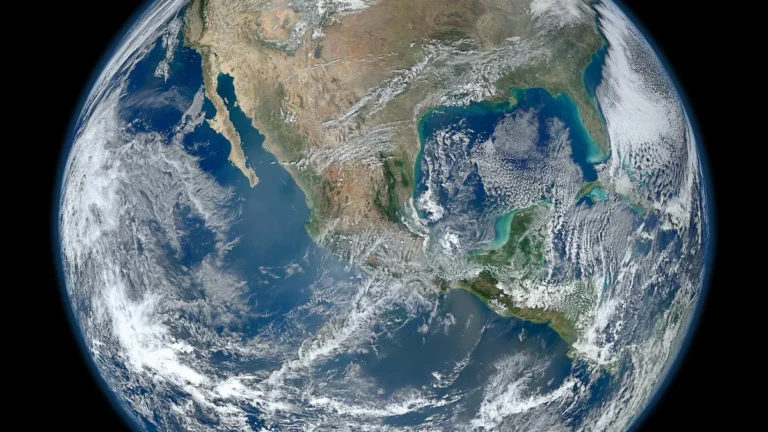
For comparison, Earth’s present‑day magnetic field measures about 50 microteslas, so the early lunar field, while weaker, would still have been able to deflect solar wind. The combination of a magnetized volcanic rock dated to 4.2 billion years ago and a persistent field suggests volcanism occurred while a dynamo was active, pointing to a more vigorous early interior than previously thought. Lunar swirls are bright, sinuous surface markings that arise where local magnetic anomalies alter the way space‑weathering affects the regolith.
These swirls can mark regions where ancient magnetic fields once shielded the surface from solar‑wind implantation, a process that darkens the regolith over time. Such natural shielding is relevant for protecting future astronauts and lunar base concepts because it reduces the radiation dose from the solar wind. Artemis aims to land near the lunar south pole for water resources; magnetic anomalies identified there could provide additional radiation shielding for habitats.
Upcoming missions such as Lunar Vertex (targeting Reiner Gamma), Chang’e‑7 and Chang’e‑8, and Artemis surface operations could return samples to test the early dynamo hypothesis. Analyzing returned rocks would allow scientists to measure remnant magnetism and refine models of the ancient lunar field. Scientists could apply the same gravity‑magnetic analysis technique used to locate the buried structure to other worlds like Mars. However, current orbital data for Mars lack the resolution needed to detect comparable subsurface magnetic signatures.
Understanding that the Moon once hosted a magnetic dynamo reshapes ideas about its early volcanic activity and highlights locations where ancient fields could have protected the surface. This knowledge feeds directly into Artemis landing‑site selection and the design of future lunar habitats that seek to use natural magnetic shielding for radiation safety.


Join the discussion