
Key facts
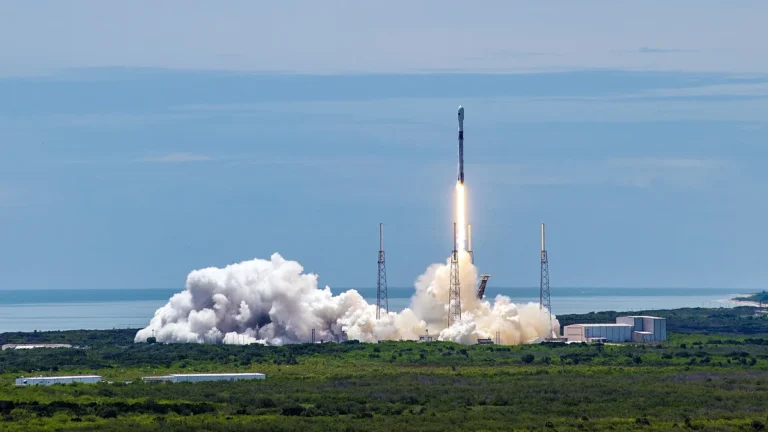
- JUICE launched on 14 April 2023 from Kourou aboard an Ariane 5 rocket.
- JUICE is on its way to Jupiter and should arrive in July 2031 for about four years of study of the Jupiter system.
- JUICE will enter orbit around Jupiter in 2031 and then move to an orbit around Ganymede three years later, in 2034.
- Before its final year, JUICE will fly past Ganymede, Europa and Callisto several times, then go into orbit around Ganymede.
ESA’s JUICE spacecraft passed 8,640 kilometers above the Indian Ocean on September 28, 2026, using Earth’s gravity to bend its path toward Jupiter, mission officials said.
The encounter changed the craft’s direction by 20 degrees and added 3.5 kilometers per second to its speed without burning much propellant. Angela Dietz, JUICE’s spacecraft operations manager, said the flyby required ultra-precise navigation and that careful planning used only a small portion of the propellant reserved for the maneuver, leaving more for Jupiter observations. Mission controllers began tracking JUICE particularly closely on August 17, 2026, and maintained intensive monitoring through October 10, 2026.
In the four weeks before the encounter, controllers used just one of six reserved opportunities to make a small course correction. During the September 2026 flyby, JUICE spent several days traveling through Earth’s magnetotail, the stretched magnetic field trailing behind the planet, measuring magnetic fields and electrically charged particles far from Earth. At the same time, the European-Chinese Smile mission observed the aurora and measured magnetic fields and particles nearer to Earth.
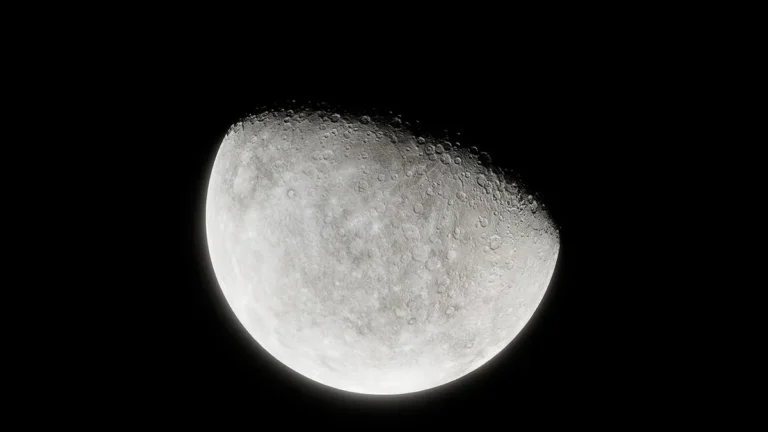
Combining the two datasets could give scientists a rare way to link activity deep in Earth’s magnetotail with events around the planet’s polar regions. Cameras captured images of Africa, Madagascar, and the Moon as the spacecraft skimmed the outer atmosphere. In the coming weeks, scientists plan to release images and spectra from some JUICE instruments once the data reach Earth and teams evaluate them. The release will include JANUS high-resolution views of Earth and the Moon.
The September 2026 Earth encounter was the third instrument-calibration opportunity of the mission. It followed a 2024 lunar-Earth gravity assist and 2025 observations of Comet 3I/ATLAS. Flybys give rare chances to calibrate and validate instruments under well-understood environmental conditions before arrival at Jupiter. During a Moon flyby in August 2024, the JANUS camera took an image of the Moon and the RIME radar acquired a radargram, a radar image of subsurface structure.
JANUS observed Comet 3I/ATLAS in November 2025. During an Earth flyby in August 2024, UVS recorded geocoronal hydrogen atoms, MAJIS imaged Earth’s cloudy structures, RPWI recorded radio waves, PEP measured electron fluxes, RADEM measured Earth’s radiation belts, and SWI measured atmospheric composition. The August 2024 Earth encounter gave teams multiple instrument datasets from a real planetary target. JUICE launched on 14 April 2023 from Kourou aboard an Ariane 5 rocket.
Europe’s Spaceport in Kourou, French Guiana, hosted the launch, the same site that sent the James Webb Space Telescope aboard an Ariane 5 in December 2021. The truck-size spacecraft carries two cross-shaped solar arrays for power and lead-lined vaults to protect its most sensitive electronics. Because of the eventual spacecraft-Earth distance, a one-way signal to JUICE will require 45 minutes. JUICE is the first large-class mission in ESA’s Cosmic Vision programme; it was proposed in 2007 and selected in 2012.
The ESA-led mission includes contributions from NASA and the Japanese Aerospace Exploration Agency. JUICE is scheduled to arrive at Jupiter in July 2031 for about four years of study of the Jupiter system. After arrival, the spacecraft will examine the giant planet and its icy satellites before settling into a final orbit around one moon. The spacecraft will enter orbit around Jupiter in 2031 and then move to an orbit around Ganymede three years later, in 2034.
That will make JUICE the first spacecraft to orbit a moon in the outer solar system. JUICE will return to Earth for a third and final flyby in January 2029, which will place the spacecraft on the final trajectory needed to reach Jupiter in 2031. The January 2029 encounter completes the series of Earth, Moon, and Venus gravity assists that shape JUICE’s path to Jupiter. JUICE is scheduled to carry out 35 flybys of Jupiter’s large moons Ganymede, Callisto, and Europa.
Before its final year, JUICE will fly past Ganymede, Europa and Callisto several times, then go into orbit around Ganymede. The icy-moon encounters form the core scientific campaign after Jupiter arrival. JUICE’s trajectory was designed for 21 Callisto flybys but only two Europa swing-bys. Europa sits within Jupiter’s radiation halo, and two orbits there would cause a third of the spacecraft’s overall radiation exposure.
Jupiter’s magnetic field is 20 times stronger than Earth’s and creates a harsh radiation environment that affects its moons, including auroras, hot spots, radio emissions, and waves of charged particles. Christian Erd, JUICE spacecraft and system manager, said modeling showed what seemed dangerous was not completely out of reach. He said three and a half years at Jupiter equals 20 years of geostationary satellite radiation exposure. JUICE will investigate conditions that may support habitable environments within Jupiter’s icy moons, all of which are thought to contain subsurface liquid water oceans.
Assessing habitability is central to the mission’s science case for the Galilean satellites. Ganymede, the largest moon in the Solar System, is a prime target due to its internal structure, possible subsurface ocean, unique intrinsic magnetic field, and complex interactions with Jupiter’s magnetosphere. Michele Dougherty, a Royal Society research professor at Imperial College London and JUICE magnetometer principal investigator, said JUICE confirms that ideas about where to look for possible habitability have shifted over the past 20 years.
Scientists view the icy moons as possible habitats because interior heating could maintain subsurface oceans beneath thick ice shells. Dougherty said life as understood on Earth requires liquid water, a heat source, and organic material, stable over a long enough period. She said JUICE will confirm liquid water and heat sources while other instruments remotely sense organic material on the surface. Dougherty said the first one or two JUICE flybys of Ganymede are when the spacecraft will confirm the existence of an ocean.
The first one or two flybys is when we are going to confirm the existence of an ocean. — Michele Dougherty, Royal Society research professor at Imperial College London and principal investigator of JUICE’s magnetometer. Early Ganymede encounters are considered the most critical for verifying a subsurface ocean. JUICE can search the moons for evidence of life building blocks including carbon, oxygen, nitrogen, iron, and magnesium. Galileo and Cassini earlier confirmed that liquid water exists on distant planets and moons and probably lies beneath their surfaces.
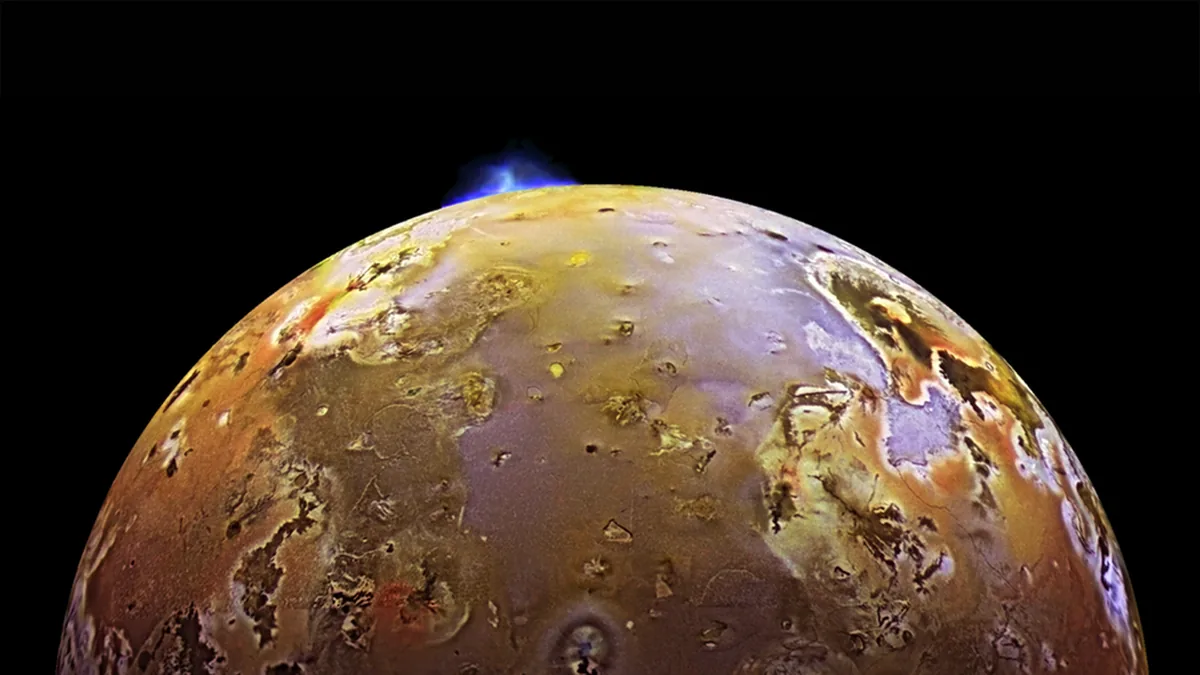
JUICE will study Jupiter’s atmospheric circulation, composition, and energy flow from the cloud tops to the thermosphere as part of a global investigation of the giant planet system. Jupiter serves as the archetype for gaseous giant planet systems across the Universe. The spacecraft will characterise the three-dimensional structure of Jupiter’s magnetosphere and its coupling with the ionosphere and thermosphere. The magnetosphere investigation addresses how the giant planet’s magnetic environment connects to its upper atmosphere.
It will study how the moons interact with the magnetosphere and examine tidal and gravitational changes across the Galilean system. These studies address how Jupiter’s satellites and its magnetic field shape one another over time. Other goals cover Io, its neutral cloud and plasma torus, several small inner and irregular moons, and the rings. JUICE carries 10 instruments, an onboard radiation monitor, and one experiment that uses its telecommunications link to ground-based radio telescopes for radio science.
The instrument suite supports remote sensing, geophysical, and in-situ measurements across the Jupiter system. Teams from ESA’s spacecraft operations, science operations, and technical centers spent months coordinating with outside groups responsible for JUICE’s 10 scientific instruments to schedule operations and extract science and calibration time. Limited spacecraft resources meant instrument activities sometimes had to be prioritized, such as during passages through Earth’s shadow when JUICE relied on battery power.
Claire Vallat, the JUICE project scientist, said the trip to Jupiter offers only a handful of chances to calibrate and test instruments in well-understood conditions. Calibration priorities weighed relevance to Jupiter preparations against whether an opportunity was unique or could be scheduled later in the journey. Planning for the Europa flybys began years in advance, and discussions about how the instruments will operate began about 10 years ago. Those discussions will continue until JUICE passes the moon in the early 2030s.
Long-term instrument planning reflects the scientific demand of each precious icy-moon flyby. The JUICE overview appeared in Space Science Reviews in 2026 and was posted on the preprint server arXiv. The exploration of Jupiter began with NASA’s Pioneer and Voyager missions in the 1970s. Dedicated Jupiter missions like Galileo followed, and the Juno probe has been orbiting Jupiter and flying by some of its moons since 2016.
JUICE joins a multi-decade history of robotic Jupiter exploration. Europa Clipper, a NASA mission that launched in 2024, is expected to arrive at Jupiter in April 2030. The spacecraft will conduct nearly 50 Europa flybys and pass within 16 miles (25 kilometers) of the surface. Europa Clipper precedes JUICE at Jupiter and focuses intensively on Europa’s habitability.
Europa Clipper is the largest spacecraft NASA has launched into deep space, weighing 12,800 pounds (6,000 kilograms). All nine of Europa Clipper’s instruments will be turned on and collecting data during the flyby. E-THEMIS will scan Earth every eight hours as Europa Clipper approaches and will track Europa’s warm regions to determine where water is closest to or may have erupted onto the surface.
Europa Clipper will pass within about 1,950 to 2,133 miles (3,140 to 3,450 kilometers) of Earth on Thursday, December 3, 2026, with the closest approach west of Africa at 3:14 p.m. EST. The Earth gravity assist gives the spacecraft a propellant-saving boost and a chance to calibrate instruments before Jupiter. Europa Clipper passed 550 miles (884 kilometers) above Mars in March 2025, using the planet’s gravity to slow down and change its solar orbit.
The Mars flyby was an earlier gravity assist in Europa Clipper’s cruise to Jupiter. Europa Clipper will begin orbiting Jupiter using Ganymede’s gravity to slow down and be captured by Jupiter’s gravity when it approaches its destination. Robert Pappalardo, Europa Clipper’s project scientist at NASA’s Jet Propulsion Laboratory, said the spacecraft is pulled by Earth’s gravity and continues on its way with a slightly changed trajectory moving faster than before. Erin Leonard, a Europa Clipper project staff scientist at JPL, said teams are rehearsing collaboration to produce the best science.
JUICE and Europa Clipper together might reveal major mysteries about Jupiter and its moons. Pappalardo said the Earth flyby will allow absolute magnetometer calibration, using Earth observations to improve calibrations made before launch and during flight. Earth observations provide a known reference to pin down the instrument’s actual measured values. The Magnetometer will examine Jupiter’s magnetic field at Europa to verify the ocean hidden beneath the icy crust.
The thermal imager previously captured Mars in infrared during the 2025 Mars flyby. Europa-UVS will study Europa’s atmosphere and surface, and teams will compare its Earth observations with Lunar Reconnaissance Orbiter’s LAMP instrument, which will study Earth’s geocorona during the flyby. Multi-spacecraft Earth observations serve as a test run for similar studies at Jupiter. Kurt Retherford of Southwest Research Institute is principal investigator for LAMP, Europa-UVS, and the UVS instrument on ESA’s JUICE mission.
Europa has its own atmospheric corona of escaping hydrogen and other atoms, Retherford notes. On later Europa flybys, Europa Clipper will measure icy-shell thickness, study composition, and characterise geology. Findings will help scientists assess the potential for habitable worlds beyond Earth.

Join the discussion