Key facts
- Because white dwarf luminosity declines, a planet depending only on the star's irradiative heating has trouble staying habitable for long.
- Researchers use an orbit-dependent induction model together with white dwarf cooling tracks to gauge how much ohmic dissipation adds to planetary surface energy budgets and to set a ceiling for effective heat deposition.
- Scientists reported possible first evidence of a second-generation planet around white dwarf HS 0209+0832, about 270 light years from Earth, in a Nature Astronomy study covered on October 12, 2026.
- A repeating brightness cycle of about 4.4 days could line up with day-night temperature variation on a massive planet orbiting at 0.04 AU, 25 times closer than Earth is to the Sun.
A preprint by Xueyuan Wang, Cong Yu, Bo Ma, Di-Chang Chen and Jianheng Guo posted to the astro-ph.EP server on November 27, 2026, examines whether magnetic unipolar induction can deliver steady warmth to rocky planets orbiting near white dwarfs.
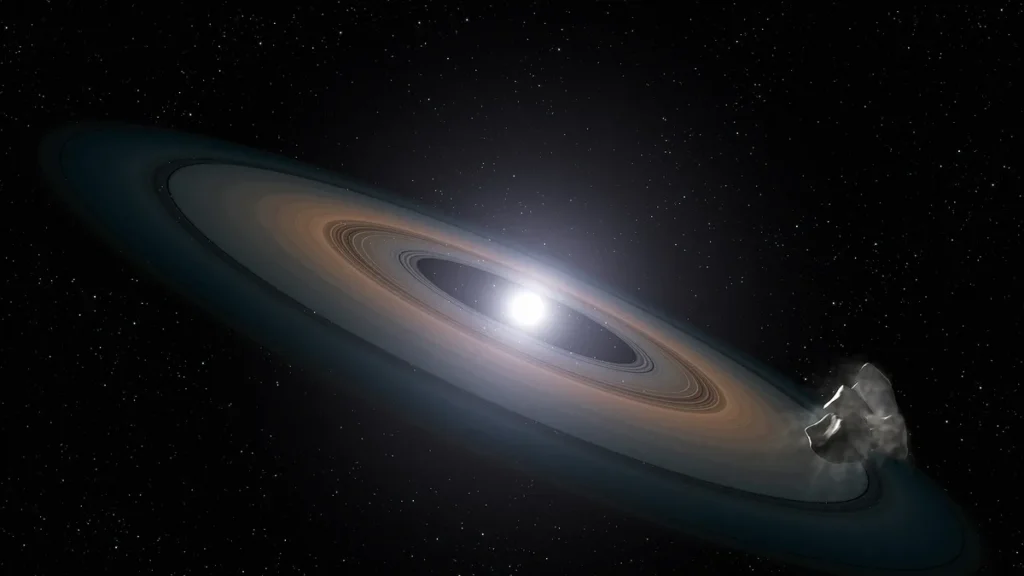
White dwarfs are the dense remnants of stars like the Sun after they shed their outer layers, and their luminosity declines as they cool. A planet depending only on that fading irradiative heating has trouble staying habitable for long. The authors pair cooling tracks with an orbit-dependent induction model to measure the ohmic dissipation contributing to planetary surface energy budgets and set an upper limit under efficient heat deposition. The paper notes several non-radiative heating ideas have been proposed but says white dwarf magnetism’s role in planetary energy budgets remains largely unexplored.
The authors found that for certain orbital distances and stellar spins, induction heating can deliver a nearly steady surface energy flux that partly offsets fading white dwarf irradiation late in the star’s life. The result points to a lasting outer temperate region and, in some cases, a narrow inner zone emerging after substantial cooling. They describe magnetic induction as a viable long-lived supplement to radiative heating rather than a fleeting effect.
White dwarfs host remnant planetary material, evidence that rocky objects can survive the post-main-sequence phase and migrate into very close orbits. The authors point to this surviving material as evidence that rocky objects survive the post-main-sequence phase and migrate into very close orbits, which sets up the habitability question their paper addresses.
A possible second-generation planet around the cooling white dwarf HS 0209+0832, about 270 light years from Earth in the constellation Cetus, was reported on October 12, 2026. British researchers looked again at 1999 Hubble observations of HS 0209+0832 in the Milky Way’s Cetus constellation and catalogued roughly one hundred unmatched chemical features. They theorized that abundant niobium and other elements heavier than iron indicate a planet formed from material ejected as the white dwarf died, and that the star is feeding on that world; these elements form only briefly inside dying stars.
Dr. Nicholas Stone, a theoretical astrophysicist at the University of Wisconsin – Madison and study co-author, said these heavy elements emerge only in exotic conditions that briefly appear inside dying stars. A brightness cycle repeating about every 4.4 days might match day-night temperature swings on a massive planet orbiting at 0.04 AU, a distance 25 times tighter than Earth’s orbit around the Sun. Should the planet exist, it is losing atmosphere, but Jamie Williams, a University of Warwick astronomer and study co-author, said the world is likely to survive.
She said the white dwarf will cool to a steady temperature and maintain a planet within a stable habitable zone for millions of years. She told Universe Today that a close rocky planet could remain habitable for tens of billions of years, longer than Earth’s expected fate when the Sun dies in about 5 billion years. Experts said official confirmation of the first-ever second-generation planet has not yet taken place, and more research is still required.
The first habitable-zone concept counted any planet at the right distance from its star as potentially habitable because liquid surface water could exist there. Researchers now apply an optimistic habitable zone that expands outward thanks to geothermal heating and inward because rotation can block greenhouse conditions, plus a narrower conservative habitable zone. For the conservative zone, the inner edge marks where a planet could face a greenhouse condition, while the outer limit occurs when CO2 condenses from the atmosphere and removes warmth required for liquid surface water. Habitable-zone thinking has moved from a basic liquid-water distance to optimistic and conservative versions and newer temperate-zone research.
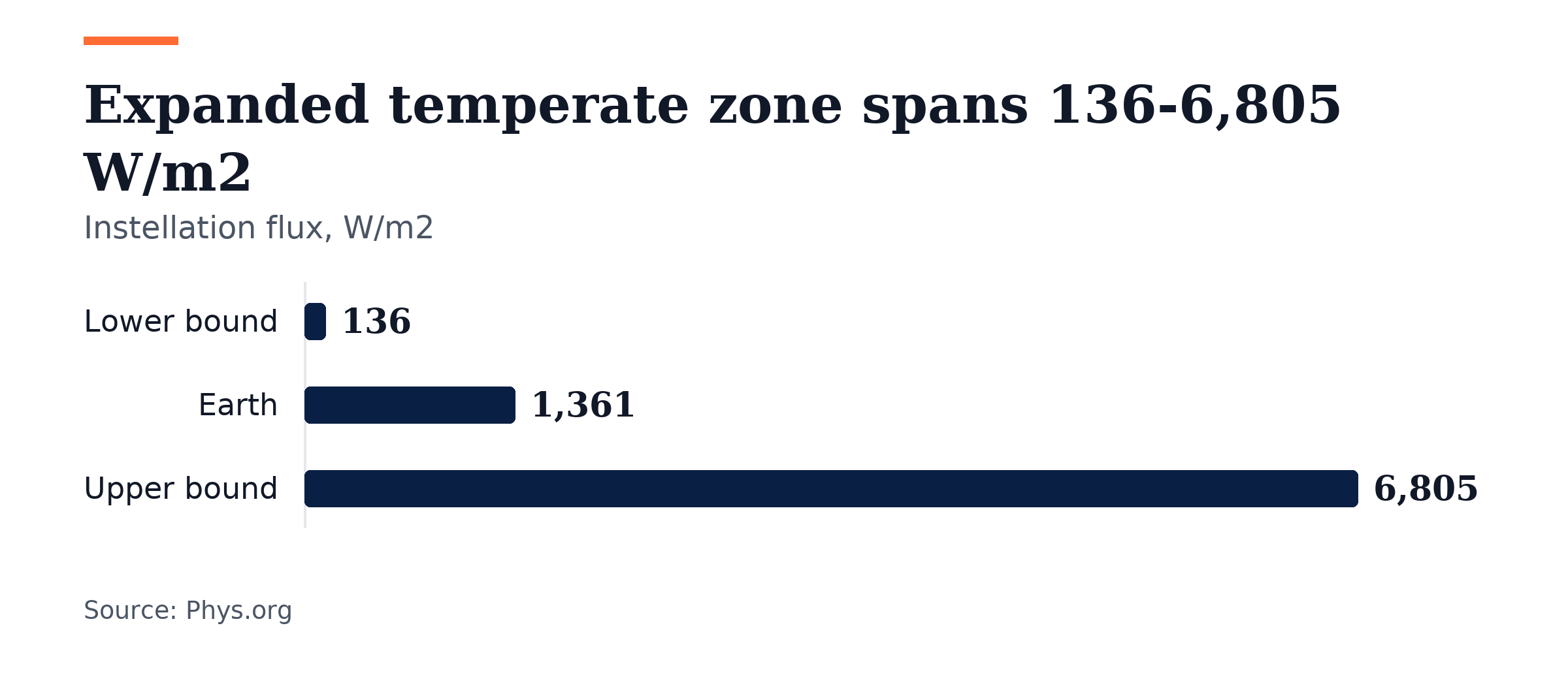
Work appearing in Monthly Notices of the Royal Astronomical Society in 2026, co-led by Madison Scott of the University of Birmingham School of Physics & Astronomy and Georgina Dransfield, an exoplanet scientist at the University of Oxford, adds a temperate-zone concept to habitable-zone definitions. The expanded temperate zone uses instellation flux, the energy a star sends to a planet, ranging from 0.1 to 5 times Earth’s solar constant, or about 136 W/m2 to 6,805 W/m2 against Earth’s roughly 1361 W/m2. This zone is deliberately wider than the conservative habitable zone and groups planets that receive moderate instellation without demanding liquid surface water.
TEMPOS, the Temperate M Dwarf Planets With SPECULOOS survey, is introduced in the paper to seek Earth-like planets around tiny, dim stars and catalog precise radii of temperate planets transiting mid- to late-type M dwarfs. SPECULOOS stands for Search for habitable Planets EClipsing ULtra-cOOl Stars. Temperate planets orbiting mid- to late-type M dwarfs at or below 3400 K are much more likely to pass in front of their star and be detected, since equilibrium temperature depends on orbital distance and stellar temperature.
TOI-6716 b is an Earth-sized, likely rocky world measuring roughly 0.91 to 1.05 Earth radii, while TOI-7384 b is a sub-Neptune, a planet larger than Earth but smaller than Neptune, spanning about 3.35 to 3.77 Earth radii and possibly hiding a rocky core beneath a thick envelope of hydrogen and helium. Neither world sits in its star’s optimistic habitable zone, yet both occupy a barely populated part of temperate planet parameter space useful for future atmospheric studies. TOI-6716 b looks like a strong rocky-world target for JWST if it kept its atmosphere, with a transmission spectroscopy metric comparable to TRAPPIST-1, while TOI-7384 b’s size and predicted mass also make it appealing for JWST and other upcoming facilities.
On July 29, 2026, astronomers announced the first detection of an atmosphere around an Earth-like rocky planet orbiting within another star’s habitable zone. Researchers detected the atmosphere on LHS 1140 b, a rocky exoplanet roughly 48 light-years from Earth that circles a red dwarf inside the star’s habitable zone, where temperatures and conditions could support liquid surface water. Collin Cherubim, the lead author who recently earned a Ph.D. in Earth and Planetary Sciences from Harvard University, said a planet must have an atmosphere to support life as we know it.
The Science paper is the first to clearly show an atmosphere on a rocky planet in a habitable zone, an atmosphere believed to have lasted for billions of years. Cherubim and colleagues’ theoretical model predicted that LHS 1140 b has an upper atmosphere rich in helium, with the gas slowly escaping into space. Observers used the Warm Infrared Echelle (WINERED) Spectrograph on the Magellan Telescope at Las Campanas Observatory in Chile during a rare night when LHS 1140 b and one other planet transited their star together.
Helium escaping from around LHS 1140 b confirmed that the planet retains an atmosphere, while the other planet showed no sign of one. David Charbonneau, head of the Harvard Department of Astronomy and an astronomer at the Center for Astrophysics | Harvard & Smithsonian, doubted the result at first but was convinced by the statistically solid detection. The astronomers estimate that LHS 1140 b’s atmosphere has likely lasted for more than three billion years, making it a valuable target for future observations.
Cherubim aims to map the atmosphere’s full composition and check whether the planet holds surface oceans. The researchers say ground-based observations that look for escaping gases could become an important tool for studying atmospheres on rocky exoplanets.




Join the discussion