Key facts
- A team including researchers from the University of Tokyo simulated the entire Milky Way galaxy down to individual stars using three supercomputers and an AI-accelerated model.
- The team ran the same software on three exascale supercomputers named Aurora, Frontier, and JUPITER, using different hardware that mixes Intel, NVIDIA, and AMD CPUs and GPUs.
- In earlier state-of-the-art simulations such as Auriga and FIRE, the smallest particles were star clusters of about 100 solar masses, and individual star behavior was averaged out.
- In the new simulation, each individually simulated particle has one solar mass, serving as a proxy for the population of stars.
A team including researchers from the University of Tokyo simulated the entire Milky Way galaxy down to individual stars using three supercomputers and an AI-accelerated model, presenting the work at SC26, the International Conference for High Performance Computing, Networking, Storage and Analysis, in Chicago from Nov. 15–20, 2026. Keiya Hirashima of RIKEN in Japan is the lead author of the paper, titled “Architecture-Agnostic Exascale Star-by-Star Simulation of Our Galaxy.” The researchers said the work can improve understanding of galactic evolution by capturing stellar-scale effects that simpler simulations miss.
The team ran the same software on Aurora, Frontier and JUPITER, three exascale supercomputers built with different hardware that mixes Intel, NVIDIA and AMD CPUs and GPUs. Linking the systems was only part of the solution, Universe Today says, and strong performance across all three required specific optimizations because each system uses different makers’ processors and graphics chips. The team described the cross-hardware adaptation as its most recent key development.
PHEASANT, an AI model built by Keiya Hirashima, a postdoctoral researcher at RIKEN, forecasts how gas around a supernova explosion changes over time. “My model predicts gas distribution after 100,000 years,” Hirashima said. Full calculation of supernova gas evolution calls for time steps of roughly 100 years, while the AI model jumps ahead to 100,000 years and allows the galaxy-wide run to use longer steps.
Michiko Fujii, a professor in the Department of Astronomy at the University of Tokyo, said finer detail requires much shorter time steps in dense, rapidly changing gas regions, greatly increasing calculation requirements. “We overcame this problem by using an AI model to predict how gas around supernova explosions evolves,” Fujii said. She described this as a barrier for Milky Way-sized galaxies even as computational power increases.
According to the researchers, the AI shortcut makes the full simulation roughly 20 times quicker than calculating the supernova process exhaustively in the usual way. The team validated the model by showing its star formation rate matches the rate estimated from observations of the actual Milky Way.
Earlier state-of-the-art simulations such as Auriga and FIRE used particles representing star clusters of about 100 solar masses, and individual star behavior was averaged out. In the new simulation, each individually simulated particle has one solar mass, serving as a proxy for the population of stars. With trillions of particles, the authors state that the simulation resolves individual stars and models their supernova feedback self-consistently within a galactic-scale simulation.
Fujii said researchers can use the simulation to examine how individual supernovae affect star birth, the scale of vast gas bubbles, and material streaming outward. She said it can also show whether groupings of stars grow into clusters.
The team has not yet fully formed a galaxy like the Milky Way in its simulations, Hirashima said, and tracing that history remains a key next step. He added that the run lets researchers track material circulation directly, with particular interest in how spiral arms connect to molecular cloud formation, the birthplaces of stars.
The team hopes the run will let scientists trace how matter moves through the Milky Way. They also want to see how elements forged inside stars enter nearby gas, blend across the galaxy, and later join new generations of stars.
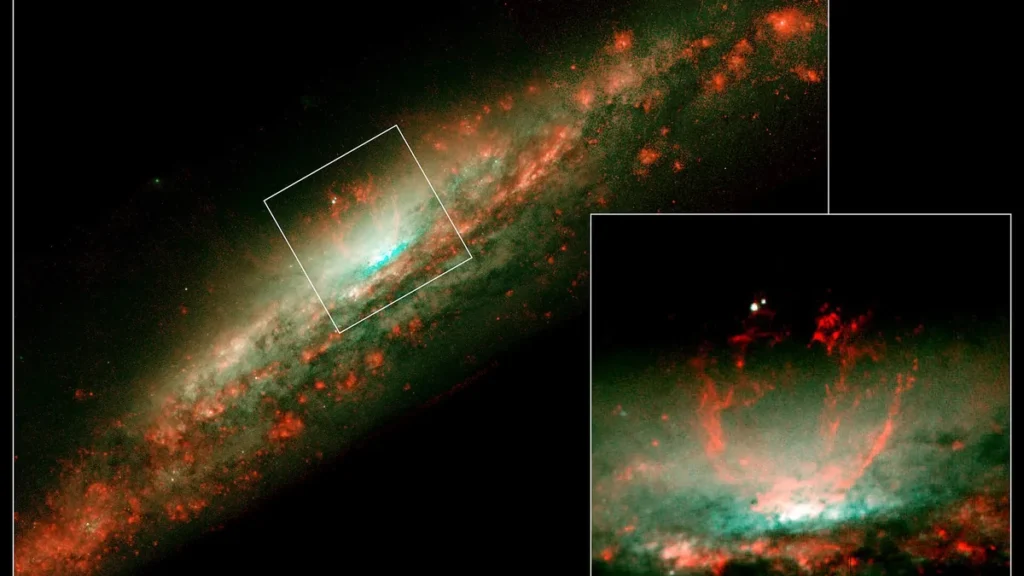
Gas collects in clouds where stars form, can be funnelled into the galactic center and “recycled” by supermassive black holes, or blasted away by explosions. Galaxies encompass vast numbers of stars alongside gas and additional matter, and every part interacts through gravitational force and other influences. A star’s mass sets how long it remains on the main sequence: some endure for trillions of years, others depart after a few billion years and remain as white dwarf cinders, while some burn through their fuel rapidly and explode as supernovae.
Groups of massive stars frequently emerge inside spiral arms, drawing on cold gas as their source material. Such stars warm the gas surrounding them, and some eventually detonate as supernovae. Multiple explosions happening near one another can produce huge bubbles of hot gas that spark more star formation and push material away from the galactic disk.
Supernovae can carve massive bubbles in the interstellar medium, drive gas away to form new stars elsewhere, and even propel gas outside the galaxy. Simulations that struggle with this detail can lead astronomers astray.
The authors say the surrogate modeling approach can generalize beyond astrophysics to other fields and could open pathways in climate modeling, space forecasting, and low-temperature plasma. In the new work, the researchers divided the Milky Way into smaller regions that could be processed by different parts of a supercomputer.

Join the discussion