Key facts
- Statistical analysis showed flare occurrence is not randomly distributed over Proxima d's orbital period, with flares tending to occur at particular orbital times, Zapatero Osorio said.
- A solar-flare physics model estimated Proxima d's magnetic field at 8 to 230 gauss, with a best median estimate around 16 gauss.
- The team's model requires magnetic interconnection between Proxima Centauri and Proxima d, where stellar surface stress releases as flares tied to the planet's orbit.
- Though the correlation was weaker for Proxima b, the team found it could be interacting with the star in a lesser capacity, suggesting it may also sustain a magnetic field.
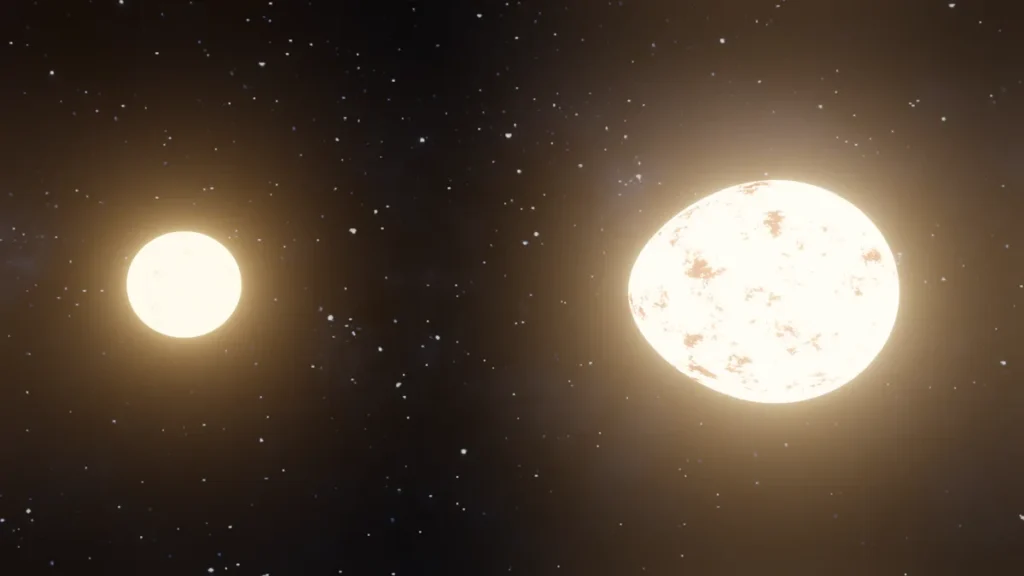
A team led by María Rosa Zapatero Osorio of the Centro de Astrobiología in Madrid published a study in Astronomy & Astrophysics in July 2026 reporting that Proxima Centauri b and d, the nearest confirmed planets outside our solar system, may host magnetic fields. The work drew on 117 ESPRESSO observations from the Very Large Telescope at Cerro Paranal in Chile.
“We detected low-energy flares occurring with a characteristic period of about 5.1 days,” Zapatero Osorio says. The team’s statistical analysis showed the flares are not randomly distributed across Proxima d’s 5.1-day orbit but tend to occur at particular orbital times, even though flares did not happen on every orbit. Proxima d is estimated at a quarter to a third of Earth’s mass and 70% of its size.
Zapatero Osorio’s group adapted a model from solar flare physics to interpret the flare timing as possible magnetic interaction between the star and planet. The model requires interconnected stellar and planetary fields, with each body sustaining its own field, allowing stress to build on the stellar surface until it releases as flares. It estimated Proxima d’s magnetic field at 8 to 230 gauss, with a best median estimate around 16 gauss, roughly 27 times Earth’s 0.6-gauss field.
The correlation was weaker for Proxima b, yet the team found the planet could be interacting with the star in a lesser capacity, suggesting it may also sustain a magnetic field. Proxima b is roughly Earth’s mass and size, orbits every 11.1 days, and lies in the habitable zone, the region where temperatures could permit liquid surface water because its star is smaller and less massive than the Sun. Astronomers do not yet know whether any planet in the Proxima Centauri system hosts an atmosphere.
Zapatero Osorio said magnetospheres around Proxima d and Proxima b might supply some protection from their host star’s activity, just as Earth’s magnetic field shields against solar wind and energetic particles and aids navigation. Proxima Centauri is a highly active red dwarf that regularly emits intense flares hazardous to life on close-orbit worlds, and red dwarfs are the most common type of star in the universe.
Earth’s 0.5-gauss field protects its atmosphere from solar wind erosion, and until the Beta Pictoris detection astronomers lacked any direct way to measure exoplanet magnetic shielding. Without a strong magnetic field, stellar wind can erode a planet’s atmosphere over geological timescales, as happened to Mars after its dynamo shut down roughly four billion years ago.
More than 6,300 exoplanets are confirmed, with more added daily. The known systems are diverse, including stars with as many planets as the Sun and planets orbiting multiple stars at once.
The researchers also considered alternative explanations: intrinsic active regions on Proxima Centauri, gravitational planet-star interactions that could disturb the star without a planetary magnetosphere, and stellar wind that could mimic magnetic shielding without an actual field. They view gravitational interactions as less likely than a planetary magnetic field.
Edo Berger, a co-author at Harvard University and the Center for Astrophysics, Harvard and Smithsonian, his student and the paper’s lead author, and Yvette Cendes of the University of Oregon posted a preprint on Sept. 15, 2026, reporting the first direct detection of a magnetic field on an exoplanet using radio bursts from Beta Pictoris b. The work has not been peer-reviewed and appeared on the arXiv preprint server.
Beta Pictoris b’s field is at least 1,250 gauss at the emission site; Earth’s field is about half a gauss, making the exoplanet’s field roughly 2,500 times stronger. The measurement relies on electron cyclotron maser instability, a process in which energetic electrons spiraling along magnetic field lines emit radio waves at a frequency proportional to field strength, with the frequency reading out field strength directly without assumptions about interior structure. MeerKAT detected the bursts at 3.5 gigahertz, the top of its observing band.
The team observed Beta Pictoris b with MeerKAT in South Africa during four sessions from February 2025 to May 2026, and every session returned a signal. Gaia-based astrometry placed the radio source on the planet itself, 4.4 sigma from the host star and 4.8 sigma from Beta Pictoris c, using nine Gaia quasar references and one VLBI calibrator as fixed points. The assignment held unchanged across all 55 possible reference subsets in leave-one-out cross-validation.
The bursts showed 40 to 70 percent circular polarization, a signature the team says distinguishes auroral emission from stellar noise, and all stellar mechanisms were eliminated. The researchers ruled out stellar wind, which underpredicts the radio power by three orders of magnitude, and moon interactions, which underproduce by more than an order of magnitude; any moon larger than roughly Saturn’s mass is also excluded by prior mass limits. Beta Pictoris b rotates every 8 to 9 hours, confirmed by ground-based spectroscopy and JWST photometry, and an 8-hour gap between the first and third bursts in one session matches that spin period.
Joe Callingham of the University of Amsterdam, who was not involved in the study, said confirmation requires bursts pulsating with the rotation period across many observations, describing the result as compelling but tentative and probably auroral. Yvette Cendes called the field incredibly strong, much stronger than anything in the solar system. “When people see ‘radio signal from an exoplanet,’ they think aliens – but it’s not aliens,” Cendes told Science News directly.

The research team said direct model-independent radio measurement reveals a planet’s interaction with stellar radiation, atmospheric protection, rotation, and internal structure, rooted in fundamental quantum physics rather than rough estimates. A 2024 uGMRT search of Beta Pictoris at 250 to 500 megahertz found nothing; success at 3.5 gigahertz required MeerKAT’s coverage, Gaia astrometry, and the star’s magnetic quietness. Dynamo scaling predictions estimate Beta Pictoris b’s mean surface field at approximately 1.2 kilogauss, close to the measured 1.25-kilogauss lower limit, placing the planet on an established solar-system magnetic-field relation for the first time.
The method applies to seven directly imaged giant exoplanets in five systems within 147 light-years, about 45 parsecs or 470 trillion miles, but requires five-to-seven-fold sensitivity improvement over MeerKAT. The Square Kilometre Array in South Africa and Australia is designed for up to one million square meters of collecting area, roughly 50 times MeerKAT’s sensitivity, while the next-generation Very Large Array planned for the United States lists planetary science among its core goals. Neither facility has a confirmed completion date, but both target first science in the 2030s.
Beta Pictoris d, confirmed in July 2026, ranks as the faintest directly imaged planet, while observations of Beta Pictoris b gave astronomers their first direct measurement of an exoplanet’s magnetic field. Because Beta Pictoris b is a gas giant with roughly a dozen times the mass of Jupiter, it is not a candidate for life. The planet orbits far from its parent star to avoid the star’s glow, at a distance comparable to Saturn’s orbit around the Sun, and is about 12 times Jupiter’s mass and 25 million years old.
Edo Berger said the detection opens a completely new window on planets outside the solar system and views it as proof that continuing the search is worthwhile even with current instruments. His team pored through about a hundred candidate systems before choosing Beta Pictoris b, which produced a signal in every session and is active most of the time. Smithsonian Magazine places Beta Pictoris b about 63 light-years away, while Tech Times reported roughly 64 light-years.
Sebastian Pineda of the University of Colorado Boulder, not involved in the study, called the detection the beginning of broader radio astronomy for exoplanetary science, but said Earth-like planet fields are unlikely to be detected soon because Earth’s ionosphere blocks those emissions and progress may take several decades. Jackie Villadsen of Bucknell University said strong magnetic fields can have downsides because energy delivered toward a planet’s poles may cause the planet to lose mass, even though Earth’s field deflects solar wind to the poles and shields the surface from charged particles.
Planetary magnetic fields require an electrically conducting fluid interior, convection, and planetary rotation, as in Earth’s liquid iron-nickel outer core, and the resulting dynamo generates the magnetic bubble that deflects solar wind to the poles. A paper in Science by D. Revilla et al. presented evidence that a planet orbiting GJ 436 magnetically imprints its host star, showing that the star-planet magnetic relationship can run both ways instead of only from star to planet, opening a new observational avenue for hundreds of close-in large-planet systems.
GJ 436 is a red dwarf about 30 light-years away and half the sun’s mass, orbited by a Neptune-sized planet four times Earth’s mass every 2.6 days. Eighteen years of hydrogen and calcium spectroscopy turned up periodic signals matching the 2.6-day orbit, but only at intermediate stellar activity levels. A model of connected planetary and stellar field lines funneling energy into the star’s atmosphere reproduced the observations while estimating the planet’s field at Jupiter-like strength.
Researchers in 2019 reported indirect magnetic-field detections around four hot Jupiters, and a 2021 study found a strong magnetic-field signature around HAT-P-11 b, a Neptune-like planet.
For GJ 436, the orbital-period signal appeared only when stellar activity was moderate, disappearing during high activity and fading to undetectable levels during very quiet stretches. To reproduce the observations, the team’s model accounted for the planet’s tilted, eccentric orbit and the star’s rotation.
JWST photometry independently confirmed Beta Pictoris b’s 8-to-9-hour rotation period, supporting the interpretation that its radio bursts are produced by rapid spin driving magnetosphere-ionosphere coupling, which sends large electrical currents and electrons downward along magnetic-field lines into the aurora. Direct, model-independent radio measurement reveals a planet’s interaction with stellar radiation, atmospheric protection, rotation, and internal structure, according to the research team, though Earth-like planet fields are unlikely to be detected soon, Sebastian Pineda said.



Join the discussion