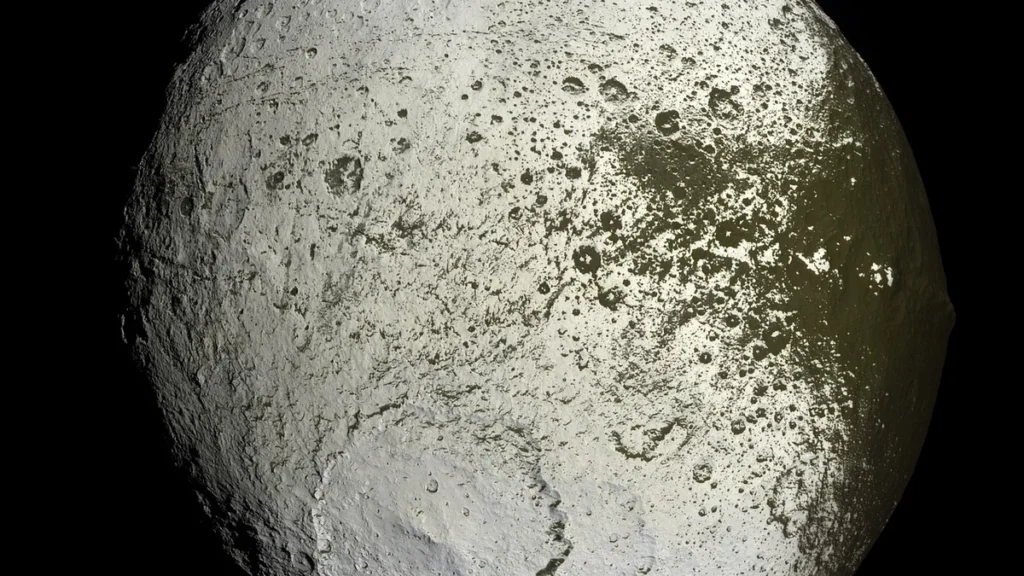
Astrobiology Web reported that a study of trapped oxygen at Europa and Ganymede by Apurva V. Oza, Robert E. Johnson, Carl A. Schmidt, Wendy M. Calvin, and Yuk L. Yung was accepted by Astrobiology on June 1, 2026. The paper is listed under Earth and Planetary Astrophysics, Materials Science, Geophysics, and Space Physics.
Plasma particles striking the surface generate a localized imbalance in defect concentration inside the ice grains of Europa and Ganymede. Voyager measurements of the moons’ ambient magnetospheric plasmas led laboratory data to show that ions, mostly ejected from volcanic Io, impact and sputter the surfaces. The sputtering decomposes ice and produces thin oxygen atmospheres. Those plasma-produced observables include oxygen aurora and condensed O2 bands identified at 5773 and 6225 Angstroms.
Europa’s and Ganymede’s oxygen atmospheres were inferred from oxygen aurora, condensed O2 bands at 5773 and 6225 Angstroms, and a dusk/dawn enhancement confirmed by recent Juno data. The paper notes that although plasma produces these observables, processes occurring within the topmost surface are not well understood.
Volatiles created inside the ice grains either pass into the satellites’ atmospheres or stay lodged at defect sites or within empty spaces. They form bubbles whose survival time is capped by the plasma-induced destruction rate. Trapping competes with annealing of the radiation damage.
Hemispheric differences at Europa and Ganymede roughly determine the observed trend with latitude of O2 bands. The study assesses how condensed O2 and O2 stuck to regolith grains compare as sources of atmosphere, explaining dusk/dawn enhancements and changes over time in condensed O2 band depths. These surface processes help explain spatial and temporal variability of trapped oxygen on the icy moons.
Damage from plasma and thermal annealing timescales controls how oxidants vary across icy moons such as Callisto, Dione, and Rhea. The paper links these timescales to volatile downwelling and upwelling of other trapped oxidants such as CO2 that is suggestive of ongoing geologic activity.
Join the discussion