
Key facts
- Browne projected that satellite communications, Earth imagery, and space situational awareness will account for 25 percent of total agency spending by 2030.
- If agency spending allocates a 25 percent share to space by 2030, annual space expenditure would rise above EUR 300 million per year.
- Dylan Browne, the NCIA general manager, said the agency plans to award about EUR 2.7 billion, or $3 billion, in commercial contracting through 2028.
- NCIA expects to issue procurements worth 2.7 billion euros ($2.97 billion) during the next two years, spanning space, cyber, AI, and cloud.
NATO Communications and Information Agency General Manager Dylan Browne said the agency intends to award roughly EUR 2.7 billion, or $3 billion, in commercial contracts through 2028, a development he announced at the NATO Edge 26 conference in Izmir, Turkiye, held Nov. 16 through Nov. 19, 2026. Browne delivered the plan while speaking at the forum. The number reflects planned commercial contracting volume instead of direct government purchases.
The through-2028 figure is nearly three times the EUR 975 million in commercial awards from the previous two-year period. Browne said the agency’s commercial procurement spending over the next two years will rise to nearly three times earlier levels. The comparison covers total commercial awards, not space-specific spending, and the source describes the near-tripling as evidence of expanded procurement volume before 2028. The current pace runs at roughly EUR 1.3 billion ($1.42 billion) annually, and the source ties that pace to the planned rise in space-related procurement.
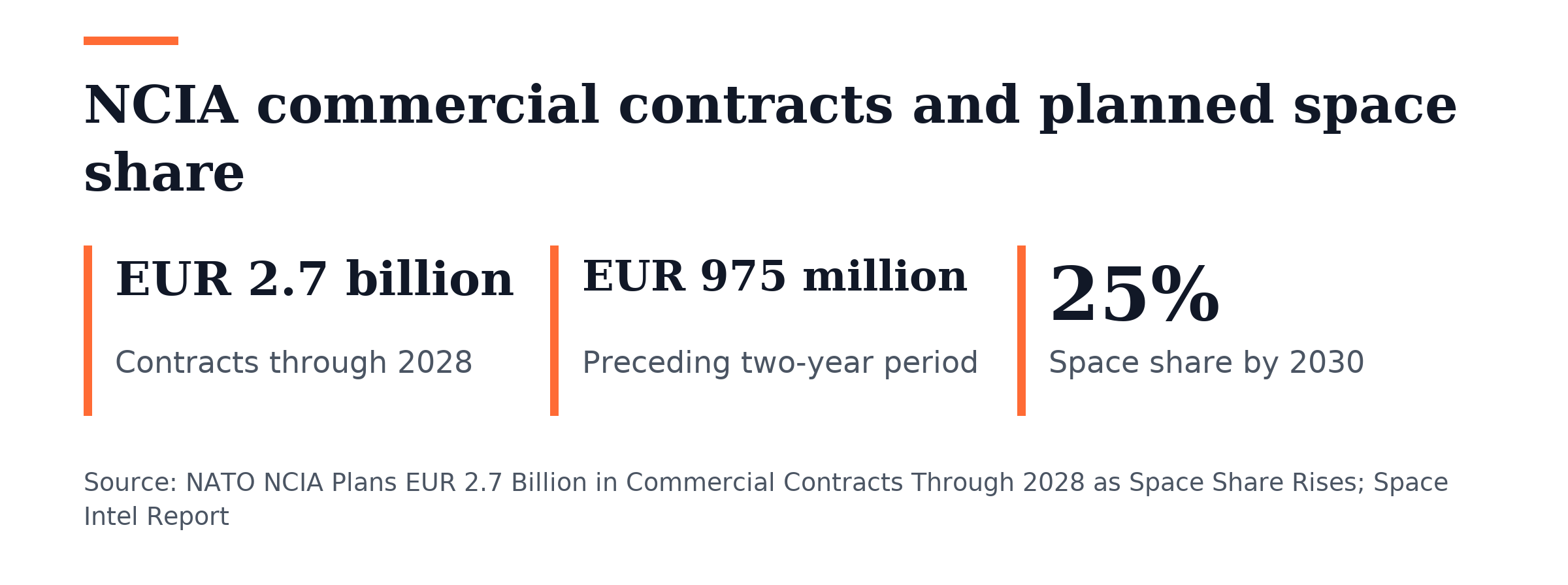
Browne projected that satellite communications, Earth imagery, and space situational awareness will make up 25 percent of total agency spending by 2030. The three capability areas form the agency’s space portfolio under the projection, part of the broader commercial contracting outlook presented at NATO Edge 26. Applying that share to agency spending, annual space expenditure would exceed EUR 300 million per year, a figure the source describes as a minimum for yearly space spending rather than a maximum. Reaching the target depends on how fast contracting brings commercial satcom, imagery, and space situational awareness into routine operational use, linking success to contracting speed instead of budget size alone.
Buying more commercially would give NATO quicker access to dual-use satellite capacity and high-revisit orbital imaging, while adding orbital tracking data to the alliance’s own assets across alliance military operations. The source links these purchases to faster operations instead of replacing government-owned capabilities. NCIA is increasingly pairing commercial space providers with alliance mission requirements, building on prior agreements such as Planet’s NCIA monitoring contract and the Starlift launch brokerage announced at NATO Edge 26. Bringing commercial satcom, imagery, and space situational awareness into NCIA procurement portfolios addresses rising bandwidth and awareness needs across multi-domain military operations, an integrated response to rising operational demand that covers multiple space mission areas simultaneously.
NCIA must change alliance demand signals into competitive tenders and multiyear contracts for suppliers in member states. The roadmap runs through 2028, creating an execution challenge for NCIA centered on turning announced demand into actual contracts.
Browne labeled the current NATO model NATO 3.0 and described it as centered on moving faster. The label reflects the alliance’s stated move toward faster procurement and industry engagement, casting the commercial spending plans as part of a wider cultural shift. He said NATO should engage industry earlier by sending clearer demand signals and creating more ways to act quickly. NATO has already changed its cyber procurement approach through a marketplace backed by 22 nations, an example described as faster and evidence that change is already happening, illustrating the broader acquisition reform NATO wants to replicate in other domains.
The agency expects to issue 2.7 billion euros ($2.97 billion) in procurements over the next two years across space, cyber, AI, and cloud.
NATO Deputy Secretary General Radmila Shekerinska called Russia the biggest long-term security threat and said it is increasing hybrid attacks on NATO nations through drone incursions and sabotage, speaking on the first day of NATO Edge. She described the threat environment as urgent and ongoing. Air Chief Marshal Johnny Stringer, deputy supreme allied commander of Europe Allied Command Operations, said digital capabilities are foundational and that all forms of industry underpin credible deterrents while addressing NATO’s digital transformation at the conference. He argued that ambition and imagination must remain ahead of technology in the current era.
Roughly 2,500 attendees and 270 exhibitors participated in the NATO Edge 26 forum in Izmir, Turkiye. The forum’s size was meant to signal sustained procurement intent to industry. The gathering brought together government and commercial technology suppliers. The gathering concluded Nov. 19, 2026.



Join the discussion