Key facts
- Chlorides and carbonates seldom appeared together in sodium-rich particles, instead turning up in separate particles.
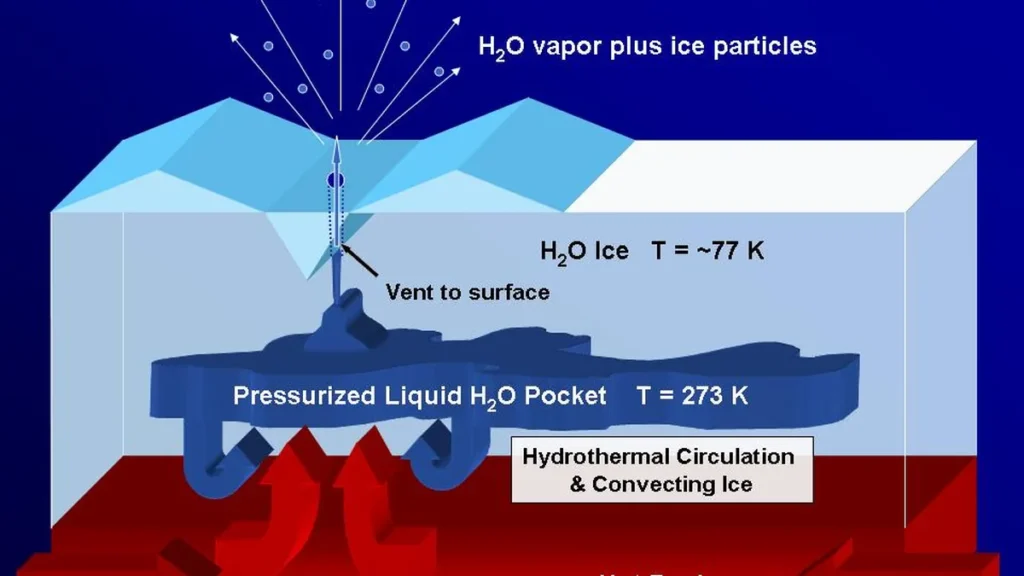
- Near the surface, accelerating gas flow causes frozen droplets to strike channel walls at high speed and break into small ice particles carrying different salts into space.
- Individual analysis of ice grains could help future spacecraft detect compounds that stay diluted and mixed in the ocean.
- Slow freezing may form tiny brine pockets between growing ice crystals, gathering salts and organic compounds in a process possibly tied to prebiotic chemistry.
An international research team including Earth-Life Science Institute researchers combined Cassini spacecraft data with laboratory freezing experiments and calculations to explain why ice grains escaping Saturn’s moon Enceladus show varied salt chemistry, publishing the work in Science Advances on 25-Sep-2026.
Cassini detected water vapor and ice particles streaming into space from a south-polar crack on Saturn’s moon Enceladus in 2005. The find showed active plumes near the south pole and confirmed that subsurface ocean material reaches space.
The mission’s long record gave researchers observational material that the current study revisits with lab work and calculations. Those grains carry salts and other material from the moon’s subsurface ocean, and some of them form Saturn’s E ring. Enceladus is ice-covered with a global ocean beneath its shell, and fractures near the south pole release ocean material into space, letting scientists study an alien ocean without drilling through kilometers of ice.
Earlier studies assumed that Enceladus’s seawater spray freezes quickly and heads toward space shortly after leaving the ocean. Instead, the new findings indicate that droplets travel slowly through the subsurface vent system at first, potentially using complex fracture routes before arriving at the surface. The team proposed that ocean spray forms droplets ranging from tens to hundreds of micrometers across, and that slow freezing deeper in the vent system lets salts separate as the droplets turn to ice.
The Earth-Life Science Institute researcher Yasuhito Sekine and colleagues created laboratory water droplets containing the main salts thought to exist in Enceladus’s seawater, then froze them at various sizes and cooling rates. Salts separated in droplets measuring about 200 micrometers across when cooling proceeded at roughly 10 K per minute or more slowly. Rapid freezing left the salts evenly distributed throughout the droplet. Droplets of about 15 micrometers did not separate clearly even under slow cooling, showing that droplet diameter affects whether salts can separate during slow freezing.
As a droplet freezes, separate composition zones appear because early salts remain solid while later salts crystallize from the liquid left behind. Scientists think this step-by-step precipitation creates the internal chemical separation seen in the lab droplets. Modeling a solution with the experiment’s composition showed that phosphates solidify first as the temperature falls, followed by carbonates and then chlorides. Slow freezing can produce small brine pockets between growing ice crystals, and those pockets gather salts and organic compounds, possibly linking the process to prebiotic chemistry.
Near the surface, accelerating gas flow drives frozen droplets into channel walls at high speed, breaking them into small ice particles that carry different salts into space. During freezing and fragmentation, particular compounds may be concentrated in different grains, and the process separates salts from organics, with organic species appearing at elevated levels in some particles.
Researchers found striking chemical diversity, with individual grains enriched in different salts such as sodium chloride, carbonates, phosphates, and potassium chloride. In sodium-rich particles, chlorides and carbonates rarely showed up together, instead appearing in separate grains, a pattern that raised questions about how grains from the same ocean could differ so much.
Frank Postberg and colleagues at Freie Universitat Berlin studied 961 mass spectra from salt-rich Type 3 ice particles that Cassini’s Cosmic Dust Analyzer observed in Saturn’s E ring between 2004 and 2017. The Cosmic Dust Analyzer gathered data from individual ice grains, and Saturn’s E ring receives a steady supply of material erupting from Enceladus. Postberg said, “The Cassini data showed us that these salt-rich grains are far more chemically diverse than an average ocean composition would suggest,”
The findings appeared in Science Advances in volume 12, issue 39, in 2026, with an article date of 25-Sep-2026. The peer-reviewed, open-access Science Advances paper describes how salts separate inside Enceladus ice grains when ocean spray freezes slowly and the frozen droplets later shatter. Yasuhito Sekine said, “What surprised us was that the diversity seen by Cassini could emerge from droplets originating from essentially the same ocean water,”
Looking at single ice grains could let future spacecraft spot compounds that stay spread out and mixed within the ocean. Figuring out how the particles form can show what conditions exist below the surface and help scientists read the samples that future missions collect while hunting for habitability and signs of life. Much of the material thrown out from Enceladus lands back on the moon, so freezing, concentration, and recycling could happen again and again.

Join the discussion