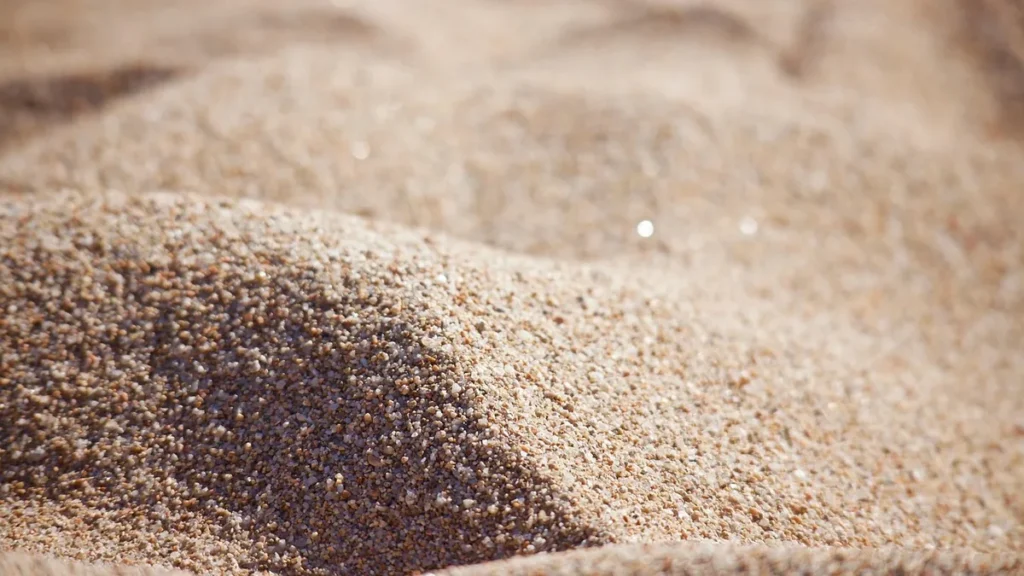
A Stanford-led paper dated Nov. 20, 2026, in the Proceedings of the National Academy of Sciences shows that sand dunes on atmosphered solar-system bodies can reveal wind speed as well as wind direction. For decades, researchers have used dune size and orientation like weather vanes to learn which way the wind blows and how consistently winds have blown, but those observations could not reveal how fast the wind was moving.
The new work closes that gap between knowing direction and knowing speed. M. Colin Marvin, a PhD student in Stanford’s Department of Earth and Planetary Sciences, gathered wind speed data and grain-size measurements from 24 dune fields worldwide. The work builds on a hypothesis advanced by University of Pennsylvania scientists in 2010.
The study appears under the title Windblown dunes are born in sand at the brink of transport and DOI 10.1073/pnas.2613085123. Its authors are M. Colin Marvin, Alex Gleason, Clément Narteau, Olivier Rozier and Mathieu G. A. Lapôtre. scitechdaily.com reports that the study was supported by a National Science Foundation CAREER grant and that its body text appeared in the Proceedings of the National Academy of Sciences on November 16, while its reference section gives a 20 November 2026 date.
Mathieu Lapôtre, the senior author, is an associate professor of Earth and planetary sciences at the Stanford Doerr School of Sustainability.
Researchers compared 30 years of wind observations with sand grain measurements from 24 dune fields around the world, including Coral Pink Sand Dunes State Park in Utah and ancient desert landscapes in Namibia. In all of those land-based fields, the wind speed that carried the most sand was closely linked to grain size and stayed only slightly above the level needed to move the sediment. The pattern held across different dune shapes, sizes, and environments.
Using a tool called ReSCAL, the team grew virtual dunes from flat sand beds at different wind speeds. The experiments confirmed that, given abundant loosely bound grains and winds that grow rarer as they strengthen, dunes form mainly from wind speeds corresponding directly to the grain sizes that compose them. Because winds that grow rarer as they strengthen still do the work, the grain size in a dune field points back to the speed that shaped it.
Below the transport threshold, individual grains stay stationary. Once the wind passes that critical speed, grains bounce across the ground in saltation, a process in which each impact kicks up surrounding grains in a self-sustaining cascade. The transport threshold is central to linking measured grain size to the wind speed that formed a dune.
A dune made of sand 0.2 mm across is mostly moved by winds blowing at 26 kilometers per hour 10 meters above the ground. That grain size is about the width of two pieces of paper. The example illustrates that everyday winds, rather than rare violent gales, drive most sand motion.
The same sand-size-to-wind relationship appeared in measurements from a Martian dune field despite major differences in atmospheric pressure, gravity, and sediment density between Earth and Mars. On Mars, dunes often serve as the only measurable surface feature for inferring surface winds and mineralogy. Winds only modestly exceeding the transport threshold account for much of the sand movement that builds dunes, so the process does not require rare violent dust storms. It had previously been unclear whether shifting sands were driven by rare violent storms or by much more common moderate winds.
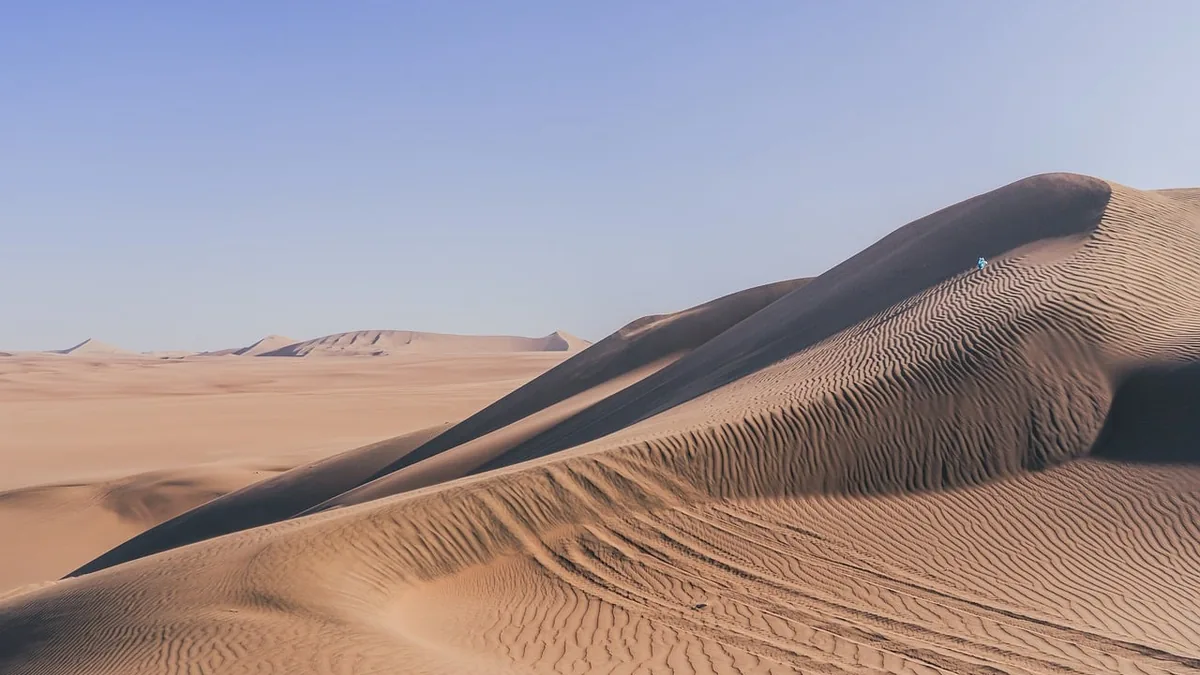
Sand grains can outlast the winds that carried them, so scientists can use the relationship to estimate ancient wind speeds from sedimentary rocks and test atmospheric-circulation models for eras when Earth’s atmosphere was very different. Mathieu Lapôtre said the approach works for modern dunes and for sandstones dating back three billion years, and that the research is already moving toward investigating atmospheric histories of Earth and Mars.
The Curiosity rover has drilled into the Stimson formation, a sandstone layer that was once a windblown dune billions of years ago. The upcoming Dragonfly mission is expected to touch down on the surface of Titan, where there are dunes of hydrocarbons, sometime in the 2030s. Universe Today notes that Titan grain-size measurements combined with the paper’s math could reveal Titan’s wind history. Venus comes to mind as another potential target for future missions to dune-ridden planets applying this technique.
The method is relevant to any atmosphered body where wind moves sand-sized grains across the surface.
Windblown dunes and ripples have been identified on Venus, Mars, Saturn’s moon Titan, and even a comet orbiting the sun; Universe Today also names Earth. Each world is made of different materials, but all share sand consisting of small grains of similar particles that wind can blow around. Research published in 2017 tied ripples seen by ESA’s Rosetta probe on Comet 67P/Churyumov-Gerasimenko to vapor flows driven by sharp swings between day and night temperatures. The comet example means not every dune-like feature on every world was necessarily built by wind.
A separate line of research strengthens the case for dunes as climate records. On Aug. 20, 2026, a Monash University study published in Nature Communications delivered the most complete and accurate digital map of Earth’s windblown sand dunes to date. The author is Dr. Andrew Gunn of Monash University’s School of Earth, Atmosphere and Environment.
Andrew Gunn’s study shows that crescent-shaped dunes known as barchans can reveal wind direction and sediment properties. On Mars, dunes often serve as the only measurable surface feature for inferring surface winds and mineralogy.
Andrew Gunn of Monash University described dunes as natural archives of climate and geological history, and he said a consistent worldwide map offers a clearer benchmark for analyzing features in the rock record or on planets like Mars.
Join the discussion