Key facts
- The observatory sits on Cerro Pachón in northern Chile.
- The U.S. National Science Foundation and the U.S. Department of Energy's Office of Science jointly pay for Rubin Observatory.
- Matthew Holman of the Center for Astrophysics | Harvard & Smithsonian spotted ED138 after executing a search code he wrote with Kevin Napier on 13 October.
- Amateur astronomers are unlikely to observe Aquarius IV because its apparent magnitude is 18.3, beyond amateur telescope reach.
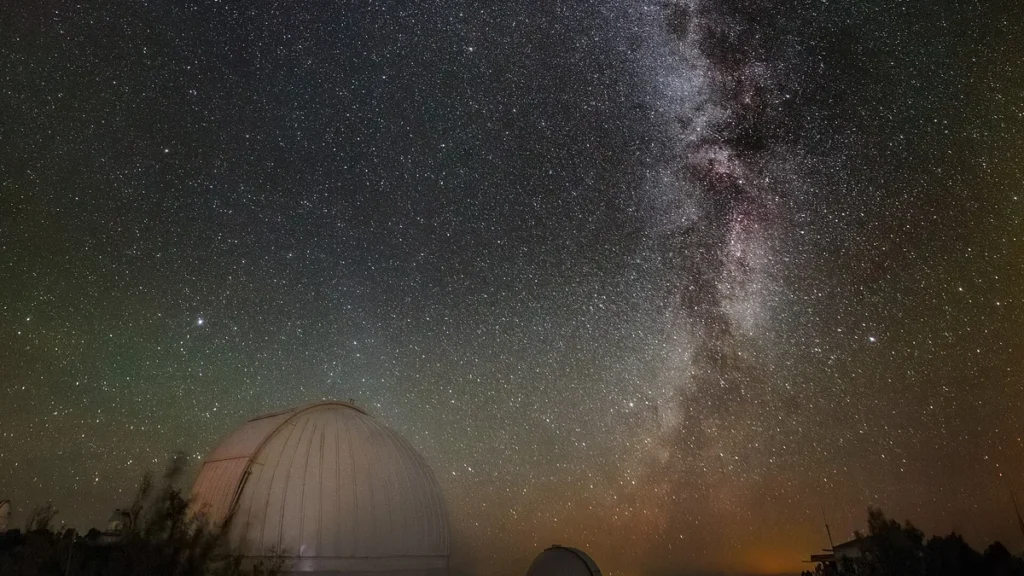
Astronomers officially began the Legacy Survey of Space and Time in June 2026 at the Vera C. Rubin Observatory on Cerro Pachón in northern Chile, opening a 10-year mission built over more than two decades.
The 8.4-meter Simonyi Survey Telescope works with the largest digital camera ever built, a 3.2-gigapixel instrument that will yield roughly 1,000 images each night. Repeated imaging across the Southern Hemisphere sky will build a time-lapse record of the universe, and the survey will revisit the whole southern sky about once every three to four nights across the decade.
The U.S. National Science Foundation and the Department of Energy’s Office of Science jointly fund the observatory, which NSF NOIRLab and SLAC National Accelerator Laboratory operate. More than 40 international organizations and teams have contributed, including France’s CNRS/IN2P3, and the site sits on Cerro Pachón, where Rubin acknowledges research privileges in Chile. The facility takes its name from astronomer Vera Rubin, whose observations provided early evidence for dark matter.
Before the survey began, astronomers identified two unknown Milky Way companions in Rubin’s preliminary data from April 2025 through January 2026. The University of Washington announced the pair on Nov. 5, and the preview data covered only a small fraction of the sky the full survey will observe. Astronomers expect many more faint objects to turn up as the 10-year survey continues.
Aquarius IV is probably an ultra-faint dwarf galaxy roughly 355,000 light-years from Earth toward Aquarius. EarthSky reports that its stars contain few heavy elements, suggesting they formed around 13 billion years ago, and its absolute magnitude of minus 1.9 means it shines 14 million times fainter than the Milky Way. It contains no more than a few hundred thousand stars, while the Milky Way holds around 100 billion.
The detection reached eight sigma significance, and a study led by Yale University doctoral student William Cerny appeared in Research Notes of the American Astronomical Society, which does not use traditional peer review, leaving the classification preliminary. Larger telescopes will next measure individual star velocities to confirm the object’s nature and estimate any dark matter halo mass.
Joshua Simon of the Carnegie Observatories, who was not involved in the research, says ultra-faint dwarfs may consist of dark matter. Aashay Pai of the University of Chicago says Rubin could find up to 100 more such objects.
Peter Ferguson of the University of Washington said, “Aquarius IV and Rubin-GC1 offer a preview of what the next decade will look like.” William Cerny said, “What I find especially exciting is that these discoveries are just the beginning for Rubin.”
Rubin-GC1 is a small star cluster buried behind thick dust clouds toward Ophiuchus, on the galaxy’s far side. The Astrophysical Journal Letters accepted its study on Oct. 28, and University of Chicago researcher Aashay Pai is first author, with Cerny as second author. Age estimates put the cluster at around 9.2 billion years old, and it may have come from a smaller satellite galaxy.
Astronomers know of roughly 65 satellite galaxies around the Milky Way, though models predict 100 to 300, so hundreds may still await discovery. Completing the census would test galaxy formation models and trace the Milky Way’s assembly history over billions of years.
Rubin also aims to map the galaxy’s halo, a roughly spherical region containing scattered stars, gas, dark matter, and faint satellites that preserve clues about the past. Dark matter is invisible, emits and reflects no light, and researchers infer it from gravity.
Marla Geha of Yale University says satellite discoveries in Rubin data have long been an exciting prospect and are now happening. Amateurs are unlikely to spot Aquarius IV; its apparent magnitude of 18.3 puts it beyond the reach of amateur telescopes, but online platforms track Rubin announcements and run citizen science programs where volunteers help classify data.
Rubin has also identified a dwarf planet candidate in the outer Solar System. The International Astronomical Union’s Minor Planet Center announced 2026 ED138, a large bright trans-Neptunian object found by Matthew Holman of the Center for Astrophysics | Harvard & Smithsonian using search code he wrote with Kevin Napier. Holman, a Rubin Operations team member, said, “My first reaction was one of excited disbelief,” when he spotted it on Oct. 13.
ED138 now orbits about 46 astronomical units from the Sun, beyond Pluto’s average distance of 40 astronomical units, and its path tilts nearly 25 degrees off the plane of the Solar System. Researchers estimate it measures between 600 and 1,500 kilometers across, but researchers need infrared observations to confirm whether its roundness qualifies it as a dwarf planet. If confirmed, it would join Pluto, Ceres, Eris, Haumea, and Makemake as the sixth IAU-recognized dwarf planet.
The Simonyi Survey Telescope observed ED138 30 times across 20 nights from March 4 to July 11, and archival Dark Energy Camera images pulled by the Asteroid Institute’s ADAM Precovery service extend its record back to 2016. Rubin found it in a crowded region near the plane of the Milky Way filled with millions of stars, which helps explain why earlier surveys missed it.
Before the formal survey start in April 2026, the Rubin Solar System team sent more than 11,000 new asteroid observations to the Minor Planet Center, including about 380 new trans-Neptunian objects. Images of ED138 are available to data rights holders on the Rubin Science Platform, and anyone can explore the object through Orbitviewer.




Join the discussion