Key facts
- NASA announced on November 17, 2026, that its annual Space Apps Challenge drew a record 181,835 registered participants for the November 14-15 hackathon.
- NASA reported that the 2026 hackathon saw a 59 percent increase in registrants, marking five consecutive years of growing participation.
- NASA explained that participants utilized open data to address 14 distinct challenges dedicated to Earth science and space exploration.
- NASA announced that 10 global winners will be selected from the submitted projects and revealed in January.
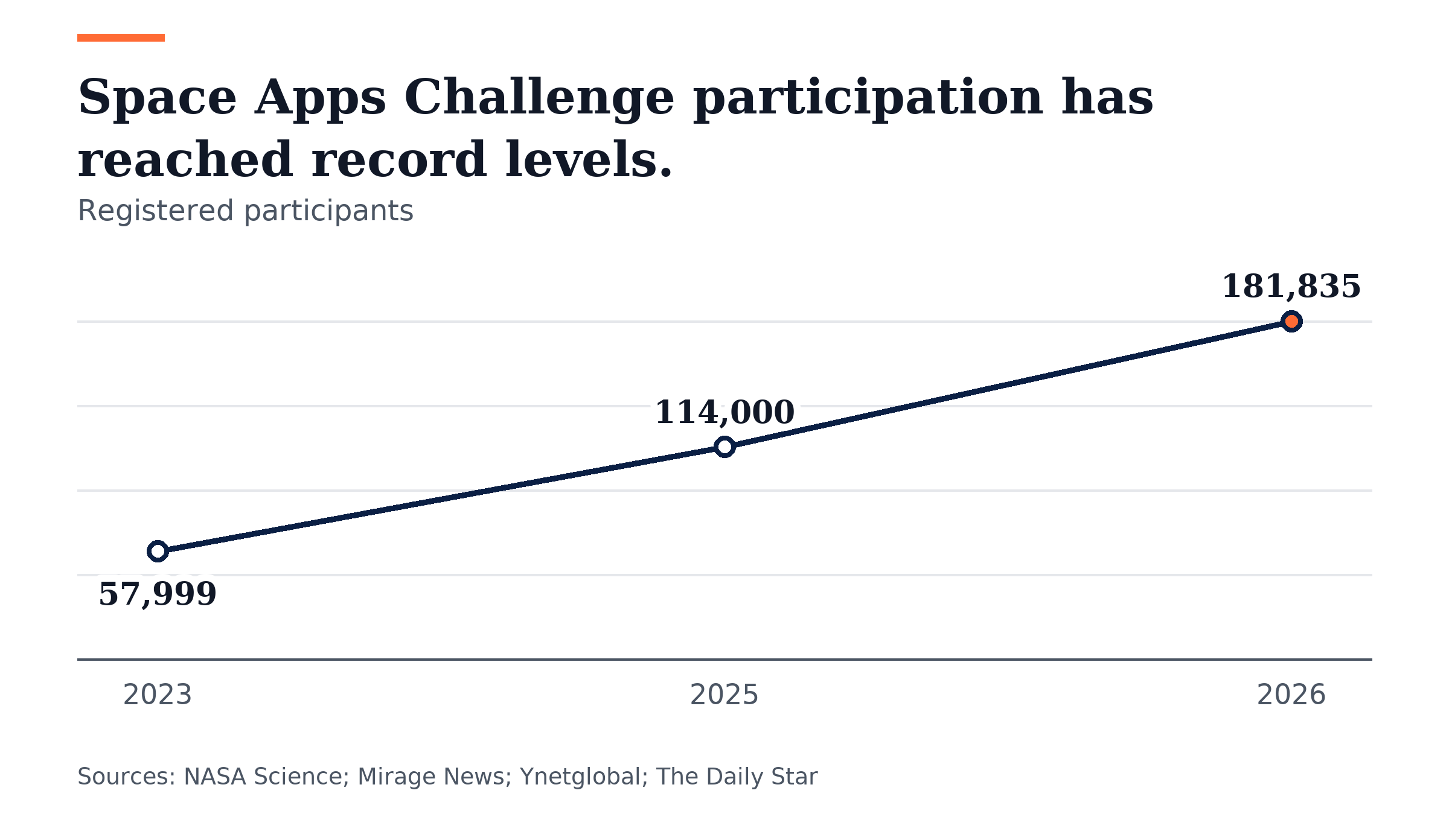
NASA announced on Nov. 17, 2026 that its yearly Space Apps Challenge logged a record 181,835 registered participants for the Nov. 14-15, 2026 hackathon held around the world, a 59 percent jump in registrants that marked five straight years of growth.
Ynetglobal said the 2025 edition drew more than 114,000 registrants from 167 countries and territories through 551 local events, with 11,511 projects submitted, and described the event’s scale as growing considerably across international locations and diverse fields. NASA reported a 59 percent increase in registrants, marking five consecutive years of growth as the multi-day event expanded steadily across multiple continents. The agency said the Nov. 14-15, 2026 hackathon included 593 separate events around the world, and since it began in 2012 the challenge has reached more than 600,000 people in more than 190 countries.
NASA said people taking part used open data to work on 14 distinct challenges split between Earth science and space exploration. Data for the 2026 challenges came from 17 international space agencies, each a signatory of the Artemis Accords. Among them, GGPEN, AEB, and CONAE wrote specific challenges for the 2026 event. Officials said the competition unites people with varied skills to apply official datasets to real-world problems.
Before the official weekend, participants can look at the challenges, form teams, and prepare approaches, then join locally organized volunteer events, work in teams on one challenge, and submit entries before the deadline for judging among the 10 global winners. NASA said judges will pick 10 global winners from the submitted projects and reveal them in January. Local champions move on to the global judging round under the Global Nominee label. The recurring two-day event gives technologists and enthusiasts worldwide hands-on experience with official space science data.
Sapporo shows how a single local event operates. Judges there rate entries using Impact, Creativity, Validity, Relevance, and Presentation, and the top team earns a Global Nominee recommendation plus an H3 rocket model worth 20,000 yen. Norimitsu Kamimori, President and CEO of HIREC Co., Ltd., leads the Sapporo judging panel; he joined Japan’s National Space Development Agency, now JAXA, in 1985 and retired from JAXA in 2022; born in Sapporo in 1961, he graduated from Hokkaido University’s Faculty of Science, held JAXA leadership posts including Director of the JAXA Washington Office, and has chaired the Sapporo Industrial Promotion Foundation’s Space and Semiconductor Seminar since 2024. The NASA Space Apps Challenge Sapporo 2026 Executive Committee organizes the event under local lead Hina Goshima, with sponsorship from Accenture Japan Ltd and HIREC Co., Ltd., and support from Hokkaido Information University, Hokkaido University of Science, and the Sapporo Industrial Promotion Foundation; the venue bars overnight on-site work, requiring the building to be vacated by 6:00 PM both days.

Ynetglobal said Technion–Israel Institute of Technology was an official local host for the first time in November 2026. The Technion event opened virtually on Nov. 14, 2026, and moved to the Haifa campus for an in-person session on Nov. 15. A student team led by Gaya Tzadok organized the event; Tzadok is a 2025 Global Nominee who studies medicine at Technion and heads AI and innovation at the Israel Aerospace Medicine Association, having begun in a combined physics and aerospace engineering program, conducted neuroscience research under Professor Dori Derdikman, and helped develop a new space medicine elective course. Alongside the hackathon, three scientific talks were scheduled at the Black Sheep pub in the Student Union Building on galaxies, the interstellar medium, and building in space with liquids, with professors Shmuel Bialy, Moran Bercovici, and Jonathan Stern set to deliver them.
Team Voyagers of Bangladesh won the best storytelling category at the 2023 NASA International Space Apps Challenge, giving Bangladesh its third straight title and fourth world championship overall. The 2023 event counted about 57,999 participants on 8,715 teams from 152 countries in 30 categories, and the source described it as the largest to date; the local phase ran for the 10th time in October across nine cities including Dhaka, Chattogram, and Rajshahi. Team Voyagers built a visual tool called “Everything Starts with Water” to explain Earth’s complete water cycle and its effect on climate change, and team leader Md Khalid Sakib said the achievement brightened Bangladesh’s image. BASIS President Russell T Ahmed said, “Our success highlighted the vast potential and innovation in the field of information and communication technology among Bangladeshis.”


Join the discussion