Key facts
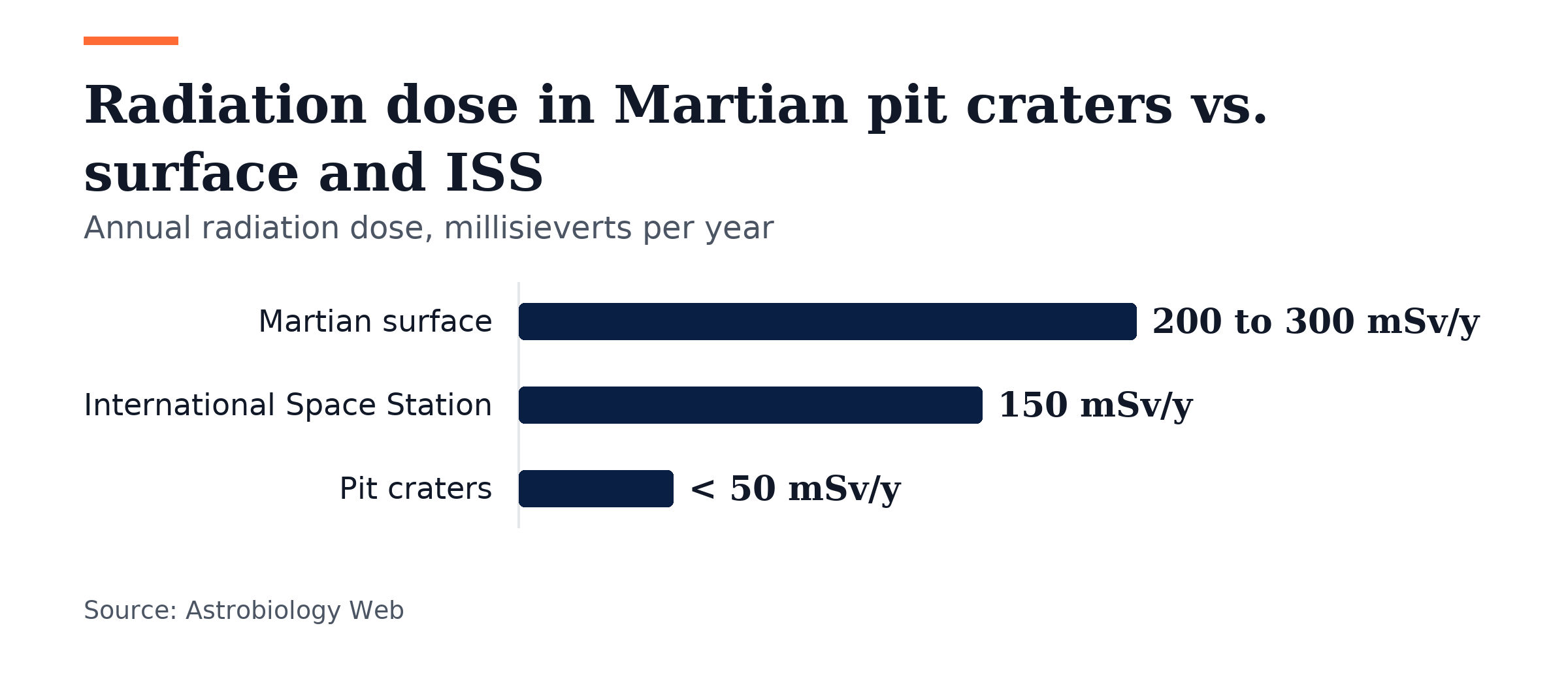
- Atypical pit craters can cut absorbed dose and dose equivalent rates by more than 80 percent at the crater floor center relative to surface conditions, according to the study's results.
- Several atypical pit craters studied show dose levels below 50 mSv/y, the U.S. NRC standard upper limit for exposed workers on Earth.
- Measurements in several atypical pit craters come in well under about 150 mSv/y recorded at the International Space Station.
- Readings in several atypical pit craters stay well under roughly 200 to 300 mSv/y found on the Martian surface by Mars Science Laboratory.
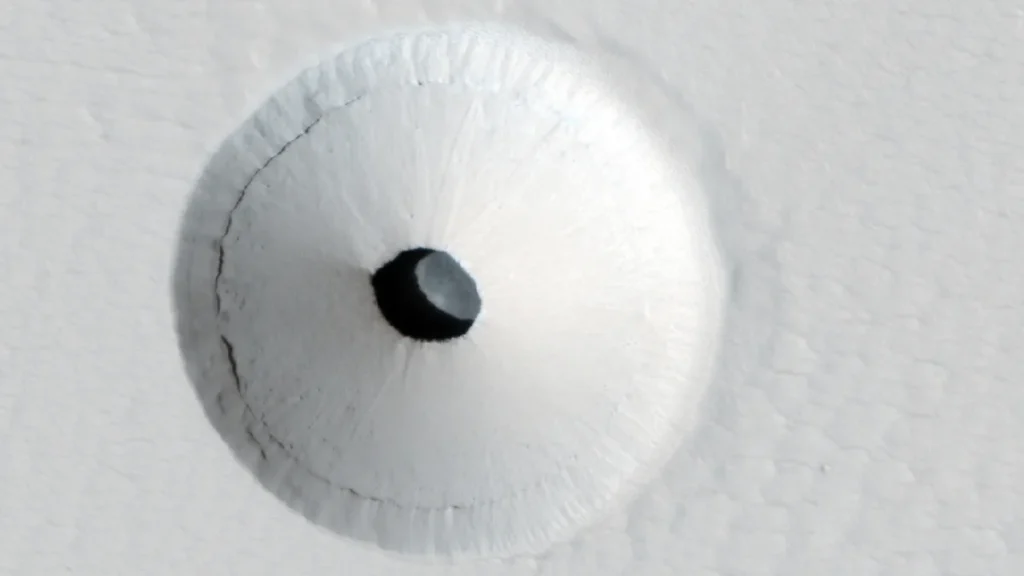
Astrobiology Web reported Nov. 16, 2026 that new peer-reviewed research in Life Sciences in Space Research quantifies the ionizing radiation environment (harmful high-energy particles and waves) and shielding in Martian pit craters and cave skylights using NASA’s HZETRN2020 radiation transport model.
The study is available through PubMed as open access, according to Astrobiology Web. It uses NASA’s HZETRN2020 three-dimensional transport model to assess expected absorbed dose and dose equivalent rates across various crater geometries and locations on Mars. Before this paper, no research had measured radiation inside Martian pit crater and cave skylight voids. Earlier work had not characterized the ionizing radiation environment within these subsurface voids.
Atypical pit craters can cut absorbed dose and dose equivalent rates by more than 80 percent at the crater floor center relative to surface conditions, the outlet reported. Researchers modeled the effect using different crater geometries and locations across the planet.
Several atypical pit craters studied show dose levels below 50 mSv/y. The U.S. NRC standard establishes 50 mSv/y as the upper limit for exposed workers on Earth. Several of the craters fall below that threshold, according to Astrobiology Web.
Measurements in several craters come in well under about 150 mSv/y recorded at the International Space Station. The source compares the pit crater results to the approximately 150 mSv/y measured at the station. Readings in several atypical pit craters also stay well under roughly 200 to 300 mSv/y found on the Martian surface.
The study suggests these craters might support indigenous or terrestrial microorganisms and keep complex organic molecules intact for millions of years. From the ionizing radiation perspective, the source links atypical pit craters to favorable conditions for microbes and preservation of complex organic molecules over million-year timescales. The findings carry major implications for planetary protection, according to Astrobiology Web.
Pit craters and cave skylights on Mars are promising targets for future missions searching for signs of past or present life. Few observational data and modeling studies were available about these features. Characterizing them is essential for mission planning, according to Astrobiology Web.
“Pit craters and cave skylights are promising targets for future robotic and manned missions to Mars searching for signs of past or present life,” the study authors said.
The research strengthens the case for Martian pit craters and cave skylights as early crewed-mission shelters and prime targets in the search for present-day life. The findings are relevant to NASA’s Moon-to-Mars planning, according to Astrobiology Web. Astrobiology Web published its report on Nov. 16, 2026.

Join the discussion