Key facts
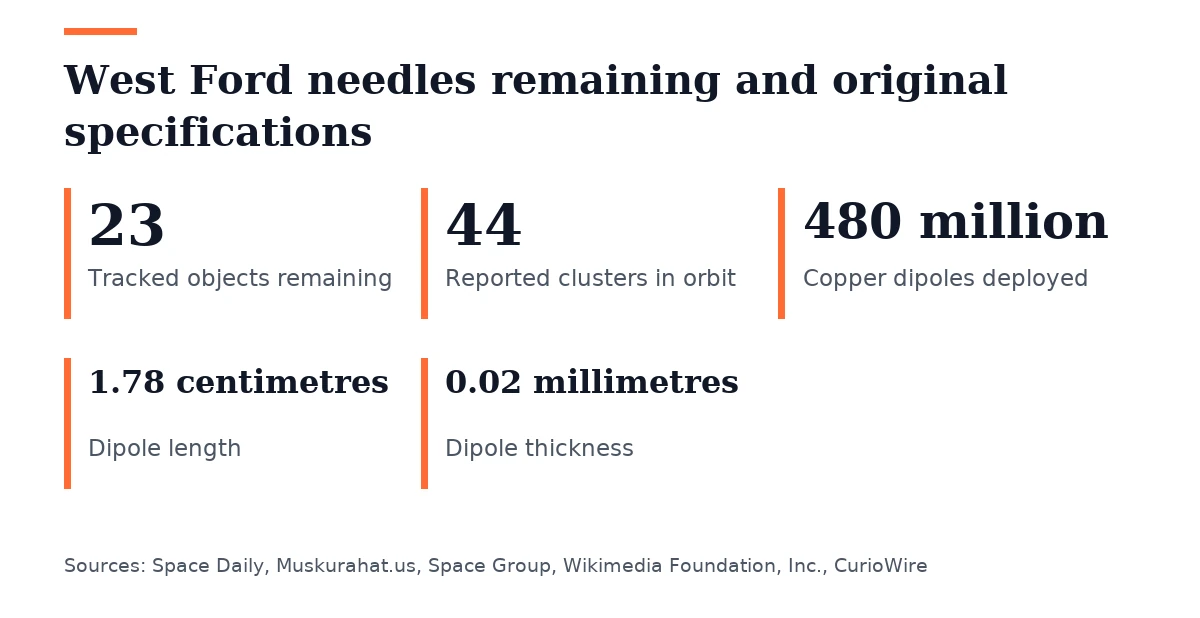
- As of October 2026, reconciliation of CelesTrak and GCAT catalogues indicates approximately 23 objects that both sources agree are still tracked as West Ford wire clumps in orbit.
- Public satellite catalogues cited in mid‑2026 record about three dozen copper‑wire clusters from the 1963 West Ford experiment still registered as orbiting objects.
- The West Ford experiment launched in May 1963 deployed roughly 480 million copper dipoles each about 1.78 centimetres long and thinner than 0.02 millimetres.
- The goal of West Ford was to create an artificial ionosphere or passive radio‑reflecting belt to provide resilient, jam‑proof long‑distance military communications.
The West Ford experiment deployed roughly 480 million copper dipoles each about 1.78 centimeters long and thinner than 0.02 millimeters in Earth orbit in May. 1963. Its goal was to create an artificial ionosphere or passive radio‑reflecting belt to provide resilient, jam‑proof long‑distance military communications. More than a hundred million of the original copper filaments are presumed to have settled on Earth, too fine to be recovered, while over twenty tangles of the wire remain in orbit, continually nudged by solar radiation pressure.
As of Oct. 2026, CelesTrak lists between 36 and 39 West Ford needle objects still in orbit, while GCAT counts 36 West Ford wire objects, with discrepancies over five objects. Reconciliation of the two catalogues indicates approximately 23 objects that both sources agree are still tracked as West Ford wire clumps in orbit. Public satellite catalogues cited in mid‑2026 recorded about three dozen copper‑wire clusters from the 1963 West Ford experiment still registered as orbiting objects.
Independent tracking by space agencies in 2023‑2024 reported about 44 clusters of West Ford needles larger than 10 centimeters still in orbit. Lincoln Laboratory’s 1964 prediction that most clusters would decay within ten years contrasted with later observations: the first documented reentry of a CelesTrak‑catalogued clump occurred in 1974, and clumps have persisted into the 2020s, with reentries recorded in Nov. 2020, Oct. 2022 and Apr. 2024.
Radar observations at Goldstone, California, detected echoes from surviving West Ford clusters between 1994 and 1996, showing the experiment’s debris remained detectable more than three decades after launch. Because small, under‑tracked objects complicate collision avoidance for large satellites and increase the background orbital debris, the West Ford case underscores the need for improved tracking of debris.
Policy lessons drawn from West Ford include requiring independent environmental assessments for experiments likely to spread debris, mandating traceable end‑of‑life commitments with escrowed funds, and improving global tracking and data sharing to inform collision‑avoidance decisions. For future mega‑constellations, the West Ford precedent indicates that voluntary standards are insufficient and that enforceable pre‑launch impact assessments, credible deorbit plans and active debris removal funding are necessary to avoid long‑lived hazards.
The West Ford episode contributed to the consultation provision in Article IX of the 1967 Outer Space Treaty, which calls for prior international consultation when an activity may cause harmful interference. The discrepancy in catalogue counts between CelesTrak and GCAT illustrates the limits of monitoring small, high area‑to‑mass debris and the resulting uncertainty in inventory and risk modelling.

Join the discussion