Key facts
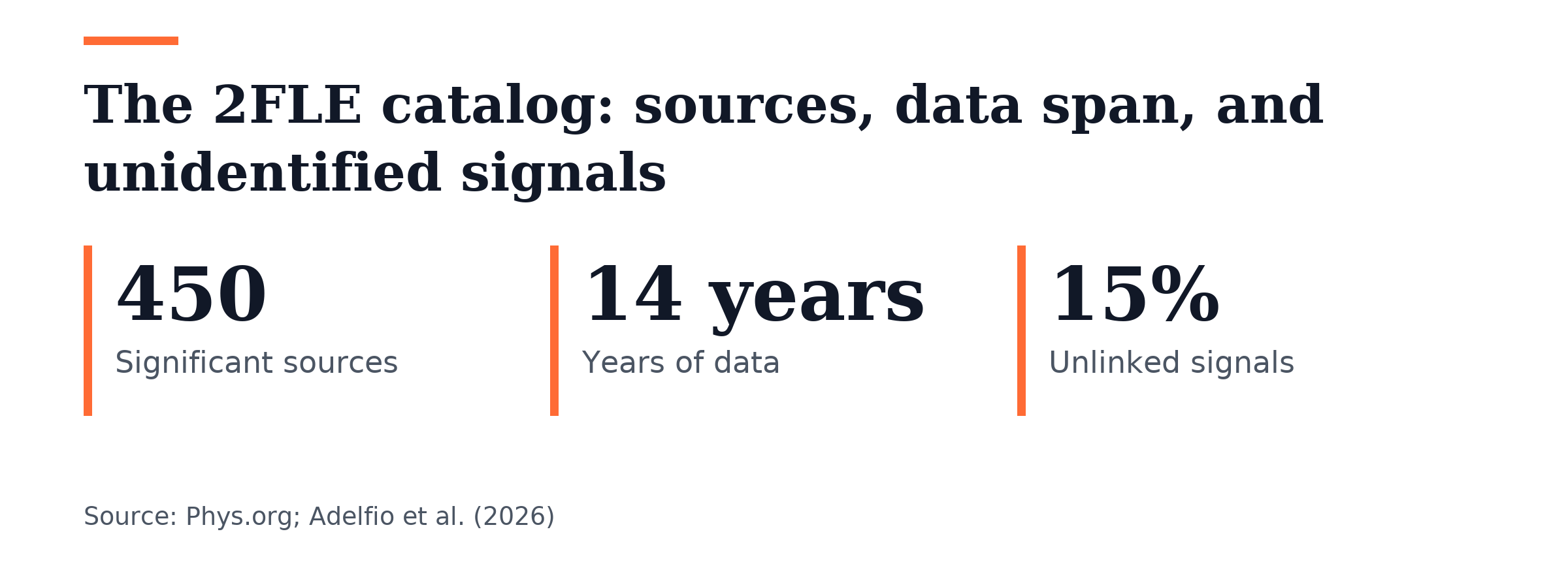
- The catalog doubles the count of known objects in this energy range and will remain the leading MeV catalog for years to come.
- Some detected sources had never been observed in gamma rays before.
- NASA launched the Fermi-Large Area Telescope into space in 2008, and it detects photons from 20 megaelectronvolts to beyond 1 teraelectronvolt.
- About 15% of the catalog's gamma-ray signals have no link to any known astronomical object.
An international team using NASA’s Fermi-Large Area Telescope found approximately 450 statistically significant sources in the 20-to-200-MeV band after studying 14 years of full-sky observations, according to research reported by Phys.org on Nov. 12, 2026.
The catalog is called the Second Catalog of Low-Energy Fermi-LAT Sources, or 2FLE. It doubles the number of known objects in this energy range and will remain the leading MeV catalog for years. The team searched for bright MeV objects to build the catalog, and some of the detected sources had not previously been observed in gamma rays. A. Adelfio et al. published the work in 2026 in The Astrophysical Journal Supplement Series under DOI 10.3847/1538-4365/aeb54d, and the catalog will be released publicly alongside the study.
The tens-of-MeV band stayed underexplored because of technical challenges. When photons reach these energy levels, they tend to interact with matter through Compton scattering—in which a photon strikes an electron and changes direction—which makes it difficult to determine where an individual photon originated. Radiation originating from distinct objects also blends with diffuse background emission, a widespread haze of gamma rays from across the sky, so faint detections can combine with each other or fade into the background. Sensor limitations have mattered as well, and tools to overcome them have only recently become available.
To confirm the detections, the team ran extensive simulations and repeated checks to verify that the signals were not artifacts of the analysis. Scott Joffre, one of the lead researchers, headed most of the effort required to check the findings. Researchers also had to deal with the odd shape of position uncertainties at low energies. The analysis also had to handle cases where signals from two separate objects blended together.
Approximately 15% of the catalog’s gamma-ray signals lack any link to a known astronomical object. Lea Marcotulli, a Helmholtz investigator group leader at DESY, says the first step for these signals is to check whether they truly come from astrophysical objects. Observations from other telescopes could help spot unknown objects, including black holes with powerful jets, young pulsars, or supernova remnants in our galaxy. If confirmed, these objects might help account for the unlinked signals.
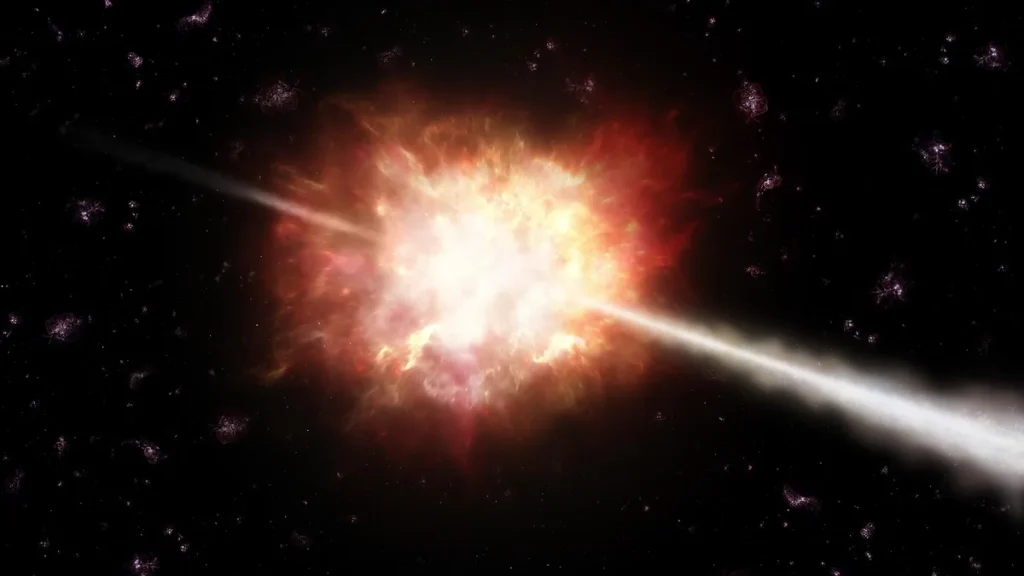
The universe’s most energetic processes create gamma rays, including activity around black holes and particles accelerated to high energies in cosmic accelerators. Gamma rays cannot be seen by the human eye and arise only in extreme settings, for example supermassive black holes, exploding stars, or astrophysical jets, so researchers must fly instruments in space to observe them. NASA sent the telescope into space in 2008. It records photons at 20 megaelectronvolts and beyond 1 teraelectronvolt.
Research into the MeV range may reveal how particles accelerate and release energy as radiation. Spectral energy distributions published in the 2FLE catalog can test models for producing high-energy radiation. Researchers can also use them to compare the catalog’s objects with observations from other telescopes.
Marcotulli says researchers require data across all energy bands because an incomplete picture of the universe results without it. Ajello, a Clemson University professor and co-lead researcher, says charting this unexplored gamma-ray sky establishes a basis for future discoveries. “By mapping this largely unexplored gamma-ray sky, they have created a foundation on which many future discoveries can be built,” Ajello said. The team presents the catalog as a bridge to future missions built to detect photons in the MeV band only.
Future MeV missions can draw on the 2FLE catalog as an important reference. COSI, the Compton Spectrometer and Imager, is a space telescope intended for MeV-range study through a separate energy window, targeting an August 2027 launch. It will gauge characteristic lines in gamma-ray light. Such lines can reveal which elements form in energetic events and where particles speed up.
Other proposed mission concepts include newASTROGAM and AMEGO-X.
The catalog ties existing observations to upcoming MeV missions. It reveals which signals are already detectable in this difficult band and which puzzles remain unsolved while awaiting a mission that can detect photons only in the MeV band.

Join the discussion