Key facts
- Horizon constructs parts with precision polymer 3D printing plus conformal metallisation and protective coatings, using polymer for the bulk geometry and adding metal only where needed.
- IP-MASS can cooperate on applications expecting at least 100 units per year, and partners may offer early-stage concepts because design-for-manufacturability decisions can still be made.
- The Green Space Center aims to make Baden-Württemberg a sustainability-driven space-technology hub through cross-sector collaboration and by applying space technologies to create ecological impact.
- Horizon is expanding coating capability and exploring new variants, including gold-coated polymer micro-additive-manufacturing components for demanding applications.
ESA Phi-Lab Austria picked Horizon Microtechnologies on September 29th 2026, for a two-year, €500,000 programme to turn its metallised polymer micro-additive manufacturing platform into a production-ready satellite hardware line. Under IP-MASS, the goal is to produce up to 50,000 precision-coated satellite components, primarily shielding housings and other passive radio-frequency hardware, through a repeatable manufacturing framework designed for constellation-class demand instead of one-off prototypes. This selection fits with ESA Phi-Lab Austria’s ‘Industrialization by Design’ approach, which supports upstream space technologies that have commercial potential.
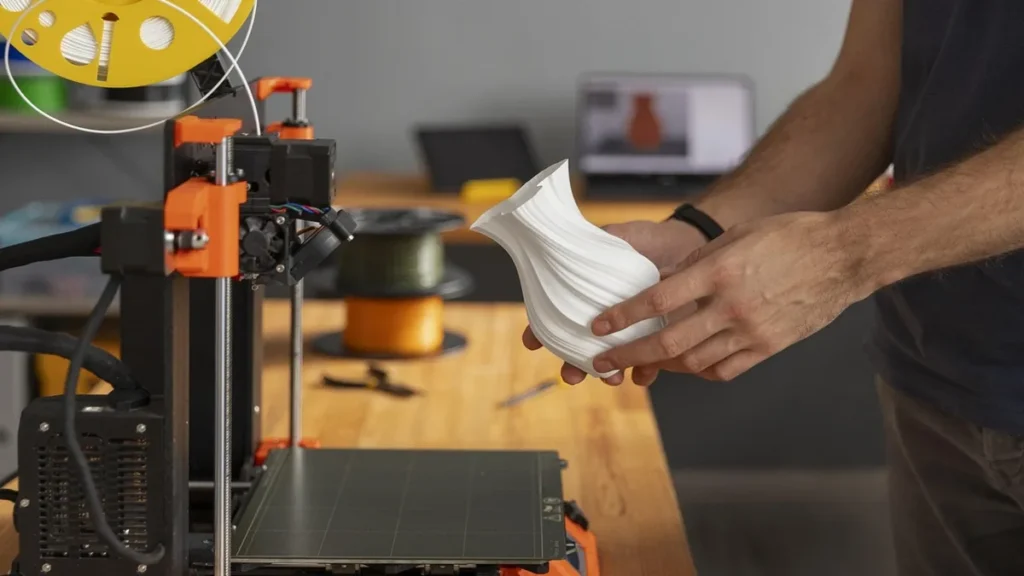
Horizon Microtechnologies, based in Karlsruhe, specialises in microscale and mesoscale parts. Its process uses precision polymer 3D printing to form the bulk geometry, then applies conformal metallisation and protective coatings, adding metal only where required. The company’s hybrid approach fuses polymer 3D printing with advanced functional coatings and metallisation, resulting in parts that have metallic surface properties along with low weight, design freedom and integration advantages. Horizon deposits conductive, antistatic or environmentally protective metal layers, including copper, silver and gold, onto lightweight printed microstructures.
This replaces bulky metal hardware while maintaining electrical and shielding performance.
Replacing aluminium and similar lightweight metals with metallised polymer can cut mass by 40%, and 3D printing brings size, weight and design advantages with economics that beat conventionally machined metal parts. According to Horizon, the target applications could deliver significant customer-side savings compared to conventionally machined metal parts, while also reducing mass by roughly 40%. In phased-array payloads, a single spacecraft may require hundreds of components, and a constellation may include hundreds of satellites. Mass and cost savings at the component level translate into programme-level gains.
Andreas Frölich, Horizon’s chief executive, stated that metallised polymer micro-additive manufacturing has moved past lightweight prototypes. He noted that the next challenge is industrial scale, covering prices, lead times, repeatability and throughput for thousands or tens of thousands of components. “Horizon has proved that metallised polymer micro-AM can deliver far more than lightweight prototypes,” said Andreas Frölich, CEO of Horizon Microtechnologies. Frölich described shielding housings as a strong initial industrialisation case, but not the only one.
He said Horizon targets parts where lightweight printed geometry and functional metallic surfaces create a technical or manufacturing advantage. Frölich also said the space economy needs credible routes to industrial production, and that weight, cost and repeatability become decisive when a component appears tens of thousands of times across a satellite constellation. “The space economy needs more than innovation, it needs credible routes to industrial production,” said Andreas Frölich.
To demonstrate space-readiness, Horizon exposed representative metallised polymer demonstrators to established low-Earth-orbit tests covering outgassing, temperature shock, radiation, mechanical shock, material fatigue and atomic-oxygen exposure. Through ESA’s SPARK program, Horizon is transitioning from feasibility studies to space-qualified production. The company is industrialising phased-array shielding housings and expanding its radio-frequency product families through late 2026. The campaign, supported by ESA’s SPARK project line, demonstrated that metallised polymer components qualify for harsh low-Earth-orbit-relevant environments when engineered correctly.
The project will expand Horizon’s in-house manufacturing infrastructure, scale up coating capabilities, verify processes and cooperate with a specialist research partner. IP-MASS can work on applications that expect at least 100 units per year. Partners may offer early-stage concepts because partners can still make design-for-manufacturability decisions. Frölich said Horizon does not want to assume it knows every valuable application.
He invited spacecraft designers to bring product and manufacturing constraints, so Horizon can assess relevance and potentially co-shape the manufacturing route. Horizon is moving beyond validation toward an industrial manufacturing platform for next-generation satellite hardware. The company is asking the space community to identify which applications to industrialise next.
Horizon belongs to the Green Space Center, an initiative backed by the State of Baden-Württemberg and located at the Chamber of Commerce and Industry Reutlingen. The centre promotes innovation in water management, New Space and intelligent systems. Marcin Bielecki, Head of Technology at the Green Space Center, said the centre helps small and medium enterprises in Baden-Württemberg internationalise space-related business models and products and supports entry into international markets. The Green Space Center aims to make Baden-Württemberg a sustainability-driven space-technology hub through cross-sector collaboration and by applying space technologies to create ecological impact.
Baden-Württemberg is home to a fast-growing New Space ecosystem that includes ATMOS Space Cargo, HyImpulse, ConstellR and CELERES. The state also supports emerging firms InSpacePropulsion Technologies and Yugen Space.
Horizon anticipates continued momentum in space, radio-frequency and production-scaling in the second half of 2026. The company plans to prioritise customer-led passive radio-frequency programmes and aims to become a go-to source for space contract development and manufacturing. Horizon also expects work in electronics testing, sensing, medtech and life sciences and high-frequency components. The outlook includes selective growth, more customer conversations, application-specific validation and stronger industrialisation.
Contract development and manufacturing sit alongside application-led product families at the company, including antennas, filters, waveguides, shielding housings, electrodes, nozzles, microfluidic devices and MEMS or optics packaging. These use coatings branded HMT-Metal, HMT-Conductive and HMT-Protect. Horizon sees size, weight and power pressures rising in space as constellations scale and payloads grow more complex. Millimetre-wave designers are pushing smaller waveguides, filters, antennas and feed structures that challenge conventional machining.
CNC machining faces severe geometric, lead-time and weight constraints as constellation architectures scale and radio-frequency systems push into millimetre-wave bands. Horizon is expanding coating capability and exploring new variants, including gold-coated polymer micro-additive-manufacturing components for demanding applications. Earlier Horizon work demonstrated copper-coated micro-additive-manufacturing horn antennas as a route to proving manufacturing suitability for high-frequency and antenna applications.



Join the discussion