Key facts
- The Dragon spacecraft touched down at 8:34 a.m. PDT on that date.
- The returning crew consisted of NASA astronauts Jessica Meir and Jack Hathaway, ESA astronaut Sophie Adenot, and Roscosmos cosmonaut Andrey Fedyaev.
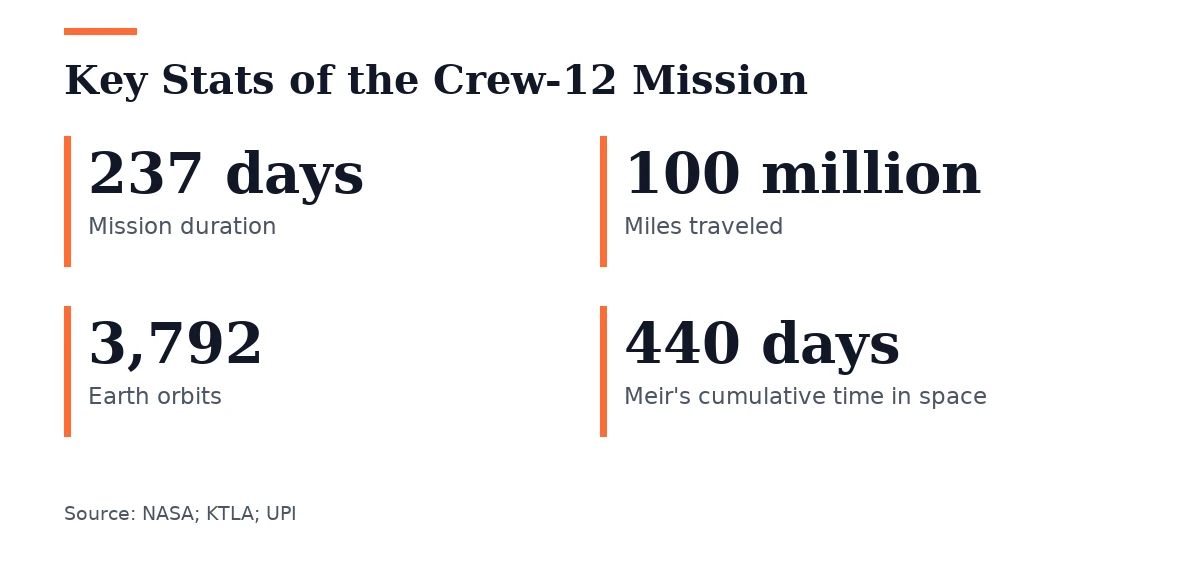
- The mission lasted 237 days, covering more than 100 million miles of orbital travel.
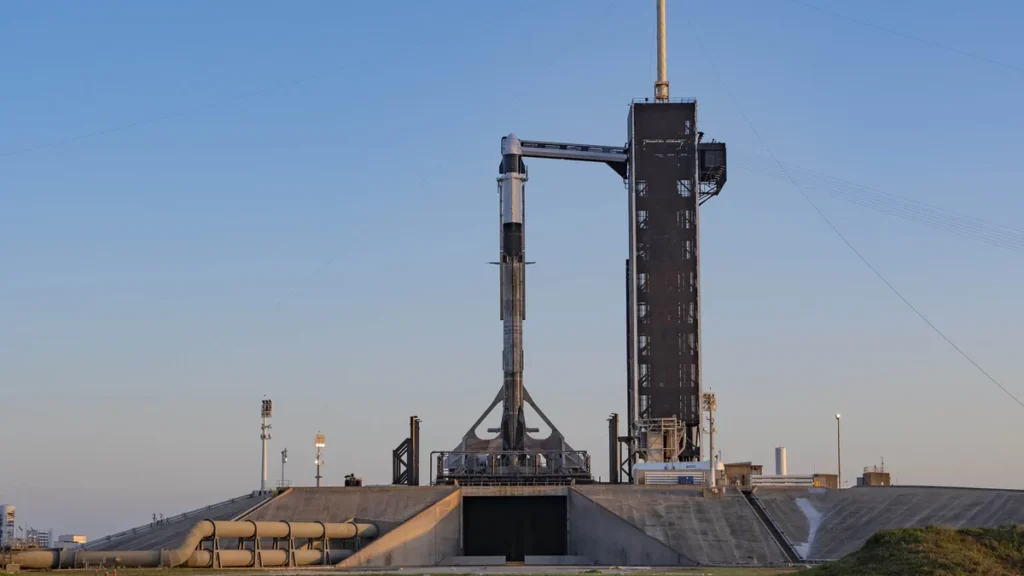
- Crew-12 launched on February 13, 2026 at 5:15 a.m. EST from Cape Canaveral Space Force Station aboard a SpaceX Falcon 9 rocket.
NASA’s SpaceX Crew-12 astronauts Jessica Meir, Jack Hathaway, Sophie Adenot, and Andrey Fedyaev splashed down in the Pacific Ocean near Los Angeles on October 8, 2026.
Crew-12 launched on February 13, 2026 at 5:15 a.m. Eastern Standard Time (EST) from Cape Canaveral Space Force Station aboard a SpaceX Falcon 9 rocket. The spacecraft, named Freedom, arrived at the International Space Station (ISS) the following day, February 14, 2026.
The returning crew consisted of NASA astronauts Jessica Meir and Jack Hathaway, ESA astronaut Sophie Adenot, and Roscosmos cosmonaut Andrey Fedyaev. Jack Hathaway and Sophie Adenot were on their first spaceflight, while Jessica Meir and Andrey Fedyaev were on their second.
The mission lasted 237 days, covering more than 100 million miles of orbital travel. During the flight the crew completed over 3,792 orbits around Earth.
All the investigations were designed to advance knowledge needed for human missions to the Moon and Mars and to provide benefits for people on Earth. The crew carried out hundreds of hours of science experiments, including growing stem cells in space to explore future cell‑based medical therapies and testing a system for producing intravenous fluids on demand to reduce medical‑supply mass on deep‑space missions.
Undocking from the station began at 5:05 a.m. Pacific Daylight Time (PDT) on October 7, 2026, starting a roughly 27‑hour return trip. They also researched how pneumonia‑causing bacteria might contribute to long‑term heart damage to improve treatments on Earth and participated in nutrition studies while investigating how individual physical traits affect blood circulation during weightlessness.
A deorbit burn ignited at 7:46 a.m. PDT and lasted about 9.5 minutes, slowing the craft for reentry. The capsule entered the atmosphere at approximately 8:22 a.m. PDT, then deployed drogue parachutes near 18,000 feet and main parachutes near 6,000 feet to reduce speed.
The Dragon spacecraft touched down at 8:34 a.m. PDT on October 8, 2026. Recovery teams aboard SpaceX vessels secured the capsule and lifted it onto a ship’s deck after splashdown.
After routine medical checks, the astronauts were taken to shore before flying back to NASA’s Johnson Space Center in Houston. experiments looked at bone loss and regeneration to support future lunar or Martian bases.
NASA held a news conference for the crew at 3:30 p.m. EDT on October 15, 2026 at the Johnson Space Center. NASA also conducted a media teleconference at 10:15 a.m. PDT on October 8, 2026 to discuss the splashdown and the next cargo resupply flight.
Jessica Meir performed four spacewalks during the mission, raising her career total to seven and placing her third among NASA women for career spacewalks. Sophie Adenot completed three spacewalks, becoming the first French woman to conduct extravehicular activity (EVA, or spacewalk) outside the International Space Station (ISS).
Andrey Fedyaev logged his second trip to space; Jessica Meir’s cumulative time in orbit reached 440 days, ranking her among NASA’s top 10 astronauts for total flight duration. They also tested cancer‑targeting treatments and automated plant health monitoring to support crop production for future lunar or Martian bases.




Join the discussion