Key facts
- The team measured the nucleus surface temperature at 328 ± 7 Kelvin when the comet was about 1.1 astronomical units from the sun, matching an empirical model prediction of about 327 Kelvin.
- Mid-infrared observations detect thermal emission from the nucleus itself, and Subaru's high spatial resolution made Comet Encke appear as a point source, showing coma emission contributed only slightly to the signal.
- During the observations, the comet's brightness varied, and the team links this change to the rotation of the elongated nucleus, which alters how much surface area is visible from Earth.
- Johann Encke identified the object as a periodic comet with a solar swing roughly every 3.3 years, and he noted its orbital period was gradually shortening, though the cause was unknown.
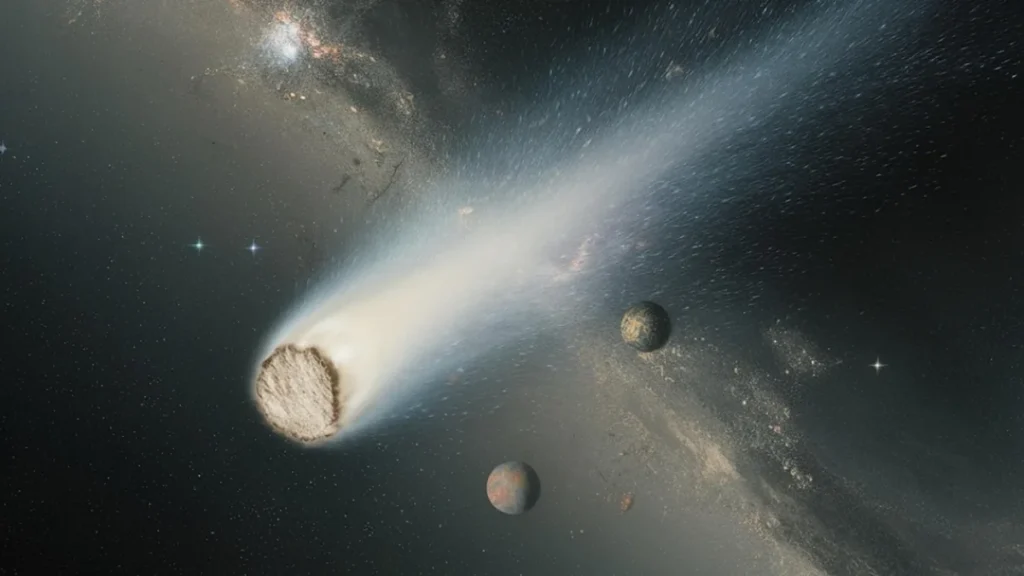
Researchers from the University of Occupational and Environmental Health, Kyoto Sangyo University and Photocross Co., Ltd. studied Comet 2P/Encke’s nucleus using Subaru Telescope’s COMICS instrument during observations made in November 2003 at Maunakea, finding that the nucleus is an elongated body with a length of about 7 kilometers and a width of about 3 kilometers, plus a surface temperature reading of 328 ± 7 Kelvin, or about 55 degrees Celsius, Phys.org reports.
The research team came from the University of Occupational and Environmental Health, Kyoto Sangyo University and Photocross Co., Ltd. They worked with archival Subaru Telescope data gathered in November 2003. The Astronomical Journal published the findings in 2026.
The observations took place in November 2003 at a wavelength of about 10 micrometers. At that time, Comet Encke was about 1.1 astronomical units from the sun. The researchers recorded a nucleus surface temperature reading of 328 ± 7 Kelvin, or about 55 degrees Celsius.
A nucleus’s surface temperature shows how it absorbs sunlight and radiates heat into space, revealing details about its thermal properties and cometary activity. The Encke reading of 328 ± 7 Kelvin lined up closely with an earlier model forecast of roughly 327 Kelvin. This agreement with the previous model supports the validity of the measurement.
Thermal emission from the nucleus itself is what mid-infrared observations—measurements of heat radiating from an object—detect. When a comet nears the sun, released gas and dust spread around the nucleus to create a coma, so ground-based observatories struggle to directly observe the small central body. This is why researchers relied on thermal emission rather than visible light to study Encke’s nucleus. This wavelength of about 10 micrometers falls in the mid-infrared band that detects heat radiating directly from the nucleus.
Subaru’s high spatial resolution made Comet Encke appear as a point source, so the coma contributed only a small part of the measured signal. The point-source appearance allowed the team to separate the nucleus signal from the surrounding coma. Using this method, they separated the nucleus’s own heat from the cloud of gas and dust around it.
During the observations, the comet’s brightness varied. The team links this change to the rotation of the elongated nucleus, which alters how much surface area is visible from Earth. As the elongated body spins, that brightness variation provided the measurements used to calculate the dimensions. Because of that rotation, the nucleus looked like an elongated ellipsoid instead of a sphere.
Past visible-light and radar studies had indicated that Encke’s nucleus might be elongated. Spacecraft missions have revealed that many cometary nuclei are far from spherical. The Subaru study adds an independent thermal-emission estimate based on heat rather than reflected light or radar.
Comet nuclei preserve material from the solar system’s birth 4.6 billion years ago. That makes them important for studying early solar system history. Since nuclei hold primordial material, they help reveal the conditions that existed when the solar system formed. That scientific value motivates efforts to observe them directly even though observations are difficult.
Johann Encke identified the object as a periodic comet in the 19th century, with a solar swing roughly every 3.3 years. He also noted that its orbital period was gradually shortening, though the cause was unknown. The name honors the 19th-century German astronomer who studied its orbit in detail. Later, studies linked the shortening of its orbital period to non-gravitational forces from outgassing.
Fred Whipple proposed in the mid-20th century that gas and dust jetting from a comet creates a reaction force that changes its orbit. He also advanced the dirty snowball model of an ice-and-dust nucleus. Whipple’s work from the mid-20th century is still considered fundamental to comet science. His reaction-force concept shows how outgassing can change a comet’s trajectory without gravitational perturbations.
A non-gravitational effect happens when material departing the nucleus behaves like a rocket thruster and alters the comet’s path. This comet was among the examples that helped scientists identify the phenomenon. How large the effect is, and which way it points, rely on the nucleus’s shape and spin plus the location and direction of gas release.
The researchers state that the new shape data do not establish what caused Encke’s orbital period to change. They warn that the dimensions by themselves cannot identify what drove the historical period change. Still, they describe the dimensions as fundamental for modeling the comet’s long-term activity and orbital evolution.
COMICS, formerly known as the Cooled Mid-Infrared Camera and Spectrometer, delivered high-spatial-resolution imaging and spectroscopy on the Subaru Telescope until its observations ended in 2020. The instrument’s resolution made Comet Encke appear as a point source, keeping the coma’s contribution to the signal small.
The summit of Maunakea stands at about 4,200 meters, which is roughly 13,800 feet. Its dry air, with minimal water vapor, makes the site suitable for mid-infrared observations. Water vapor absorbs mid-infrared radiation, while the atmosphere and the telescope give off strong thermal radiation. For that reason, high-altitude, dry locations are necessary for these wavelengths.
Subaru’s telescope features a large aperture measuring 8.2 meters. Together with the dry Maunakea summit at about 4,200 meters, this aperture helped the telescope handle difficult mid-infrared observations complicated by atmospheric water vapor. The instrument relied on this aperture for its imaging and spectroscopy tasks.
Presently, Maunakea does not have an instrument that routinely performs mid-infrared observations. Dr. Takafumi Ootsubo leads a restart of COMICS. He works at the University of Occupational and Environmental Health. Retiring the instrument created a gap in routine ground-based mid-infrared comet work.
Ootsubo said their work demonstrates that mid-infrared observations can directly record heat coming from the nucleus itself. “Our study of Comet Encke showed that mid-infrared observations can directly capture thermal emission from the nucleus itself,” says Ootsubo. He hopes a restarted COMICS will allow study of many more nuclei.
The researcher envisions using a restarted COMICS to get closer to revealing the true faces of cometary nuclei. That goal reflects the team’s broader aim beyond the single Encke measurement.
In 2021, that same research group found another comet’s nucleus through mid-infrared observation. That 2021 detection demonstrates that the team had already succeeded with this method. Taken together, they show that ground-based mid-infrared observing is slowly uncovering cometary nuclei.
The Astronomical Journal published the research in 2026 in a paper on photometric and spectroscopic observations of Encke’s nucleus at mid-infrared wavelengths, assigned DOI 10.3847/1538-3881/aea614. Takafumi Ootsubo and colleagues wrote the paper. The DOI offers a permanent link to the peer-reviewed article.
According to the team, the findings offer fresh insight into shifts in cometary activity and orbits, along with the early history of the solar system. They say the work adds to understanding of cometary activity, orbital evolution, and how the solar system began. That broader meaning is what the researchers credit to their own work.



Join the discussion